If you have recently looked at your hormone blood test and noticed SHBG on blood test results, you may be wondering what that number actually means. SHBG stands for sex hormone-binding globulin, a protein made mainly by the liver that binds to hormones such as testosterone and estrogen in your bloodstream.
SHBG is important because your total testosterone number does not always tell the whole story. A significant portion of testosterone circulates attached to proteins, including SHBG and albumin, while a smaller amount remains unbound or “free.” This is one reason SHBG can be useful when doctors are trying to understand testosterone-related symptoms or unusual hormone results.
For people interested in bodybuilding, testosterone, muscle growth, libido, or hormone blood work, understanding SHBG on blood test results can make your lab report much easier to understand. What Is PCT? Dosage & Chart
Let’s break it down.
What Is SHBG on Blood Test?
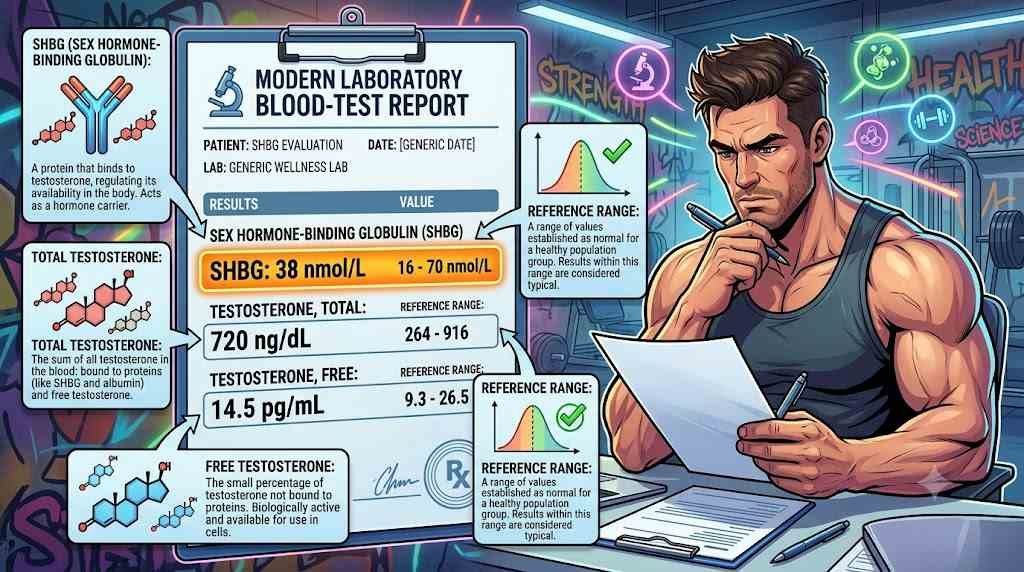
When you see SHBG on blood test results, the test is measuring the amount of sex hormone-binding globulin circulating in your blood.
SHBG is a transport protein produced primarily by the liver. It binds to sex hormones and influences how much of those hormones remains available in an unbound form. It has a particularly strong relationship with testosterone and dihydrotestosterone (DHT), as well as estrogen.
Think of SHBG like a transport system.
Instead of testosterone simply floating around freely in your bloodstream, some of it is attached to proteins. SHBG is one of the important proteins involved in this process.
This means that looking at SHBG on blood test results alongside total testosterone and, when appropriate, free testosterone can provide more context than looking at total testosterone alone.
Why Is SHBG on Blood Test Important?
The reason doctors may order an SHBG test is that total testosterone and the amount of testosterone available to tissues are not always the same thing.
A testosterone blood test can measure total testosterone, which includes testosterone that is bound to proteins as well as the free portion. Free testosterone measures the portion that is not attached to proteins.
SHBG can therefore help explain situations where:
- Total testosterone looks normal but symptoms suggest otherwise
- Total testosterone appears low or borderline
- Free testosterone needs to be estimated or interpreted
- Hormone-related symptoms don’t match the total testosterone result
- A doctor is investigating abnormal androgen levels
This is why SHBG on blood test results are often interpreted together with other hormone measurements rather than in isolation.
SHBG on Blood Test and Testosterone
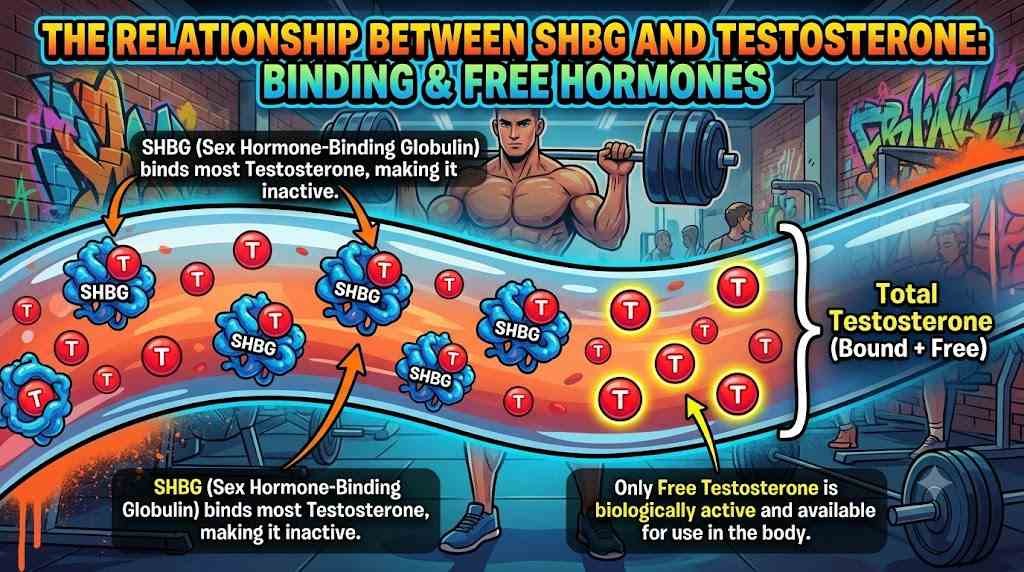
The relationship between SHBG and testosterone is one of the biggest reasons this test gets attention from men interested in hormones.
Testosterone in the bloodstream exists in different forms. Some is tightly bound to SHBG, some is loosely associated with albumin, and some remains unbound.
The exact interpretation is more complicated than simply saying “high SHBG equals low testosterone.” However, changes in SHBG can influence the relationship between total testosterone and free or bioavailable testosterone.
For example, someone can have a total testosterone result that doesn’t look dramatically abnormal while their free testosterone is different from what might be expected.
That is why clinicians may consider SHBG when evaluating testosterone status, particularly when total testosterone is borderline or doesn’t appear to match the person’s symptoms.
SHBG on Blood Test and Free Testosterone
This is where SHBG becomes particularly interesting.
Free testosterone refers to testosterone that is not bound to proteins. It represents only a small fraction of circulating testosterone, while much more testosterone is protein-bound.
If SHBG changes, the amount of testosterone available in different forms can change as well.
For this reason, a doctor may look at:
Total testosterone + SHBG + albumin + free testosterone
rather than relying on total testosterone alone.
Depending on the laboratory and clinical situation, free testosterone may be measured directly or calculated from other measurements. These different methods are not necessarily interchangeable, so the method used by the laboratory matters when interpreting results.
What Is a Normal SHBG on Blood Test Result?
There isn’t one universal SHBG number that should be considered “normal” for every person.
Reference ranges can vary between laboratories and may depend on factors such as:
- Sex
- Age
- Hormonal status
- Pregnancy status
- Laboratory testing method
For example, published adult reference intervals differ between laboratories, which is why your own laboratory’s reference range should be considered when reading your report.
So if your report says something like:
SHBG: 45 nmol/L
you shouldn’t automatically label that as high or low without checking the reference interval printed next to your result.
The number itself is only part of the picture.
SHBG on Blood Test: What Does High SHBG Mean?
A high SHBG result means your blood contains more sex hormone-binding globulin than the laboratory’s expected reference range.
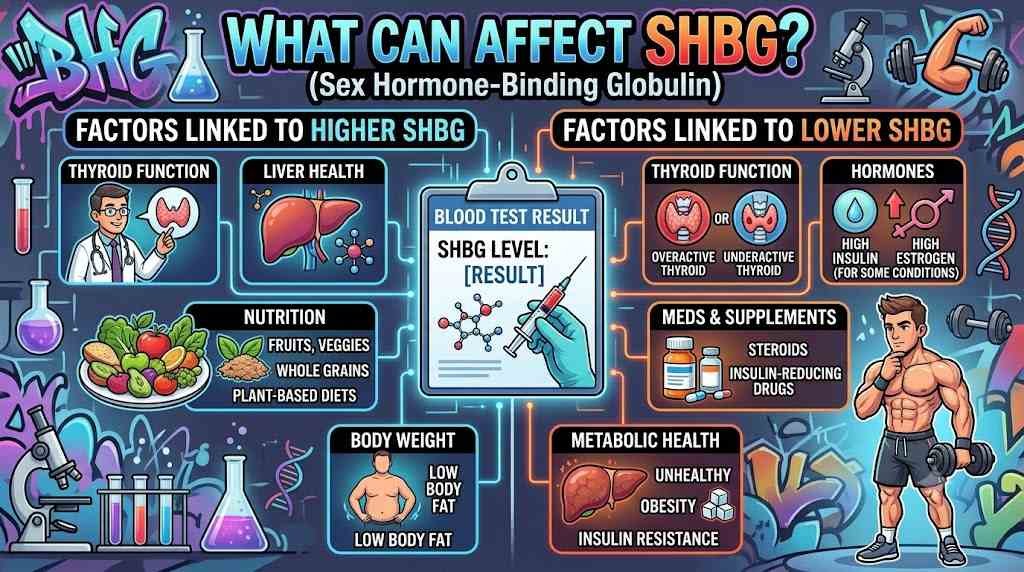
High SHBG can be associated with several different situations, including increased estrogen exposure, pregnancy, hyperthyroidism, some liver conditions, aging, and certain medications or hormonal states.
In men, higher SHBG can sometimes be associated with lower available testosterone even when total testosterone doesn’t appear severely reduced.
But high SHBG does not automatically mean that you have low testosterone.
Doctors usually interpret it together with total testosterone, free testosterone, symptoms, age, medications, and other relevant laboratory findings. SARMs vs Steroids: What’s the Difference?
Common Reasons for High SHBG
Some situations associated with increased SHBG include:
- Hyperthyroidism
- Pregnancy
- Estrogen exposure
- Certain liver diseases
- Aging
- Some forms of androgen deficiency
- Certain medications
- Significant calorie restriction or low body weight in some situations
The underlying reason matters more than simply trying to “lower the number.”
SHBG on Blood Test: What Does Low SHBG Mean?
Low SHBG means the amount of sex hormone-binding globulin in your blood is below the laboratory’s reference range.
Low SHBG has also been associated with several different conditions and metabolic factors.
These can include:
- Obesity
- Hyperinsulinemia or insulin resistance
- Hypothyroidism
- Androgen exposure
- Certain medications
- Growth hormone excess
- Polycystic ovary syndrome (PCOS)
- Some metabolic conditions
Clinical laboratory references also note that SHBG can be affected by liver function, thyroid activity, hormones, medications, and metabolic factors.
Again, low SHBG isn’t automatically a good thing or a bad thing.
The important question is why it is low and what the rest of the hormone and metabolic picture looks like.
High SHBG vs Low SHBG
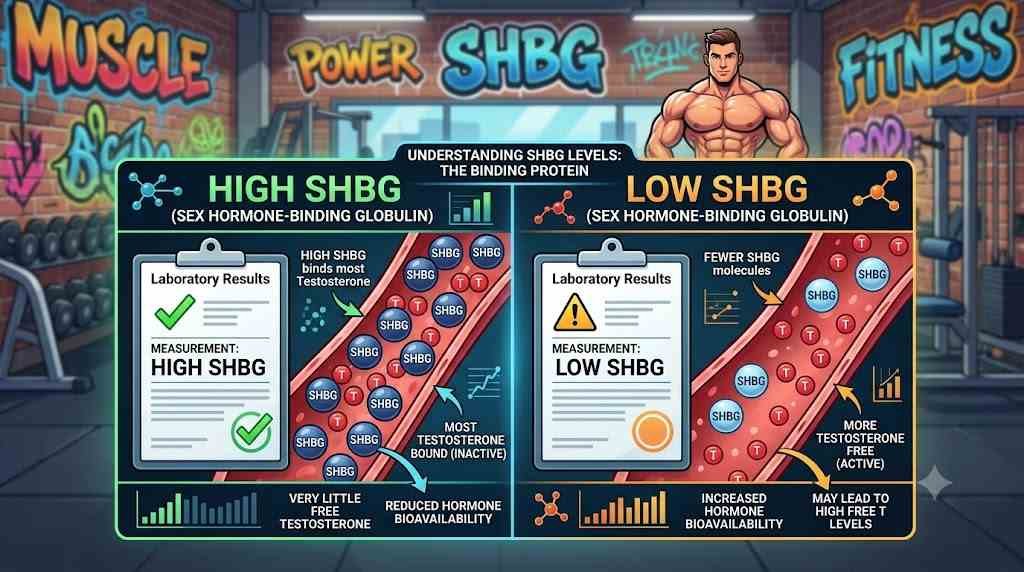
Here’s a simple way to think about it:
| SHBG result | Possible relationship | What doctors may consider |
|---|---|---|
| High SHBG | More hormone may be bound | Free testosterone may need evaluation |
| Normal SHBG | Binding protein is within lab reference range | Interpret alongside other hormone results |
| Low SHBG | Less hormone may be bound | Free hormone may be relatively higher |
| Very high/low | May make hormone interpretation more complicated | Underlying cause and other labs |
This table is only a general guide. Your actual result needs to be interpreted using your laboratory’s reference range and the rest of your clinical information.
SHBG on Blood Test and Muscle Growth
For bodybuilding readers, this is probably one of the most interesting parts.
Testosterone is important for muscle development, but SHBG itself is not a muscle-building hormone.
Instead, SHBG affects how sex hormones are carried in the bloodstream.
A common mistake is assuming that lower SHBG automatically means better muscle growth because more testosterone may be available in an unbound form.
That’s too simplistic.
Having extremely low SHBG isn’t automatically beneficial. Low SHBG can occur alongside metabolic problems, obesity, insulin resistance, thyroid disorders, or androgen exposure.
So if you’re looking at SHBG because you’re trying to improve your physique, don’t treat the number as an isolated bodybuilding target.
The bigger picture includes:
- Total testosterone
- Free testosterone
- SHBG
- Albumin
- Estradiol when clinically relevant
- Thyroid function
- Metabolic health
- Body composition
- Diet
- Training
- Sleep
SHBG on Blood Test and Libido
SHBG can also become relevant when someone has symptoms such as reduced libido.
But libido is influenced by many factors, including testosterone, estrogen, medications, psychological factors, sleep, relationships, stress, and general health.
Therefore, an abnormal SHBG result alone doesn’t establish the cause of low libido.
If SHBG is high and free testosterone is low, the combination may provide more useful information than either number by itself.
This is another reason doctors don’t normally diagnose a hormone problem based on SHBG alone.
What Causes High SHBG in Men?
High SHBG in men can have several possible causes.
Some recognized associations include:
Aging
SHBG can increase with age, while testosterone levels can change as well. This can alter the relationship between total and free testosterone.
Hyperthyroidism
An overactive thyroid can increase SHBG levels.
Estrogen Exposure
Estrogenic states can increase SHBG production.
Liver Conditions
Because the liver is the main site of SHBG production, liver health can influence SHBG levels.
Low Body Weight or Severe Calorie Restriction
Certain states involving very low energy intake or body weight can be associated with higher SHBG.
That’s why an unexpectedly high result deserves context rather than a quick internet diagnosis. Oral vs Injectable Steroids: What’s the Difference?
What Causes Low SHBG in Men?
Low SHBG can occur for different reasons.
Common associations include:
- Obesity
- Insulin resistance
- Hyperinsulinemia
- Hypothyroidism
- Androgen exposure
- Certain medications
- Growth hormone excess
- Metabolic disorders
Some laboratory references specifically note associations between low SHBG and obesity, hyperinsulinemia, hypothyroidism, glucocorticoids, and androgens.
For someone involved in bodybuilding, androgen or anabolic steroid use is particularly relevant because androgens can suppress SHBG.
That doesn’t mean every low SHBG result is caused by steroid use. It simply means medication and supplement history can be important when a doctor is interpreting the result.
SHBG on Blood Test and Steroid or Testosterone Use
This is where bodybuilding and medical testing overlap.
Exogenous androgens, including testosterone and anabolic steroids, can affect SHBG and other hormone markers.
If someone is using testosterone or anabolic compounds, interpreting a testosterone panel becomes more complicated because the body’s natural hormone production can be altered.
A low SHBG result in someone using androgenic compounds should therefore not automatically be interpreted as a sign that their hormone health is optimal.
If you’re getting blood work while using hormones, it’s important to tell your healthcare professional what you’re taking. Accurate information makes the laboratory results much easier to interpret safely.
Does Low SHBG Mean More Free Testosterone?
It can affect the proportion of testosterone that is unbound, but the answer isn’t as simple as:
Low SHBG = high testosterone = better.
SHBG is one part of the hormone-binding system.
Total testosterone, SHBG, albumin and free testosterone all provide different pieces of information.
For example, a person with low SHBG may have a different free-to-total testosterone relationship than someone with higher SHBG even if their total testosterone values are similar.
That’s why looking at only one number can sometimes give a misleading picture.
Does High SHBG Mean Low Testosterone?
Not necessarily.
High SHBG can reduce the proportion of testosterone that remains unbound, but whether someone actually has clinically low testosterone depends on the complete laboratory picture and symptoms.
A person could have:
- Normal total testosterone
- High SHBG
- Lower free testosterone
while another person could have a different combination entirely.
This is exactly why SHBG on blood test results can be useful when total testosterone doesn’t tell the complete story.
How Is SHBG Tested?
An SHBG test is a blood test.
A healthcare professional takes a blood sample and the laboratory measures the concentration of SHBG.
Depending on why testing is being performed, the clinician may order SHBG together with testosterone and other hormone tests.
MedlinePlus notes that SHBG testing can help determine how much testosterone or estrogen may be available for the body’s use and is often interpreted alongside other hormone measurements.
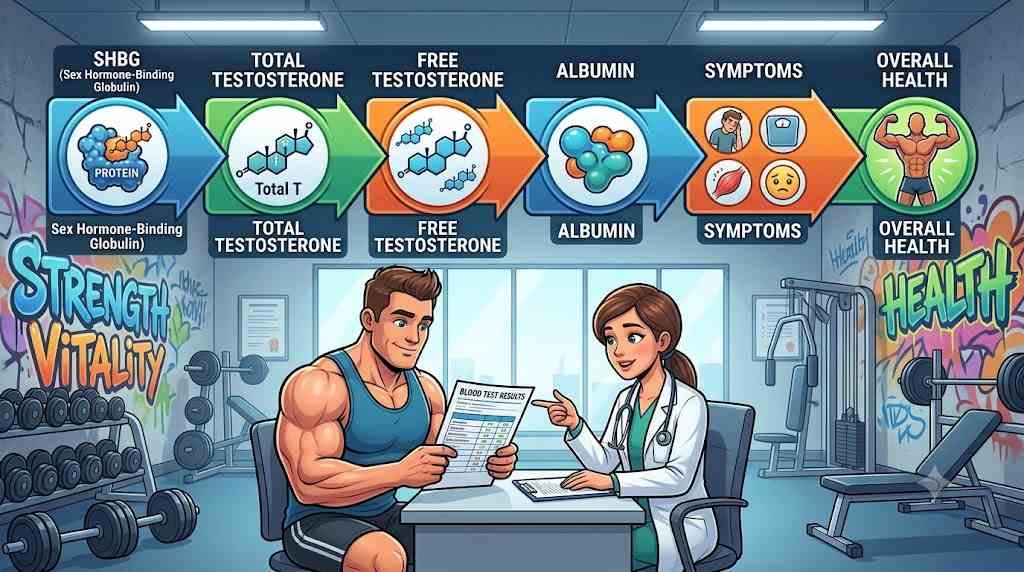
SHBG Blood Test Results: What Should You Look At?
Don’t look at your SHBG number alone.
When reviewing a hormone panel, the useful questions are:
1. What is my SHBG result?
2. What reference range does my laboratory use?
3. What is my total testosterone?
4. What is my free testosterone, if measured or calculated?
5. Are there relevant symptoms?
6. Are there medications, hormones, or medical conditions that could affect SHBG?
7. Are other tests abnormal?
This approach is much more useful than searching for one “perfect” SHBG number. What Is Testosterone? Guide to Types, Dosage & Benefits
SHBG on Blood Test: Can You Change It Naturally?
This is one area where you should be careful with online bodybuilding advice.
There is no universal reason to deliberately push SHBG higher or lower.
The appropriate approach is to identify why the value is abnormal.
For example, if someone has low SHBG alongside obesity or metabolic abnormalities, improving overall metabolic health may be more relevant than trying to manipulate SHBG directly.
Likewise, if SHBG is high because of an underlying thyroid, liver, hormonal, medication-related, or nutritional issue, addressing the underlying factor is more meaningful than chasing the SHBG number itself.
Don’t use supplements or hormones simply because an internet post says they can “crush SHBG.”
SHBG on Blood Test: When Should You Talk to a Doctor?
An abnormal SHBG result doesn’t automatically mean something serious is wrong.
However, you should discuss it with a healthcare professional if:
- Your SHBG is significantly outside the laboratory reference range
- You have symptoms of abnormal testosterone or estrogen activity
- Your total and free testosterone results don’t seem to match
- You have unexplained libido changes
- You have significant changes in body composition or energy
- Other hormone tests are abnormal
- You are taking testosterone, anabolic steroids, SARMs, or other hormone-active substances
- You have a known thyroid, liver, or metabolic condition
The goal is to understand why SHBG is abnormal rather than simply trying to force the number into a particular range.
SHBG on Blood Test: The Bottom Line
SHBG on blood test results can provide important information about how sex hormones are carried through the bloodstream.
SHBG binds hormones such as testosterone and estrogen, and changes in SHBG can influence the amount of hormone that remains unbound.
For men interested in testosterone and bodybuilding, the biggest takeaway is simple:
Don’t judge your testosterone status from total testosterone alone.
SHBG, free testosterone, total testosterone, albumin, symptoms, age, medications and overall health can all matter.
And don’t assume that lower SHBG is automatically better. Both unusually high and unusually low SHBG can occur for different reasons, and the correct interpretation depends on the individual situation.
If you have an SHBG result that looks unusual, the smartest move is to look at the whole hormone panel and discuss the result with a qualified healthcare professional rather than trying to correct one number by yourself.
Frequently Asked Questions About SHBG on Blood Test
What does SHBG mean on a blood test?
SHBG stands for sex hormone-binding globulin. It is a protein produced mainly by the liver that binds sex hormones such as testosterone and estrogen in the bloodstream.
What does high SHBG mean?
High SHBG means the level is above your laboratory’s reference range. It can be associated with conditions such as hyperthyroidism, pregnancy, estrogen exposure, aging and some liver conditions. The result needs to be interpreted with other hormone tests and clinical information.
What does low SHBG mean?
Low SHBG means the level is below your laboratory’s reference range. It can occur with obesity, insulin resistance, hypothyroidism, androgen exposure and several other conditions.
Is SHBG related to testosterone?
Yes. SHBG binds testosterone and influences the relationship between total and free testosterone. That’s why SHBG can be useful when evaluating testosterone levels.
Is low SHBG good for bodybuilding?
Not necessarily. Low SHBG can change the proportion of testosterone that is unbound, but low SHBG can also be associated with metabolic and hormonal conditions. It should not be treated as a bodybuilding target by itself.
Can high SHBG cause low free testosterone?
High SHBG can be associated with a lower proportion of testosterone being free, which is one reason clinicians may consider SHBG and free testosterone together when evaluating hormone status.
What is the normal SHBG range?
There is no single universal range for everyone. Reference intervals vary between laboratories and can depend on sex, age and other factors. Always check the reference range printed on your own laboratory report.
Should I worry if my SHBG is high or low?
An abnormal result doesn’t automatically mean you have a serious problem. The importance of the result depends on how far it is outside the reference range, your symptoms, other hormone results and possible underlying causes.
Should SHBG be tested with testosterone?
Often, SHBG is interpreted together with total testosterone and, when appropriate, free testosterone or calculated free testosterone. The combination can provide more context than total testosterone alone.
Can steroids affect SHBG?
Yes. Androgen exposure can reduce SHBG, which can change the relationship between total and free testosterone. If you’re using testosterone or anabolic compounds and having blood work done, tell your healthcare professional what you’re taking so the results can be interpreted correctly.
Quick SHBG Blood Test Checklist
If you’re looking at your own report, check these together:
SHBG → Total Testosterone → Free Testosterone → Albumin → Symptoms → Other Hormone/Metabolic Tests
That’s a much better way to understand your hormone results than focusing on SHBG alone.
Talk to Us on WhatsApp
If you have questions about bodybuilding, training, nutrition, supplements, or understanding general information about hormone blood tests, you can contact us on WhatsApp at 7696593279.
This article is for educational purposes and isn’t a diagnosis or a substitute for medical advice. Blood-test results should be interpreted using your laboratory’s reference ranges and your individual medical history.