If you have spent any time around bodybuilding, muscle building, or men’s health, you have probably heard the word testosterone hundreds of times. But what is testosterone, exactly, and why does it matter so much for muscle growth, strength, sex drive, recovery, and overall male health?
Testosterone is the primary androgen hormone in males. It is produced mainly by the testicles in men, with smaller amounts coming from the adrenal glands. Women also produce testosterone, but normally in much smaller amounts.
Testosterone plays a role in muscle development, bone health, red blood cell production, libido, sperm production, body-hair growth, and the development of male sexual characteristics. When testosterone levels are genuinely low because of a medical condition, testosterone replacement therapy may be prescribed after appropriate testing.
In bodybuilding, however, testosterone is also discussed as an anabolic-androgenic steroid because synthetic testosterone can increase androgen activity and muscle-building potential. That is where things get more complicated.
So, what is testosterone from a bodybuilding perspective? It is both a naturally occurring hormone and the base molecule behind several pharmaceutical testosterone preparations, including different testosterone esters and combinations such as Sustanon 250. Types of SARMs: Benefits, Uses, Research, and Safety
What Is Testosterone and What Does It Do?
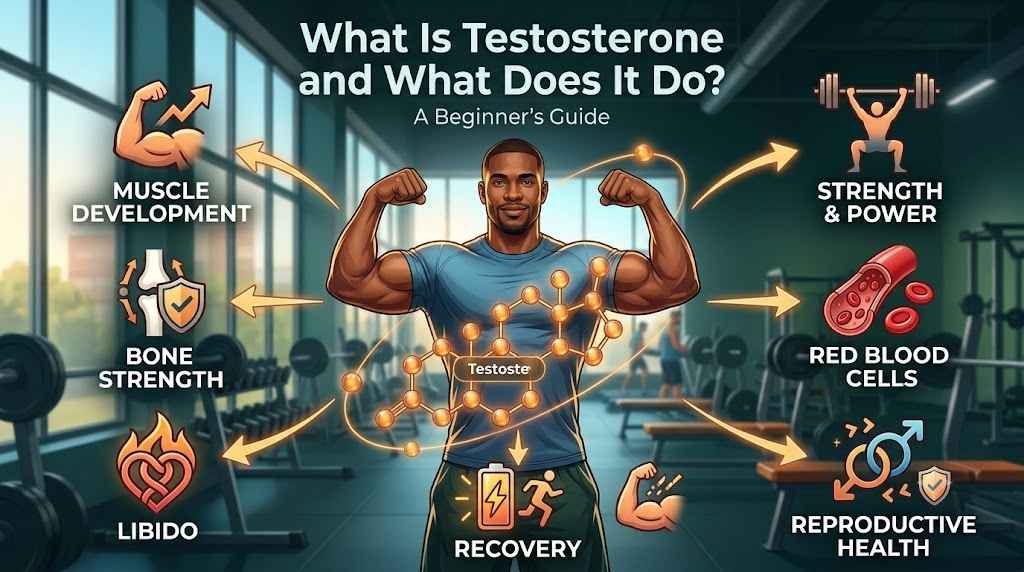
Testosterone is a steroid hormone belonging to the androgen family.
In simple gym language, think of testosterone as one of the major hormonal signals involved in maintaining and building male tissue.
It contributes to:
- Muscle protein synthesis and muscle development
- Maintenance of muscle mass
- Bone strength
- Red blood cell production
- Sex drive
- Sperm production
- Male sexual development
- Body and facial hair growth
- Fat distribution
- Energy and general wellbeing
Testosterone also interacts with other hormones. Some testosterone can be converted into dihydrotestosterone (DHT) through the enzyme 5-alpha-reductase, while another portion can be converted into estradiol, a form of estrogen, through aromatase.
That is one reason testosterone isn’t simply an “all muscle” hormone. Changing testosterone levels can affect several systems at the same time.
What Is Testosterone Made From?
Testosterone belongs to a group of hormones called steroid hormones.
The body starts with cholesterol and uses several biochemical steps to produce steroid hormones. In males, the testes are the main source of testosterone production.
The hypothalamus and pituitary gland help control this process through the hypothalamic-pituitary-gonadal (HPG) axis.
The simplified process looks like this:
Hypothalamus → GnRH → Pituitary → LH → Testes → Testosterone
When testosterone levels rise, the body normally uses negative feedback to reduce the signals that stimulate further testosterone production.
This feedback system becomes particularly important when someone uses testosterone from outside the body.
What Is Testosterone: Total vs Free Testosterone
A testosterone blood test can report different measurements, and this is something beginners often misunderstand.
Total testosterone refers to testosterone circulating in the blood, including testosterone that is bound to proteins and the smaller fraction that remains unbound.
Free testosterone refers to the testosterone that is not bound to proteins.
Sex hormone-binding globulin (SHBG) and albumin are important proteins involved in testosterone transport.
This means two people can have similar total testosterone numbers but different free testosterone levels depending on factors such as SHBG.
For diagnosing testosterone deficiency, current clinical guidance emphasizes symptoms together with consistently low, accurately measured testosterone levels rather than relying on a single number or symptoms alone.
What Is Testosterone: Natural Production vs Injected Testosterone
Your body naturally produces testosterone according to its own hormonal feedback system.
Injected or otherwise externally administered testosterone is different because you are introducing testosterone from outside the body.
When circulating androgen levels become high enough, the brain detects the hormonal signal and can reduce LH and FSH production. Lower LH stimulation means the testes receive less stimulation to produce testosterone themselves.
This is one reason exogenous testosterone can suppress natural testosterone production.
It can also reduce sperm production and testicular volume in some users.
That difference between natural testosterone production and external testosterone use is one of the most important concepts for beginners to understand.
What Is Testosterone Ester?
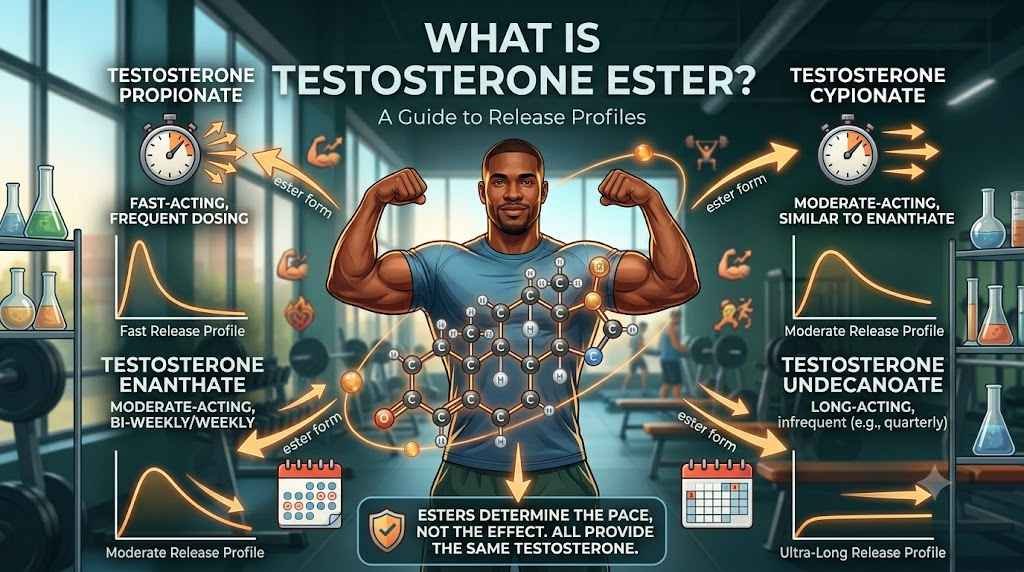
If you have looked at testosterone products, you have probably seen names such as:
- Testosterone propionate
- Testosterone enanthate
- Testosterone cypionate
- Testosterone phenylpropionate
- Testosterone isocaproate
- Testosterone decanoate
- Testosterone undecanoate
These are not completely different hormones.
They are different esters of testosterone.
An ester is essentially a chemical modification attached to testosterone that changes how quickly the compound is released and cleared from the body.
The testosterone molecule ultimately becomes testosterone after the ester is removed.
The practical difference is mainly about pharmacokinetics — how quickly the preparation enters circulation, reaches peak levels, and declines.
What Is Testosterone Propionate?
Testosterone propionate is a relatively short-acting testosterone ester.
Because it is shorter acting than many other injectable testosterone preparations, testosterone levels generally change more quickly after administration.
In medical contexts, shorter-acting preparations can require more frequent administration.
In bodybuilding discussions, testosterone propionate is often mentioned because users associate it with faster changes in blood testosterone levels compared with longer esters.
But shorter acting does not mean safer.
The same androgen-related risks can still occur, including suppression of natural testosterone production, acne, changes in blood counts, hair loss in genetically susceptible people, and fertility problems.
What Is Testosterone Enanthate?
Testosterone enanthate is a longer-acting testosterone ester.
It has been used medically as testosterone replacement and is also widely discussed in bodybuilding.
Because it releases testosterone more slowly than propionate, it does not generally require the same frequency of administration.
A common beginner mistake is thinking that a longer ester is automatically stronger.
It isn’t.
The ester mainly changes the release profile. The underlying hormone remains testosterone.
What Is Testosterone Cypionate?
Testosterone cypionate is another long-acting testosterone ester.
It is widely used as an injectable testosterone replacement formulation in some countries.
Like enanthate, it is commonly discussed in bodybuilding because of its relatively long duration compared with short esters.
The key thing to understand is that testosterone cypionate is not a completely different type of hormone. It is testosterone attached to a different ester.
What Is Testosterone Undecanoate?
Testosterone undecanoate is available in different formulations, including long-acting injectable preparations and oral formulations depending on the country and product.
The injectable form is designed to provide a much longer testosterone release profile than short-acting testosterone preparations.
Because of its long duration, medical monitoring is particularly important.
It isn’t something someone should casually switch to or dose based on what another gym member is doing. Dianabol vs Superdrol: Which Is Stronger?
What Is Testosterone Suspension?
Testosterone suspension is different from the common oil-based ester preparations because it contains testosterone without a conventional ester attached.
This produces a much shorter duration of action.
It is mostly encountered in bodybuilding discussions rather than ordinary modern testosterone-replacement practice.
Because of its short duration, it has historically been associated with frequent administration.
Again, shorter acting does not equal safer or better.
What Is Sustanon and How Is It Different?
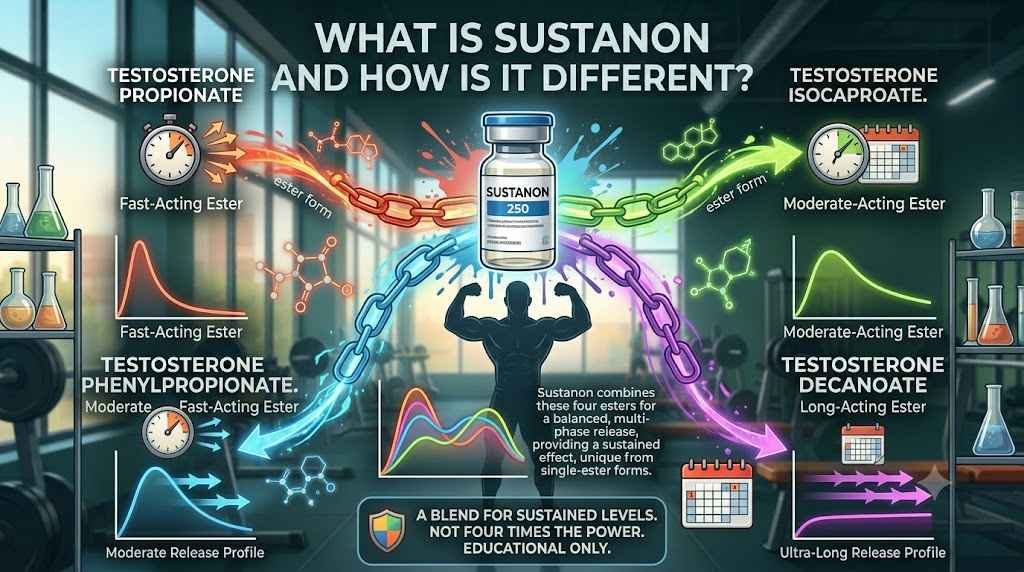
Now we get to one of the most commonly discussed testosterone products in bodybuilding: Sustanon 250.
Sustanon 250 is a pharmaceutical testosterone preparation containing four testosterone esters in one injection.
According to the current product information, each 1 mL contains:
| Testosterone ester | Amount |
|---|---|
| Testosterone propionate | 30 mg |
| Testosterone phenylpropionate | 60 mg |
| Testosterone isocaproate | 60 mg |
| Testosterone decanoate | 100 mg |
| Total ester weight | 250 mg |
| Testosterone itself | 176 mg |
The four esters have different durations of action, creating a mixed release profile. The official product information states that the esters are converted into testosterone after entering circulation.
This is why Sustanon is often described as a multi-ester testosterone blend.
What Is Testosterone in Sustanon 250 Actually Doing?
Despite having four different ester names on the label, the body ultimately receives testosterone.
The different esters mainly influence how the testosterone becomes available.
According to the product information, after a 1 mL injection, testosterone reaches peak plasma concentrations at approximately 24–48 hours, while levels return toward the lower end of the male reference range at around 21 days.
That does not mean everyone will experience identical blood levels.
Individual metabolism, injection timing, body composition, SHBG, baseline testosterone, and other factors can influence actual blood results.
What Is Testosterone Used for in Medicine?
Medically prescribed testosterone is primarily used for men who have confirmed testosterone deficiency associated with an appropriate underlying condition.
The Endocrine Society recommends diagnosing hypogonadism using compatible symptoms and consistently low testosterone measurements, with repeat morning testing used to confirm the finding.
Sustanon 250’s official indication is testosterone replacement for adult men with confirmed hypogonadism.
That is very different from taking testosterone simply because someone wants bigger muscles.
What Is Testosterone Used for in Bodybuilding?
This is where the conversation changes from medical testosterone replacement to performance-enhancing use.
Bodybuilders may discuss testosterone because increasing androgen exposure can promote increases in lean body mass and strength when combined with resistance training and adequate nutrition.
But using testosterone for bodybuilding is not the same thing as medically treating testosterone deficiency.
The official Sustanon information specifically warns that misuse to enhance sporting ability carries serious health risks.
That distinction matters.
A person with clinically low testosterone may need treatment to restore physiological hormone levels.
A healthy person using testosterone to push levels substantially above the normal physiological range is doing something different, with a different risk profile.
What Is Testosterone: Commonly Discussed Benefits
When testosterone levels are medically low, restoring testosterone toward an appropriate physiological range can help address symptoms associated with testosterone deficiency.
Potential benefits of medically appropriate testosterone treatment can include improvement in:
- Sexual symptoms and libido
- Maintenance of muscle mass
- Bone health
- Red blood cell production
- Some symptoms associated with testosterone deficiency
- Male secondary sexual characteristics
Sustanon’s patient information specifically describes testosterone as being involved in muscle and bone development, body hair, red blood cell production, and male sexual characteristics. Dianabol vs Anadrol: Differences, Results & Side Effects
For bodybuilding, people commonly discuss testosterone in relation to:
- Increased muscle size
- Increased strength
- Improved training capacity
- Better recovery
- Increased bodyweight
- Improved fullness and muscular appearance
However, the size of these effects depends heavily on the person’s baseline hormone levels, training, nutrition, genetics, and amount of androgen exposure.
More testosterone does not simply mean proportionally more muscle.
What Is Testosterone’s Effect on Muscle Growth?
Testosterone has anabolic effects on skeletal muscle.
That is one reason testosterone and related anabolic-androgenic steroids have such a major place in bodybuilding culture.
Testosterone can support processes involved in muscle protein turnover and muscle tissue development.
But the hormone does not replace the basics.
You still need:
Progressive training + sufficient calories + enough protein + recovery + consistency
Someone can have high testosterone and still make poor progress if training and nutrition are badly managed.
On the other hand, medically restoring low testosterone does not automatically turn someone into a competitive bodybuilder.
What Is Testosterone’s Effect on Strength and Recovery?
Testosterone can contribute to increases in lean body mass, which can indirectly support strength.
In bodybuilding, users also commonly report feeling better recovery and improved training performance while using anabolic-androgenic steroids.
However, subjective feelings should not be confused with proof that a particular dose is safe.
Higher androgen exposure can produce larger physiological changes while simultaneously increasing the possibility of adverse effects.
That is one of the biggest mistakes beginners make: focusing only on the mirror and ignoring what is happening inside the body.
What Is Testosterone Dosage: Medical vs Bodybuilding Use
This is the section where beginners need to be especially careful.
There is no universal bodybuilding testosterone dose that can be considered safe for everyone.
Medical dosing is individualized according to the patient’s diagnosis, bloodwork, response, formulation, and clinical goals.
For example, the current Sustanon 250 product information states that the usual adult medical dose is 1 mL every three weeks, with the exact regimen adjusted according to the individual patient.
Medical/reference dosage example
| Product | Official medical reference |
|---|---|
| Sustanon 250 | Usually 1 mL every 3 weeks |
| Route | Deep intramuscular injection |
| Purpose | Testosterone replacement in confirmed hypogonadism |
| Adjustment | Based on individual response and testosterone monitoring |
This should not be interpreted as a bodybuilding cycle recommendation.
Bodybuilding forums and gym communities commonly discuss substantially different testosterone doses and schedules, but reproducing those protocols as a how-to guide would turn an educational article into instructions for non-medical anabolic-steroid use.
For a beginner, the important takeaway is simple: medical testosterone replacement and bodybuilding steroid cycles are not interchangeable.
What Is Testosterone Side Effects?
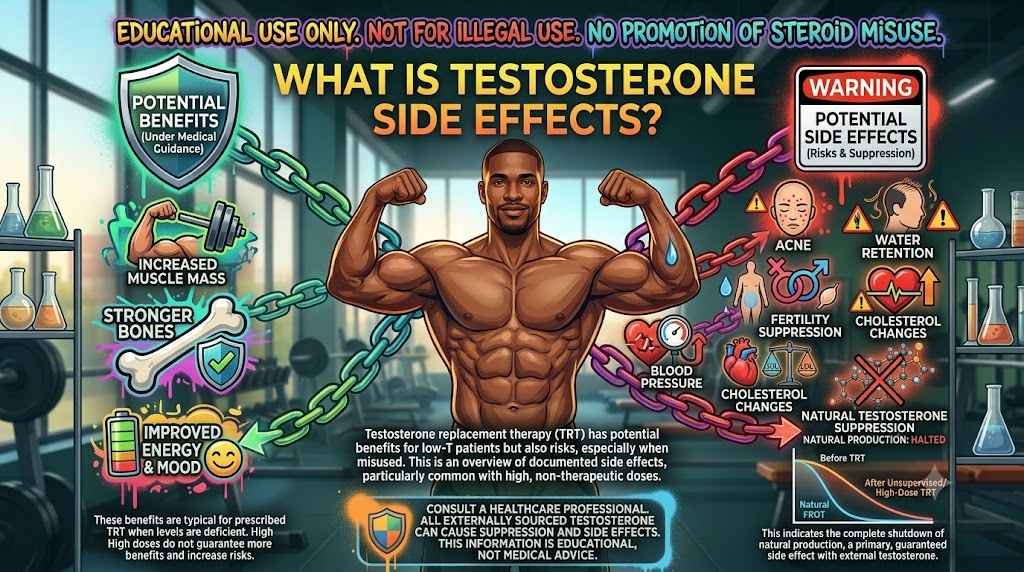
Testosterone can produce unwanted effects even when it is prescribed appropriately, which is why monitoring is important.
With non-medical or excessive androgen use, the risks can become more significant.
Commonly discussed problems include:
- Acne and oily skin
- Increased body or facial hair
- Male-pattern hair loss in genetically susceptible people
- Water retention
- Increased red blood cell count
- Reduced natural testosterone production
- Reduced sperm production
- Testicular shrinkage
- Changes in cholesterol
- Increased blood pressure
- Gynecomastia
- Mood changes
- Changes in libido
- Possible worsening of sleep apnea in susceptible people
The FDA notes that testosterone products can increase blood pressure, and current product information emphasizes monitoring hematocrit, hemoglobin, liver function, lipids, testosterone levels and prostate-related parameters when appropriate.
What Is Testosterone’s Effect on Estrogen?
Testosterone can be converted into estradiol through aromatase.
That means increasing testosterone can sometimes increase estrogen activity as well.
This is where some users experience problems such as:
- Water retention
- Breast tenderness
- Gynecomastia
- Mood changes
The answer isn’t automatically to start another drug.
Hormones exist in a balance, and aggressively trying to manipulate one hormone because of a symptom can create another problem.
Bloodwork and medical assessment are much more useful than guessing based on symptoms alone.
What Is Testosterone’s Effect on Fertility?
This is one of the most important points for younger men.
External testosterone can suppress the hormonal signals that normally stimulate the testes.
As a result, sperm production can fall.
That means a person can have high testosterone in the bloodstream while simultaneously having reduced sperm production.
The Endocrine Society recommends against starting testosterone therapy in men who are planning fertility in the near term.
So if having children is an important goal, testosterone should not be treated like an ordinary bodybuilding supplement. Why Do Steroids Cause Hair Loss? DHT, Genetics & More
What Is Testosterone’s Effect on Blood?
Testosterone can increase red blood cell production.
This is one reason hematocrit and hemoglobin are monitored during testosterone treatment.
Sustanon’s current product information lists increased red blood cell count, hematocrit and hemoglobin as recognized effects requiring monitoring.
A blood test can therefore tell you something that the mirror can’t.
You might feel completely normal while a blood marker is moving in an undesirable direction.
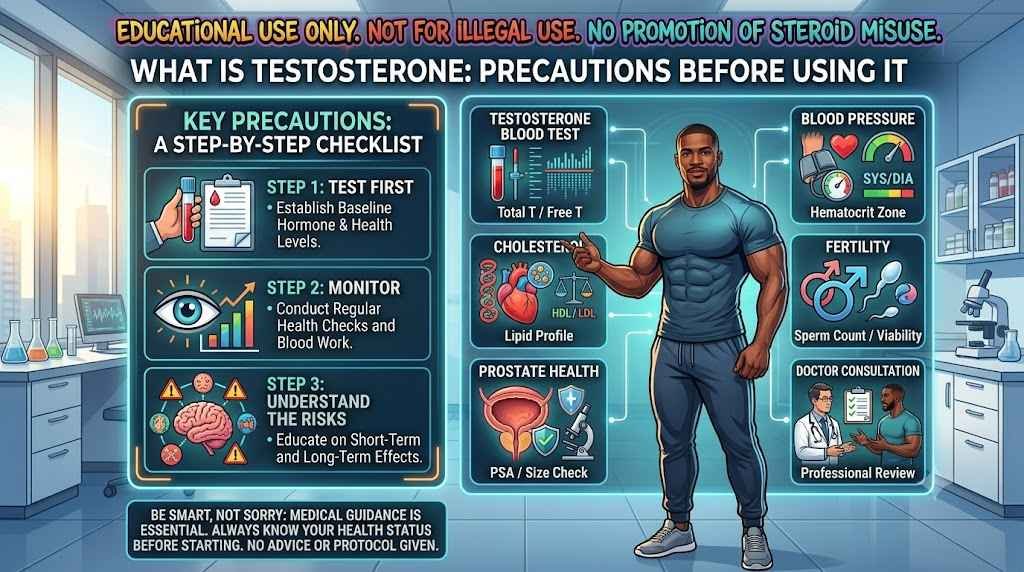
What Is Testosterone: Precautions Before Using It
Before testosterone therapy is started, the first question shouldn’t be:
“Which testosterone is strongest?”
The better question is:
“Do I actually have a medical reason to use testosterone?”
Clinical guidelines emphasize confirming testosterone deficiency with appropriate testing and investigating the underlying cause.
Important medical considerations can include:
- Morning testosterone testing
- Repeat testing when appropriate
- LH and FSH
- Hemoglobin and hematocrit
- Blood pressure
- Lipid profile
- Liver-related testing where appropriate
- Prostate assessment when clinically indicated
- Fertility plans
- Existing cardiovascular conditions
- Sleep apnea
- Current medications
Sustanon specifically requires attention to prostate monitoring, hematocrit/hemoglobin and other laboratory parameters during long-term therapy.
What Is Testosterone: Who Should Be Extra Careful?
Testosterone therapy is not appropriate for everyone.
The Endocrine Society identifies several situations requiring avoidance or additional specialist assessment, including plans for fertility in the near term, certain prostate or breast conditions, elevated hematocrit, untreated severe obstructive sleep apnea, uncontrolled heart failure, recent major cardiovascular events and thrombophilia.
Sustanon is also contraindicated in people with certain allergies because its formulation contains refined peanut oil.
Anyone considering testosterone treatment should therefore disclose their complete medical history to the prescribing clinician.
What Is Testosterone: Final Takeaway
So, what is testosterone in simple terms?
It is a naturally occurring steroid hormone that plays a major role in male sexual development, muscle and bone maintenance, red blood cell production, libido and reproductive function.
For bodybuilding, testosterone is also the foundation of many anabolic-androgenic steroid discussions.
There are multiple testosterone esters, including propionate, enanthate, cypionate and undecanoate, while Sustanon 250 combines four esters — propionate, phenylpropionate, isocaproate and decanoate — into one pharmaceutical preparation.
The biggest thing beginners should understand is that different testosterone esters mainly change the release and duration profile. They don’t turn testosterone into completely different hormones.
And while testosterone can have legitimate medical benefits when used to treat confirmed testosterone deficiency, using it for bodybuilding carries risks that shouldn’t be ignored.
The smart approach is to understand the hormone, understand the formulation, understand the potential benefits and risks, and — most importantly — use medical testing and professional supervision when testosterone therapy is actually indicated.
Testosterone isn’t just about bigger muscles. It’s a hormone that affects the entire body.
Need Help Understanding Testosterone?
Still confused about what is testosterone, the different testosterone esters, Sustanon 250, testosterone replacement, bodybuilding use, side effects, or bloodwork?
If you want to discuss your bodybuilding goals, training, nutrition, or have questions about testosterone and related products, you can contact us directly on WhatsApp.
WhatsApp: 7696593279
Before using testosterone or any anabolic steroid, make sure you understand the potential risks and get appropriate medical advice and bloodwork. Testosterone is a powerful hormone, and using it without proper assessment can affect fertility, blood pressure, cholesterol, red blood cell count, natural hormone production, and other aspects of health.
Message us on WhatsApp: 7696593279 for general guidance and information.



[…] So, when comparing Oral vs injectable steroids, what really separates the two? Let’s break it down in simple gym language. What Is Testosterone? Guide to Types, Dosage & Benefits […]