Types of SARMs have become a major topic in the bodybuilding and fitness world. Ostarine, Ligandrol, RAD-140 and several other compounds are often discussed for their potential to increase muscle mass, improve strength and support physical performance. But there is a big difference between what has been investigated in research and what is claimed on bodybuilding forums or supplement websites.
SARMs, or Selective Androgen Receptor Modulators, were originally developed as compounds that could stimulate androgen receptors in a more selective way than traditional anabolic-androgenic steroids. Researchers have investigated them for conditions involving muscle wasting, bone loss and other medical applications.
However, most SARMs are not approved for bodybuilding or general muscle enhancement, and several have not been approved as medicines for human use. Research has also identified important concerns involving hormone suppression, liver effects, cardiovascular risks and unknown long-term consequences.
In this guide, we’ll look at the major types of SARMs, what researchers have studied them for, their potential benefits, common claims surrounding them, and the safety concerns you should understand before believing the marketing. Benefits and Types of SARMs: Complete Guide
What Are the Types of SARMs?
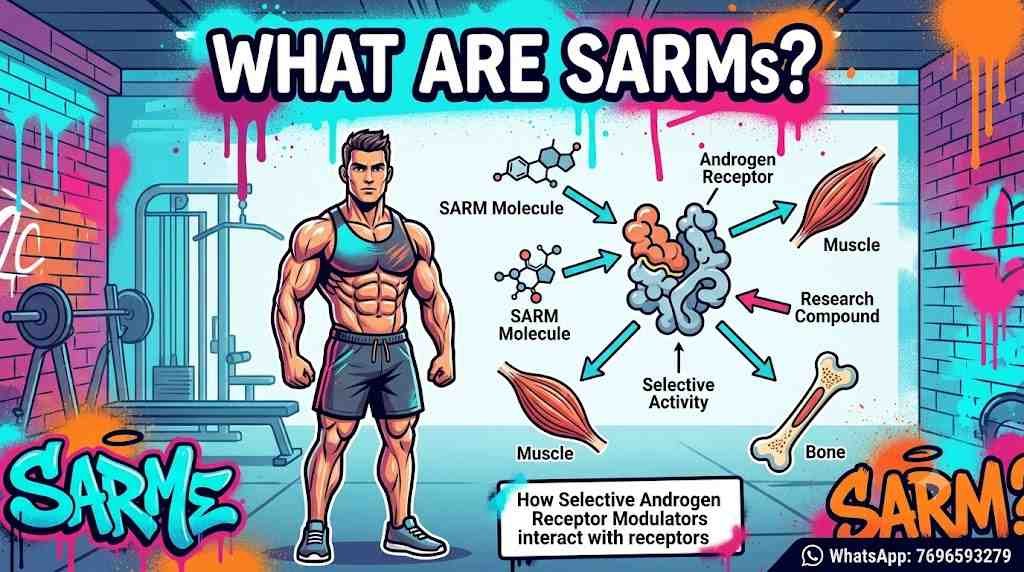
SARMs are compounds designed to interact with androgen receptors in the body.
Androgen receptors are found in tissues including skeletal muscle and bone. Testosterone and other androgenic hormones activate these receptors naturally, producing effects involved in muscle development, strength, bone maintenance and other biological processes.
The idea behind SARMs is to create compounds that produce more tissue-selective androgen activity.
In simple gym-bro language, the goal was basically:
More useful anabolic activity where researchers want it, with less unwanted androgenic activity elsewhere.
That sounds attractive on paper, but real-world results are more complicated.
SARMs are not automatically safe simply because they are described as “selective.”
Some SARMs have demonstrated anabolic effects in clinical research, while others have primarily been studied in laboratory or animal models. The amount and quality of human evidence varies considerably between compounds.
Types of SARMs and How They Differ
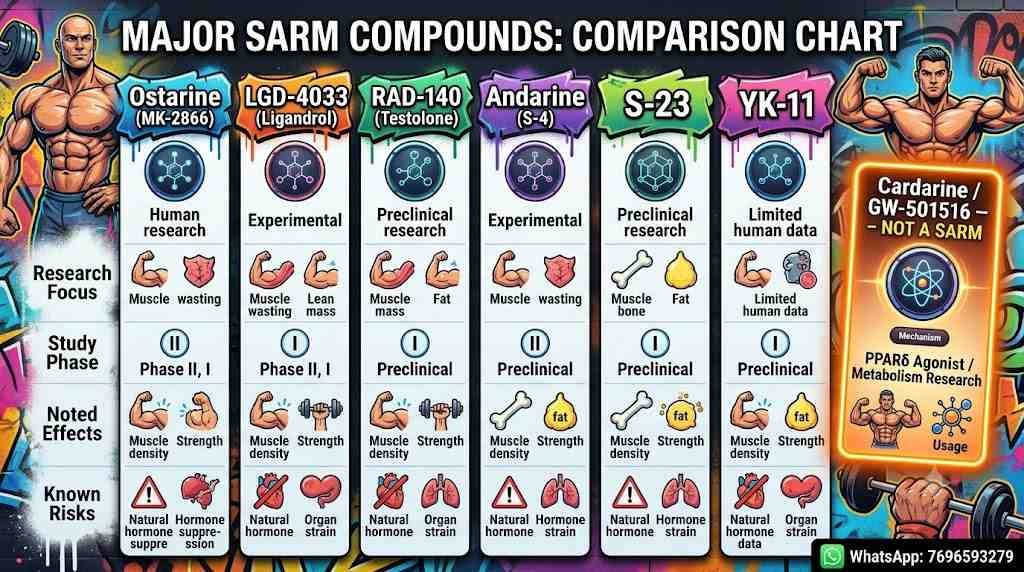
There isn’t just one SARM.
Researchers have developed and studied multiple compounds with different receptor activity, potency and research histories.
Some of the names commonly encountered in bodybuilding discussions include:
- Ostarine (MK-2866)
- Ligandrol (LGD-4033)
- RAD-140 (Testolone)
- Andarine (S-4)
- S-23
- YK-11
Another compound frequently mentioned alongside SARMs is Cardarine (GW-501516). However, Cardarine is not actually a SARM. It works through a different biological pathway and should not be classified as one.
Let’s look at the major compounds individually.
Ostarine (MK-2866)
Ostarine, also known as MK-2866 or enobosarm, is one of the best-known SARMs.
It was investigated for conditions where preserving or increasing lean body mass could be medically useful.
Human clinical research has examined enobosarm in populations including older adults and people experiencing muscle wasting. Some studies reported increases in lean body mass.
This research is one reason Ostarine became popular in bodybuilding circles.
Potential Research Uses of Ostarine
Researchers have investigated Ostarine for potential applications involving:
- Loss of lean body mass
- Muscle wasting
- Physical function
- Age-related changes in muscle
- Recovery of lean tissue in certain medical conditions
The important point is that research findings do not automatically make Ostarine an approved bodybuilding drug.
Ostarine Benefits Discussed in Research
Research has primarily focused on changes such as:
- Lean body mass
- Physical function
- Muscle preservation
Bodybuilders commonly claim additional benefits such as improved strength and muscle definition, but these claims should not be confused with established medical indications.
Ligandrol (LGD-4033)
Ligandrol, commonly called LGD-4033, is another well-known SARM.
It has been investigated for its anabolic activity and potential ability to increase lean body mass.
A controlled human study of LGD-4033 found increases in lean body mass during the study period. However, researchers also observed suppression of testosterone and other hormonal markers.
That finding is important.
A compound can increase lean mass while still producing unwanted hormonal effects.
Why Is LGD-4033 Popular?
In bodybuilding communities, LGD-4033 is often associated with:
- Muscle growth
- Strength increases
- Increased body weight
- Improved training performance
But these claims should be separated from what has actually been demonstrated in controlled research.
The hormonal suppression observed in human research is one reason safety cannot be ignored.
RAD-140 (Testolone)
RAD-140, commonly called Testolone, is another compound frequently mentioned when people discuss the types of SARMs.
It was developed as an experimental androgen receptor modulator and has attracted considerable interest because of its anabolic activity.
Compared with compounds such as Ostarine and LGD-4033, the amount of publicly available human clinical evidence for RAD-140 is more limited.
Much of the popularity of RAD-140 comes from bodybuilding and online communities rather than established medical use.
What Do People Claim About RAD-140?
Common bodybuilding claims include:
- Increased muscle mass
- Increased strength
- Improved recovery
- Improved training performance
However, online reports are not the same thing as controlled clinical evidence.
The lack of extensive long-term human data is itself an important safety consideration.
Andarine (S-4)
Andarine, commonly called S-4, is another experimental SARM.
It has been studied primarily in preclinical research and became known in bodybuilding communities because of its potential effects on muscle and bone tissue.
However, S-4 has a particularly important safety concern that makes it different from some other SARMs.
S-4 and Vision Problems
Changes in vision, including difficulty seeing in low-light conditions and altered color perception, have been associated with S-4 use.
This is one reason people should not assume that all SARMs have similar risk profiles.
A compound can have a completely different adverse-effect profile from another compound in the same general category.
S-23
S-23 is another experimental androgen receptor modulator.
It has been investigated primarily in preclinical research, including research involving reproductive biology.
S-23 has become popular in some performance-enhancement communities because of its reputation for strong androgenic/anabolic activity.
However, the amount of high-quality human safety data is limited.
That means claims about its effectiveness, long-term safety or suitability for bodybuilding should be treated cautiously.
YK-11
YK-11 is often included in online lists of SARMs, but its classification and pharmacological profile are more complicated than many bodybuilding websites suggest.
It has been described as a SARM-like compound and has attracted attention because of laboratory research involving muscle-related pathways.
However, there is very limited human clinical evidence supporting the many performance claims made about YK-11 online.
YK-11 Research vs Bodybuilding Claims
Online discussions often associate YK-11 with:
- Muscle growth
- Strength
- Increased muscle hardness
- Enhanced physique development
But these claims are not supported by the same level of human evidence available for some better-studied compounds.
This is an important lesson when researching any SARM:
Popularity does not equal scientific evidence.
Cardarine (GW-501516) Is Not a SARM
This deserves its own section because Cardarine is frequently included in lists of SARMs.
GW-501516, also known as Cardarine, is not a SARM.
It works primarily through activation of PPARδ, rather than by selectively modulating androgen receptors.
It has been studied in relation to metabolism and exercise-related pathways, which is why it became popular among athletes and bodybuilders.
However, Cardarine has serious safety concerns based on preclinical research and is not an approved performance-enhancing drug.
So if you see an article claiming that Cardarine is simply “another SARM,” be careful with that classification. LGD-4033 vs MK-677: Full Comparison Guide
Potential Benefits of Different Types of SARMs
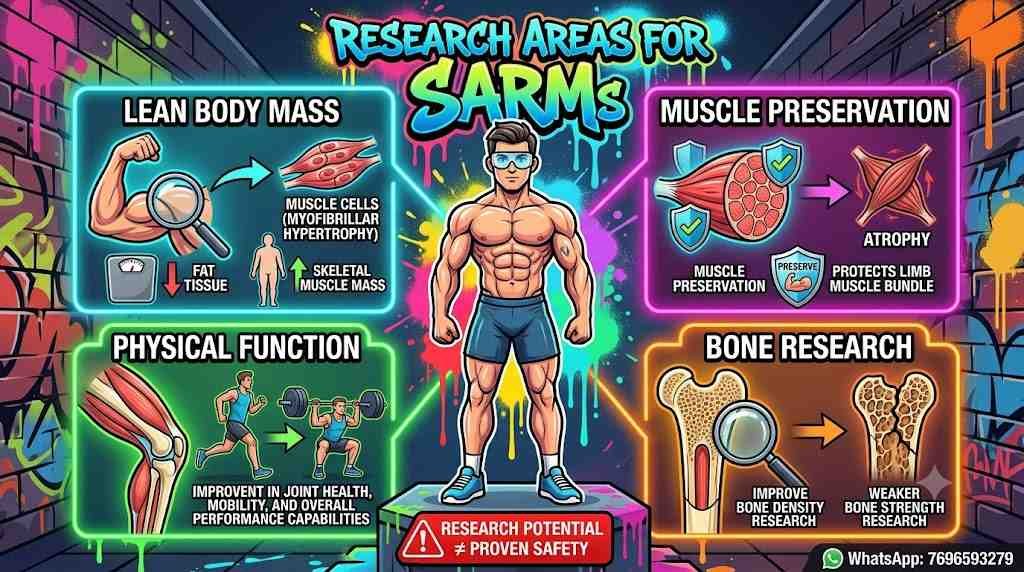
The potential benefits associated with SARMs depend heavily on the specific compound and the context in which it is being studied.
Research has explored SARMs because they may influence tissues such as:
- Skeletal muscle
- Bone
- Other androgen-responsive tissues
Potential research areas have included:
Increasing Lean Body Mass
Some SARMs have demonstrated increases in lean body mass in human trials.
This is one of the main reasons researchers became interested in them for conditions involving muscle wasting.
Supporting Muscle Preservation
Researchers have explored whether SARMs could help preserve muscle tissue during situations where muscle loss is a concern.
This could potentially have medical relevance for certain populations.
Bone Research
Because androgen receptors are involved in bone biology, researchers have also investigated SARMs for potential applications involving bone health.
Physical Function
Some clinical research has examined whether increases in lean mass translate into improvements in physical performance or function.
This distinction matters because gaining lean mass on a measurement does not automatically mean a person becomes stronger or healthier.
Types of SARMs and Dosage
Internet Gym Dosage Reports for SARMs
| SARM | Commonly reported online range | Typical online cycle discussions | Important note |
|---|---|---|---|
| Ostarine (MK-2866) | ~10–25 mg/day | 8–12 weeks | Community reports vary considerably |
| LGD-4033 (Ligandrol) | ~5–20 mg/day | 8–12 weeks | Online doses can be far above clinical-study doses |
| RAD-140 (Testolone) | ~10–30 mg/day | 8–12 weeks | Human safety data remain limited |
| S-4 (Andarine) | ~25–75 mg/day | 6–12 weeks | Vision-related adverse effects are a major concern |
| S-23 | ~10–30 mg/day | 6–12 weeks | Very limited human evidence |
| YK-11 | ~5–20 mg/day | 6–8 weeks | Extremely limited human evidence |
| Cardarine (GW-501516) | ~10–25 mg/day | 8–12 weeks | Not a SARM; separate compound class |
These ranges reflect anecdotal internet/community reports, not medically established doses. For example, forum discussions contain reports of LGD around 10–20 mg, RAD-140 around 15–30 mg, S-4 around 50–75 mg, and S-23 around 10–20 mg. More recent Reddit discussions also show users reporting combinations and doses in these ranges.
I would put this disclaimer directly under the table:
Important: The amounts above are compiled from anecdotal bodybuilding-community reports and are not recommended doses or medically established dosing guidelines. Online reports are inconsistent, products may be mislabeled or contaminated, and higher community-reported amounts can be substantially different from doses investigated in controlled human studies. SARMs are not approved for recreational bodybuilding use.
That distinction is actually useful for your article because readers can see “research doses vs internet gym doses” side by side without us presenting forum dosing as a safe protocol.
Types of SARMs vs Anabolic Steroids
SARMs and anabolic steroids are often grouped together because both can affect androgen receptors.
But they are not the same type of compound.
Anabolic steroids are generally based on steroidal structures related to testosterone or other steroid hormones.
SARMs are structurally diverse non-steroidal compounds designed to interact with androgen receptors.
The original research concept behind SARMs was greater tissue selectivity.
That does not mean SARMs are side-effect-free.
Both categories can potentially interfere with the body’s natural hormonal system.
Key Difference
A simplified comparison looks like this:
| Feature | SARMs | Anabolic Steroids |
|---|---|---|
| General category | Selective androgen receptor modulators | Anabolic-androgenic steroids |
| Chemical structures | Generally non-steroidal | Steroidal |
| Androgen receptor activity | Yes | Yes |
| Muscle-building potential | Demonstrated for some compounds | Well established for many compounds |
| Human research | Varies greatly by compound | Extensive for some medically used steroids |
| Hormonal suppression | Possible | Common with many anabolic steroids |
| Long-term safety | Not well established for many SARMs | Depends heavily on drug, dose and duration |
| Approved bodybuilding use | No | No |
The important takeaway is that “not a steroid” does not mean “safe.”
Types of SARMs: Safety and Side Effects
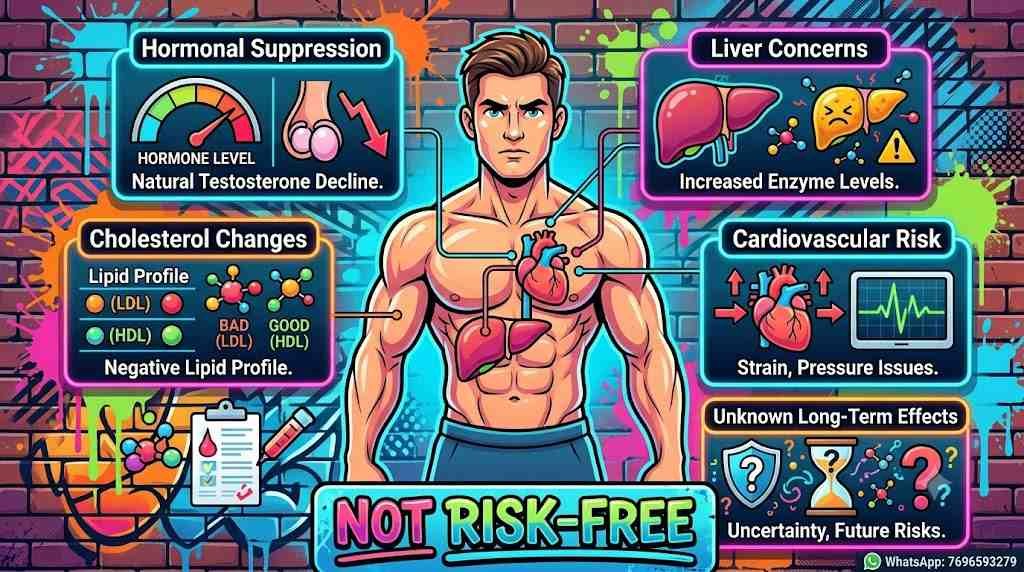
This is probably the most important section of the entire article.
Many people discover SARMs through fitness forums and social media and assume they are basically a safer version of steroids.
That assumption is not supported by the available evidence.
Potential concerns include:
Hormonal Suppression
Some SARMs can suppress natural testosterone production.
Clinical research involving LGD-4033, for example, observed suppression of testosterone and related hormonal markers.
The degree of suppression can vary depending on the compound and individual. RAD 140 Results: Benefits, Dosage, Side Effects, Before & After
Liver Concerns
Liver injury has been reported in association with SARM products.
The problem becomes even more complicated because products sold online may not always contain exactly what their labels claim.
A product marketed as one SARM could contain different compounds, incorrect quantities or additional substances.
Cholesterol Changes
Androgenic compounds can affect lipid markers.
Changes in HDL and LDL cholesterol can matter because cholesterol levels are connected to cardiovascular health.
Cardiovascular Risk
Potential effects on lipids, blood pressure and other cardiovascular markers are important safety considerations.
Long-term cardiovascular outcomes for many SARMs remain insufficiently studied.
Unknown Long-Term Effects
This is one of the biggest issues.
Many SARMs do not have decades of human safety data.
When a compound has only limited clinical research, nobody can honestly guarantee what years of repeated exposure might mean.
Are Types of SARMs FDA Approved?
Most SARMs marketed online for bodybuilding are not FDA-approved drugs for muscle building or performance enhancement.
The FDA has also warned consumers about products marketed as SARMs and has highlighted potential serious safety risks.
This is an important distinction:
Being sold online does not mean a product has been approved for human use.
The same applies to the phrase “research chemical.”
That phrase does not automatically mean a compound is safe for personal use.
Are Types of SARMs Legal?
The legal and regulatory status of individual compounds and products can vary by country and can change over time.
In the United States, SARMs marketed as dietary supplements or for unapproved human use can raise significant regulatory issues.
Athletes should also be aware that many SARMs are prohibited under anti-doping rules.
If competitive sport is involved, checking the current rules of the relevant anti-doping organization is essential.
Types of SARMs: Why SARM Products Can Be Risky
There is another problem beyond the pharmacology itself: product quality.
Online SARM products may be sold outside normal pharmaceutical quality-control systems.
Potential problems include:
- Incorrect labeling
- Unexpected ingredients
- Contamination
- Incorrect concentration
- Undeclared drugs
- Poor manufacturing standards
This means the risks may come from both the compound and the product being sold.
Types of SARMs: Research vs Internet Claims

One of the biggest mistakes beginners make is treating online testimonials as scientific evidence.
Someone saying:
“I gained 10 pounds using this SARM”
doesn’t prove that the compound caused all of the gain.
Body weight can change because of:
- Calories
- Water retention
- Glycogen
- Training
- Diet
- Sleep
- Other supplements
- Other drugs
- Individual differences
Clinical studies use controlled methods to separate these variables.
That’s why research evidence should carry more weight than random transformation posts. S4 SARM (Andarine): Complete Guide
Are Types of SARMs Safe for Beginners?
There is no general SARM that can be described as a universally safe choice for beginners.
People often search for the “mildest SARM” or the “safest SARM,” but safety depends on many factors, including the compound, individual health, other medications or substances, and duration of exposure.
More importantly, many SARMs have not been adequately studied for long-term recreational use.
If your goal is simply gaining muscle, there are much better-established foundations:
- Progressive resistance training
- Adequate calories
- Sufficient protein
- Proper sleep
- Consistent training
- Evidence-based supplements where appropriate
These fundamentals have far stronger long-term safety profiles.
Frequently Asked Questions About Types of SARMs
What are the main types of SARMs?
Commonly discussed SARMs include Ostarine (MK-2866), Ligandrol (LGD-4033), RAD-140, Andarine (S-4), S-23 and YK-11. Their research histories and evidence levels differ significantly.
Which SARM has been studied the most?
Ostarine and LGD-4033 have been investigated in human clinical research more extensively than several newer or more experimental compounds commonly discussed online. However, research does not mean that either is approved for bodybuilding use.
Is Cardarine a SARM?
No. Cardarine (GW-501516) is not a SARM. It acts through PPARδ rather than the androgen receptor.
Can SARMs increase muscle mass?
Some SARMs have increased lean body mass in clinical research. However, the magnitude of the effect and its clinical significance depend on the specific compound and study population.
Do SARMs suppress testosterone?
Some SARMs can suppress testosterone and other hormonal markers. Human research has documented hormonal suppression with compounds such as LGD-4033.
Are SARMs safer than steroids?
It is not accurate to simply label SARMs as a safe alternative to anabolic steroids. Both can have significant biological effects, while long-term human safety information for many SARMs remains limited.
Can SARMs damage the liver?
Liver injury has been reported in association with SARM products. Anyone experiencing symptoms such as unusual fatigue, dark urine, yellowing of the skin or eyes, or significant abdominal discomfort should seek medical attention.
Are SARMs banned in sports?
Many SARMs are prohibited under anti-doping rules. Athletes should check the current prohibited-substance list applicable to their sport and organization.
Final Thoughts on Types of SARMs
The world of SARMs is much more complicated than the simple “steroids without the side effects” description sometimes seen online.
Different types of SARMs have different research histories, biological effects and safety concerns.
Ostarine and LGD-4033 have human clinical research behind them, while compounds such as RAD-140, S-23 and YK-11 have much more limited human evidence. And Cardarine should not be classified as a SARM at all.
The biggest takeaway is simple:
Research potential does not equal proven safety.
Some SARMs may have legitimate future medical applications, particularly in areas involving muscle and bone loss. But recreational use for bodybuilding carries uncertainties that should not be ignored.
If you’re considering any compound that can alter your hormones, speaking with a qualified healthcare professional and getting appropriate medical advice is far safer than relying solely on online forums or product sellers.
Need Help With Your Fitness Goals?
If you’re trying to build muscle, improve your diet, plan your training, or understand supplements and performance-enhancing compounds, you can contact us on WhatsApp.
WhatsApp: 7696593279
We’ll help you understand the available information and make a more informed decision about your fitness goals.