If you have ever wondered why steroids cause hair loss, the answer usually comes down to hormones, genetics, and how sensitive your hair follicles are to androgens. Anabolic steroids can increase androgen activity in the body, and some steroids or their metabolites can increase signaling through pathways involved in male-pattern hair loss. For someone who is genetically prone to hair loss, this can potentially make shedding happen faster or become more noticeable.
This is one of those side effects that many gym users don’t think about until they start noticing more hair in the shower, a receding hairline, or thinning around the crown. The frustrating part is that you can make significant progress in the gym while your hairline is quietly moving in the opposite direction.
But does every steroid cause hair loss? Is DHT always the reason? Can steroid-related hair loss grow back? And are some compounds more likely to affect your hair than others?
For people who are genetically prone to male-pattern baldness, understanding why steroids cause hair loss is especially important before assuming that every case of shedding is temporary.
Let’s break it down in simple gym language. Why Do Steroids Cause Acne? Causes, Triggers & Solution
How Do Steroids Cause Hair Loss?
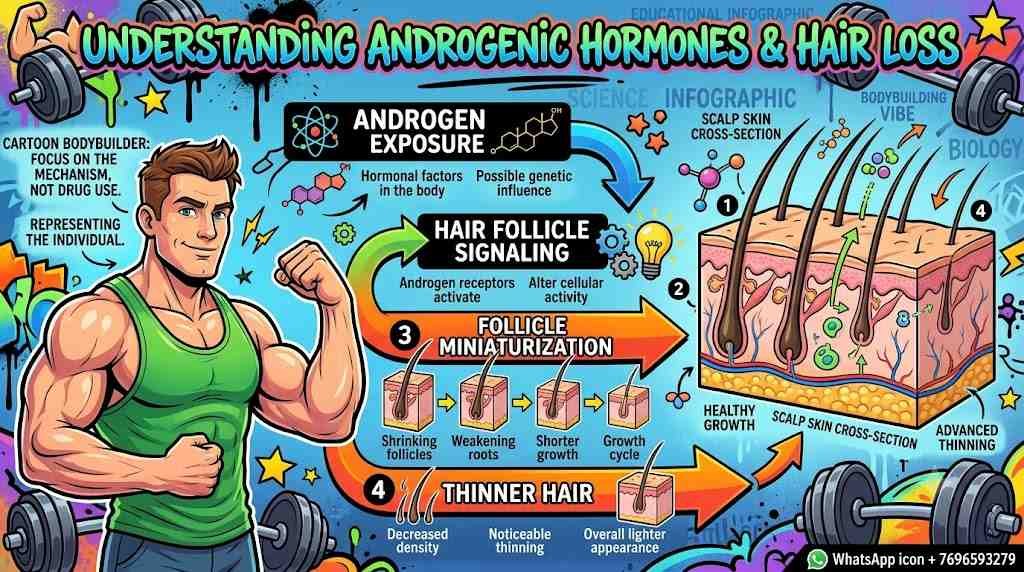
The basic connection between anabolic steroids and hair loss is androgen activity.
Anabolic-androgenic steroids are synthetic versions or derivatives of testosterone. Their anabolic effects are associated with things such as muscle growth and increased protein synthesis, while their androgenic activity affects characteristics associated with male hormones.
Hair follicles can also respond to androgen signaling.
In genetically susceptible people, increased androgen activity can contribute to a process called androgenetic alopecia, commonly known as male-pattern hair loss.
The important point is that steroids don’t necessarily create male-pattern baldness out of nowhere.
Instead, they can potentially accelerate a process that your genetics have already made you susceptible to.
Someone with very strong genetic resistance to androgen-related hair loss may use an androgenic compound and notice little change in their hair.
Another person may already have genetically sensitive follicles and suddenly notice rapid thinning.
That’s why two people can have very different experiences with the same compound. This is the main reason steroids cause hair loss in people who are already genetically sensitive to androgen-related follicle changes.
The Role of DHT in Steroid-Related Hair Loss
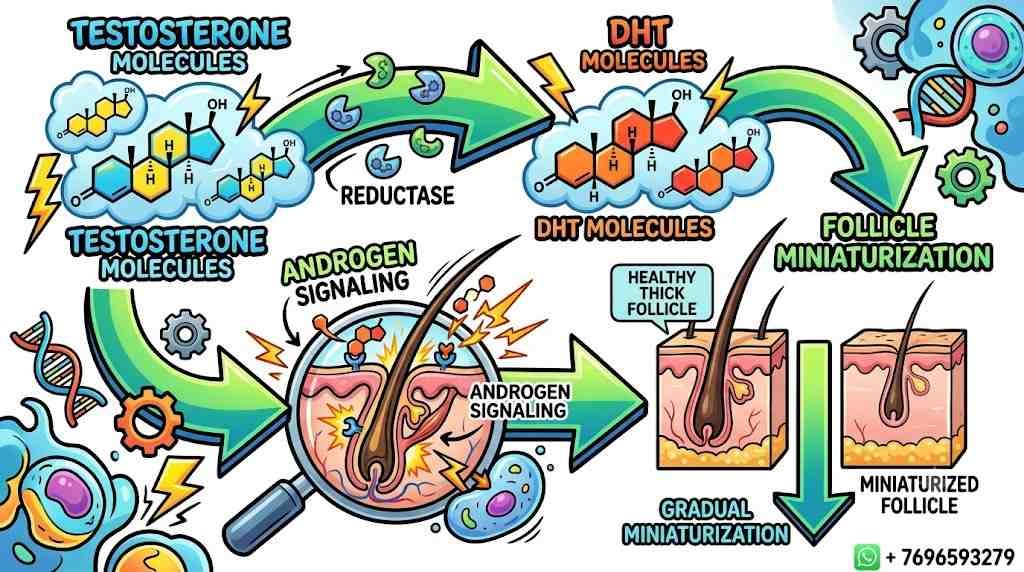
DHT, or dihydrotestosterone, is one of the major hormones involved in androgenetic hair loss.
Your body naturally produces DHT from testosterone through an enzyme called 5-alpha-reductase.
DHT binds to androgen receptors in susceptible hair follicles. Over time, repeated androgen signaling can cause susceptible follicles to gradually become smaller.
This process is called follicular miniaturization.
Instead of producing a thick terminal hair, the affected follicle may eventually produce a finer, shorter hair.
Eventually, the growth phase can become shorter and the visible hair becomes progressively thinner.
This DHT-related pathway is one of the main reasons steroids cause hair loss in genetically susceptible individuals. The important factor isn’t simply how much testosterone is in the body, but how susceptible the individual hair follicles are to androgen signaling.
This is why male-pattern hair loss doesn’t always begin with dramatic shedding.
Sometimes the first sign is simply:
- Hair looking thinner than before
- A widening part
- More scalp showing under bright lights
- Receding temples
- A thinner crown
- Hair becoming finer and weaker-looking
Steroids can potentially speed up this process when androgen exposure increases.
Does Testosterone Cause Hair Loss?
Testosterone itself isn’t automatically a guarantee of hair loss.
The bigger issue is how your body and hair follicles respond to androgen activity.
Some testosterone is converted into DHT through 5-alpha-reductase. If someone has genetically sensitive follicles, increased androgen exposure may accelerate miniaturization.
This is why testosterone and male-pattern hair loss can be connected without testosterone being the sole cause.
Genetics matter enormously.
For example, two men can have similar testosterone levels but completely different hairlines.
One may keep a thick hairline for decades while another begins thinning much earlier.
So when people say, “Testosterone caused my baldness,” the more accurate explanation is usually that androgen exposure interacted with an underlying genetic susceptibility.
Why Steroids Can Make Hair Loss Happen Faster
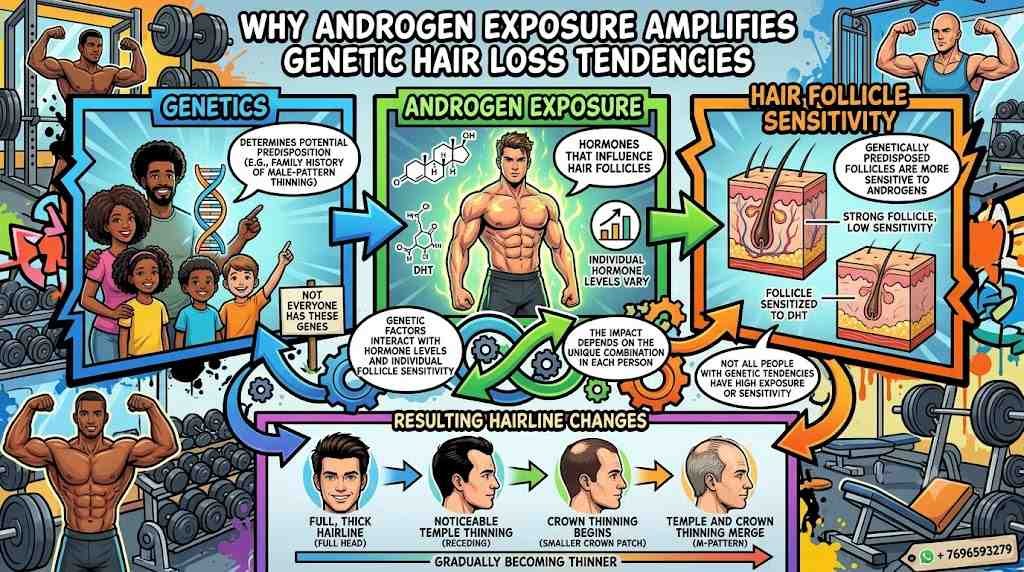
There are several reasons steroid use may make existing hair-loss tendencies more obvious. This is why steroids cause hair loss differently from person to person. Someone who already has sensitive follicles may notice accelerated thinning, while another person may experience little obvious change.
Increased Androgen Exposure
Anabolic steroids can substantially alter androgen exposure compared with normal physiological levels.
Higher androgenic stimulation can matter when hair follicles are already genetically sensitive.
Conversion Into Other Androgens
Some hormones can be converted into more potent androgenic metabolites.
The exact pathway depends on the compound.
This means different steroids can have different effects on different tissues.
Genetic Sensitivity
This is probably one of the biggest factors.
If male-pattern hair loss runs strongly in your family, your follicles may be more sensitive to androgen signaling.
Steroids may then make the progression more noticeable.
Existing Hair Loss May Already Be Developing
Hair loss can begin long before it becomes obvious.
You might already have gradual follicular miniaturization without realizing it.
An increase in androgen exposure can make the process appear to suddenly accelerate. Natural Muscle vs Steroid Muscle: Key Differences
Do All Anabolic Steroids Cause Hair Loss?
No.
It would be inaccurate to say that every anabolic steroid will cause hair loss in every person.
Different anabolic steroids have different androgenic properties, metabolic pathways, and effects on androgen receptors.
The individual’s genetics also make a huge difference.
However, people who are genetically predisposed to androgenetic alopecia may be particularly concerned about compounds with significant androgenic activity.
The important takeaway is this:
There is no simple “safe steroid for hair” rule that applies to everyone.
A compound that seems harmless to one person’s hair may be problematic for another person.
Which Steroids Are More Likely to Affect Hair?
The risk depends on the specific compound, androgenic activity, metabolism, dose, duration of exposure, and individual genetics.
Compounds with stronger androgenic effects may be more concerning for someone already prone to androgenetic alopecia.
But there is an important misconception worth clearing up.
You cannot simply rank steroids from “will make you bald” to “won’t make you bald” based on one number.
Hair follicles respond to androgen signaling in a complicated way, and systemic hormone levels don’t perfectly predict what will happen to an individual’s scalp.
This is also why online steroid charts can be misleading when they present hair-loss risk as an exact ranking.
Why Genetics Matter So Much
If your father, grandfather, brothers, or other close relatives experienced early male-pattern hair loss, you may already have a higher genetic susceptibility.
But genetics are not as simple as looking at your mother’s or father’s hairline.
Multiple genes contribute to androgenetic alopecia.
And your family history isn’t a perfect prediction of exactly when or how quickly you will lose hair.
This is why one person can use androgenic hormones for years with relatively little visible change while another person notices significant recession much earlier.
The steroid may be acting as an accelerator rather than the original cause.
Steroids and a Receding Hairline
If you’re wondering why steroids cause hair loss around the temples specifically, androgen-sensitive follicles in the frontal hairline can gradually become thinner and produce smaller hairs. One of the most noticeable signs of androgen-related hair loss is recession around the temples.
You may notice that the corners of your hairline begin moving backward.
At first, it can be difficult to tell whether this is normal maturation or actual progression.
Look for changes over time rather than judging your hairline from one photograph.
Taking occasional photos under similar lighting can make changes easier to recognize.
If the temples continue receding or the hairs become progressively finer, that may suggest ongoing miniaturization.
Steroids and Crown Hair Loss
The crown is another common area affected by androgenetic alopecia.
You might notice:
- More scalp visible from above
- A widening thinning area
- Finer hair around the crown
- Hair that looks less dense when wet
Crown thinning can sometimes be harder to notice than frontal recession because you don’t see the area easily yourself.
This is why comparing photographs over several months can be useful.
Can Steroid-Related Hair Loss Be Reversed?
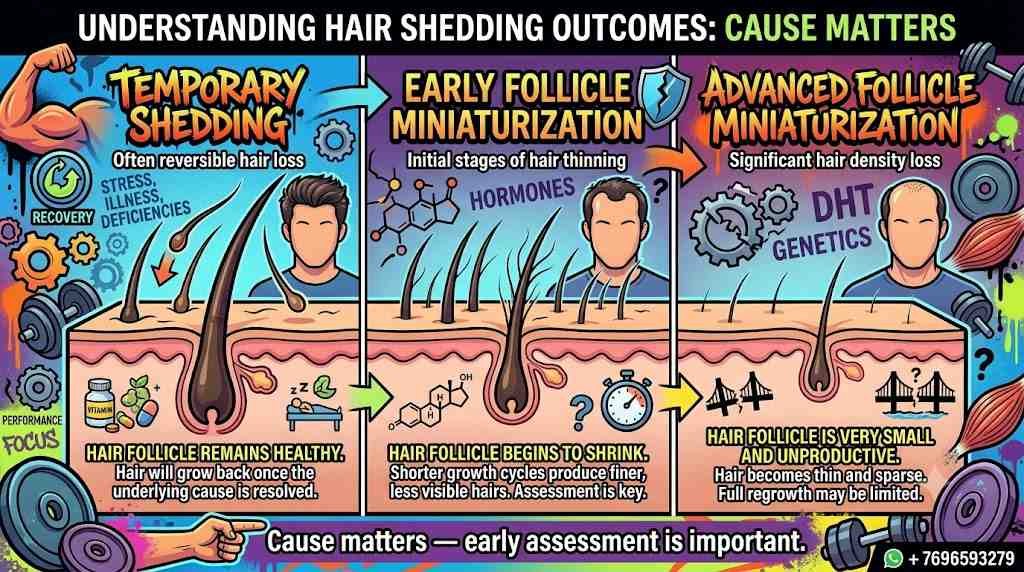
This depends on what is causing the hair loss and how advanced the follicle miniaturization has become.
If a follicle has only recently started becoming thinner, intervention may have a better chance of preserving or improving the appearance of the hair.
But once follicles have undergone extensive miniaturization for a long time, recovery becomes more difficult. The answer depends heavily on the underlying cause. Understanding why steroids cause hair loss can help distinguish temporary shedding from androgenetic hair loss that may continue progressing without treatment.
There is another important distinction:
Temporary shedding is not the same thing as progressive androgenetic hair loss.
A person can experience increased shedding for many reasons, including stress, illness, nutritional problems, major changes in hormones, and other conditions.
So not every episode of sudden hair shedding after steroid use automatically means permanent male-pattern baldness. Best Foods for Muscle Growth: Diet Plans Added
Will Hair Grow Back After Stopping Steroids?
Potentially, but there is no guarantee.
If steroid exposure contributed to temporary shedding, reducing the trigger may allow the normal hair cycle to recover.
But if androgen exposure accelerated genetic male-pattern hair loss, simply stopping the steroid does not necessarily restore follicles that have already undergone significant miniaturization.
This is why early assessment matters.
The longer a susceptible follicle remains affected, the more difficult it can become to preserve its original density.
Steroids Can Also Affect More Than Your Hair
Hair loss is only one possible androgen-related concern.
Anabolic steroid use can affect multiple body systems, and risks can include changes involving:
- Cholesterol
- Blood pressure
- Natural testosterone production
- Fertility
- Liver function, depending on the compound
- Cardiovascular health
- Skin and acne
- Mood and other hormone-related effects
The exact risks vary considerably depending on the substance, exposure, and individual factors.
So if hair loss is happening after anabolic steroid use, it is worth looking at the bigger hormonal picture rather than treating the hairline as an isolated issue.
What Can You Do If Steroids Are Causing Hair Loss?
If you are noticing rapid hair loss while using anabolic steroids, the first step is to figure out what type of hair loss you’re actually experiencing.
Don’t automatically assume every loose hair is DHT-related.
A dermatologist can examine your scalp and determine whether the pattern looks like androgenetic alopecia, another type of hair loss, or a combination of problems.
Depending on the diagnosis, treatments for androgenetic alopecia may include medications such as minoxidil or prescription treatments that affect androgen pathways.
These treatments have different benefits, limitations, and possible side effects, so they should be discussed with a qualified healthcare professional.
If you are using anabolic steroids, tell the doctor.
That information can be important when evaluating hormone-related hair loss.
What About Finasteride?
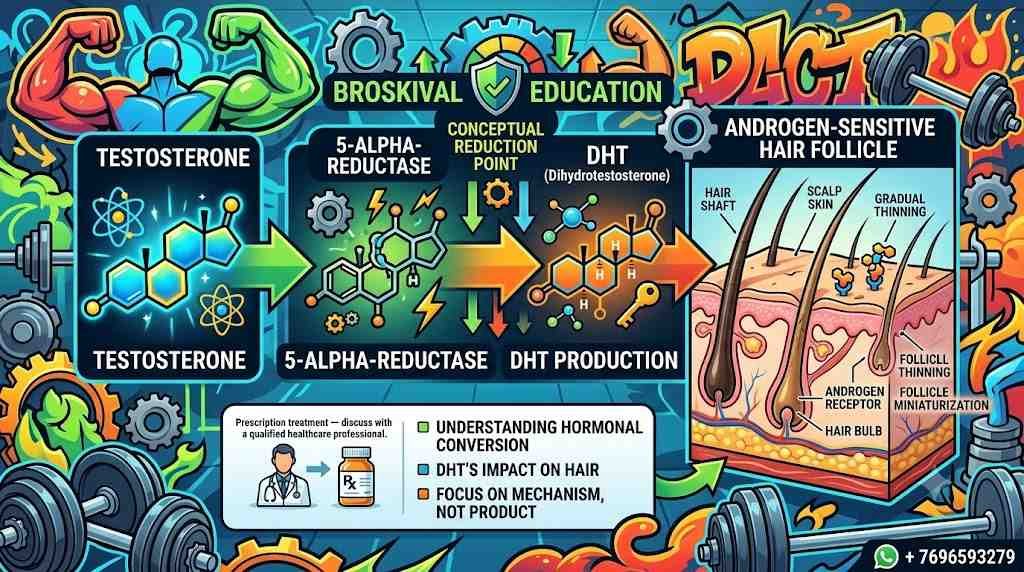
Finasteride is a prescription medication that inhibits 5-alpha-reductase, reducing the conversion of testosterone to DHT.
Because DHT plays an important role in androgenetic hair loss, reducing DHT can help slow hair loss in many men with male-pattern baldness.
However, finasteride isn’t a simple “steroid hair-loss blocker.”
It doesn’t eliminate all androgen activity, and it isn’t appropriate for everyone.
It can also have potential adverse effects.
More importantly, different anabolic steroids don’t all depend on the same pathway to exert their androgenic effects.
So someone using an anabolic steroid shouldn’t assume that blocking 5-alpha-reductase will completely protect their hair.
A doctor should assess the situation before prescription treatment is considered.
What About Minoxidil?
Minoxidil is another commonly used treatment for androgenetic hair loss.
Unlike finasteride, it doesn’t primarily work by lowering DHT.
It can help support hair growth and prolong the growth phase of hair follicles in some people.
But again, it isn’t a guaranteed solution for steroid-related hair loss.
If androgen exposure continues to drive follicular miniaturization, treating the hair without addressing the underlying trigger may not provide the result someone expects. How to Lose Fat Without Losing Muscle
Can Supplements Prevent Steroid Hair Loss?
This is where the internet gets full of exaggerated claims.
Biotin, collagen, zinc, vitamins, oils, and various “DHT-blocking” supplements are frequently marketed for hair growth.
But supplements are not magic protection against androgenetic alopecia.
If you have a genuine nutrient deficiency, correcting it can obviously be important.
But taking extra vitamins when you aren’t deficient doesn’t automatically stop androgen-driven follicular miniaturization.
The best approach is to identify the actual cause of the hair loss first.
Does Shaving Your Head Stop Steroid Hair Loss?
No.
Shaving your head doesn’t change what is happening inside the hair follicle.
It can make hair appear more uniform because every hair is cut to the same length, but it doesn’t stop follicular miniaturization.
If androgenetic hair loss is progressing, shaving won’t change the underlying process.
It can, however, be a simple style choice for someone who is comfortable with a shorter haircut.
Why Some Steroid Users Don’t Lose Their Hair
You may know someone who has used anabolic steroids and still has a thick head of hair.
That doesn’t disprove the connection between androgen activity and hair loss.
It highlights the importance of individual differences.
Hair follicles differ in their sensitivity to androgens.
Genetics, age, baseline hair density, hormone exposure, and existing follicular sensitivity all matter.
One person’s experience cannot reliably predict another person’s outcome.
How Fast Can Steroid-Related Hair Loss Happen?
There isn’t a universal timeline.
Some people may notice increased shedding relatively quickly after hormonal changes.
Others may notice gradual recession or thinning over a much longer period.
The visible timing also depends on how much hair loss was already developing before steroid exposure.
If someone was already genetically predisposed to male-pattern hair loss, an increase in androgen exposure may make the progression much easier to notice.
Is Hair Loss From Steroids Permanent?
It can be, particularly when steroid exposure accelerates androgenetic alopecia and follicles undergo progressive miniaturization.
But not every episode of shedding is permanent.
That’s why identifying the type of hair loss matters.
If you notice sudden or unusually heavy shedding, don’t automatically assume that you’re permanently going bald.
A dermatologist can examine the scalp and determine what is actually happening.
Final Takeaway: Why Do Steroids Cause Hair Loss?
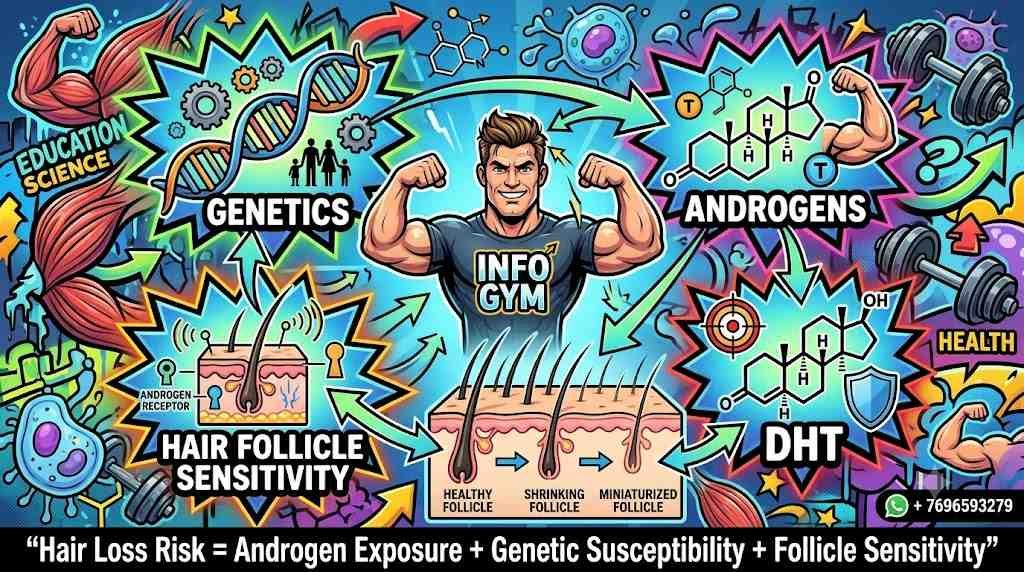
So, why do steroids cause hair loss?
The simplest answer is androgen signaling + genetics + follicle sensitivity.
Anabolic steroids can increase androgen exposure, and in people who are genetically susceptible, this may accelerate androgenetic hair loss. DHT is an important part of this process, but it isn’t the entire story.
Not every steroid affects every person’s hair in the same way, and not every episode of shedding means permanent baldness.
If you’re seeing a rapidly receding hairline, thinning crown, or significant shedding after starting anabolic steroids, getting the hair loss properly assessed is much more useful than relying on online steroid charts or random supplements.
Ultimately, why steroids cause hair loss comes down to the interaction between androgen exposure, hormone metabolism, genetics, and follicle sensitivity. Steroid exposure can accelerate a process that may already be developing beneath the surface.
Your muscles aren’t the only tissue responding to hormonal changes. Your hair follicles are responding too.
Frequently Asked Questions About Steroids and Hair Loss
Do steroids directly cause male-pattern baldness?
They can accelerate androgen-related hair loss in people who are genetically susceptible. Genetics and follicle sensitivity play major roles.
Is DHT responsible for steroid-related hair loss?
DHT is an important hormone involved in androgenetic alopecia, but steroid-related hair loss isn’t explained by DHT alone. Different compounds and individual responses can vary.
Will stopping steroids stop hair loss?
Stopping exposure may remove one potential trigger, but it does not necessarily reverse genetic male-pattern hair loss that has already progressed.
Can hair grow back after steroid use?
It depends on the type and severity of hair loss. Temporary shedding may recover, while advanced follicular miniaturization may not fully reverse.
Does finasteride prevent steroid hair loss?
Finasteride can reduce DHT and may help treat male-pattern hair loss, but it does not provide universal protection against all androgenic effects of anabolic steroids. Medical advice is important before using it.
Does minoxidil help with steroid-related hair loss?
Minoxidil can help some people with androgenetic hair loss, but its effectiveness depends on the underlying cause and individual response.
Are some people genetically more likely to lose hair from steroids?
Yes. Genetic sensitivity to androgen signaling is a major factor in male-pattern hair loss.
Does shaving your head stop hair loss from steroids?
No. Shaving changes the appearance of the hair but does not alter the follicle or hormonal process causing hair loss.
Need Help With Your Bodybuilding Goals?
If you’re dealing with questions about muscle growth, training, diet, supplements, or bodybuilding-related products, you can contact Gym Pundit on WhatsApp at 7696593279.
For hormone-related issues such as rapid hair loss, it’s also worth speaking with a qualified doctor or dermatologist rather than trying to diagnose the cause yourself.