If you spend enough time around bodybuilding, you have probably heard the debate about SARMs vs Steroids. Both are associated with muscle growth, strength, recovery, and changes in body composition, but they are not the same type of compound and they do not work in exactly the same way.
SARMs, or selective androgen receptor modulators, were developed around the idea of producing anabolic effects in tissues such as muscle and bone while being more selective than traditional androgenic drugs. Anabolic-androgenic steroids, on the other hand, are synthetic derivatives or analogues of testosterone and other androgens that can produce broad androgenic and anabolic effects throughout the body.
The big mistake is assuming that SARMs are simply “mild steroids” or that they are automatically safe because they are marketed as a newer alternative. The evidence does not support treating them as risk-free. The FDA has warned about serious adverse effects associated with products containing SARMs, including liver injury and potential cardiovascular risks.
So, what is the real difference between SARMs vs Steroids? Let’s break it down in simple gym language. Oral vs Injectable Steroids: What’s the Difference?
What Are SARMs?
SARMs stands for Selective Androgen Receptor Modulators.
These compounds are designed to interact with androgen receptors. The basic idea behind SARMs is tissue selectivity: instead of producing the same androgenic activity throughout the body, researchers have attempted to create compounds that stimulate androgen receptors more selectively in tissues such as skeletal muscle and bone.
Some compounds that have become well known in bodybuilding circles include Ostarine, Ligandrol, Andarine, RAD-140 and others.
However, there is an important distinction between research and bodybuilding marketing.
SARMs have been investigated for potential medical applications, including conditions involving muscle wasting and loss of lean body mass. But recreational products sold online are not equivalent to approved medicines. In the United States, the FDA states that SARMs are unapproved drugs and cannot legally be marketed as dietary supplements.
Research has shown that some SARMs can increase lean body mass, but questions remain about long-term safety and whether their supposed tissue selectivity produces the benefits that bodybuilding marketing often promises.
What Are Anabolic Steroids?
Anabolic steroids, more precisely called anabolic-androgenic steroids (AAS), are synthetic compounds related to testosterone.
They have two broad categories of effects:
Anabolic effects are associated with processes such as muscle protein synthesis, muscle growth and increases in lean tissue.
Androgenic effects are associated with male sexual characteristics and other androgen-sensitive tissues.
There are many different anabolic steroids, and they can differ significantly in their chemical structure, metabolism, duration of action and effects.
Bodybuilders commonly discuss compounds such as testosterone, Dianabol, Anavar, Winstrol, Deca Durabolin, Trenbolone and others. However, they are not interchangeable, and their risk profiles can be quite different.
Unlike the way SARMs are often marketed online, anabolic steroids have a much longer history of clinical and pharmacological research. That does not mean non-medical use is safe.
SARMs vs Steroids: How Do They Work?
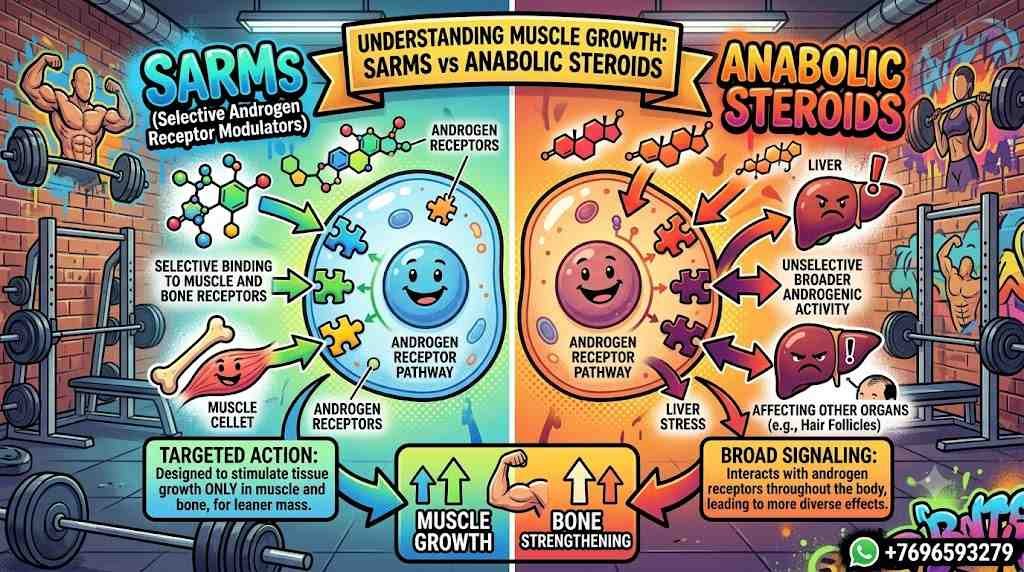
The basic connection between SARMs vs Steroids is the androgen receptor.
Androgen receptors are proteins inside cells that respond to androgenic hormones and compounds. When activated, they can influence gene expression and physiological processes involving muscle, bone and reproductive tissues.
Traditional anabolic steroids can activate androgen receptors and, depending on the compound, can also be metabolized into other active hormones or metabolites.
SARMs were designed with a different goal: to produce more selective androgen receptor activity in certain tissues.
That sounds simple, but biology is rarely that simple.
A 2025 review examining the tissue-selectivity claims surrounding SARMs concluded that their supposed selectivity is still not completely understood and that strong evidence showing clinically meaningful superiority over traditional androgens remains incomplete.
So when you see someone saying that SARMs “only affect muscle,” that is an oversimplification.
SARMs vs Steroids: Muscle Growth
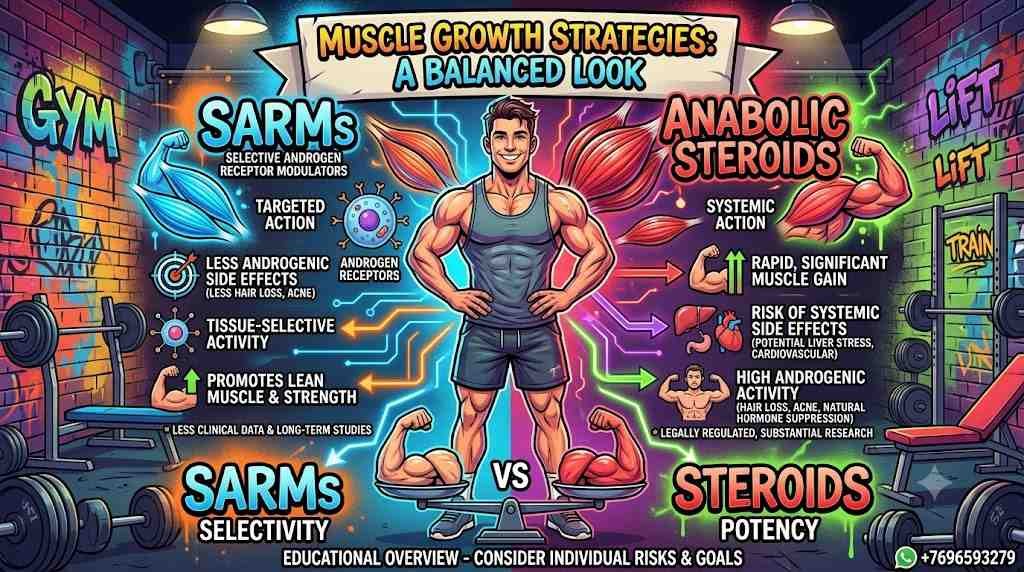
When discussing SARMs vs Steroids for bodybuilding, muscle growth is usually the first subject that comes up.
Both categories can produce anabolic activity because both interact with androgen-related pathways.
Clinical research has demonstrated that certain SARMs can increase lean body mass. However, increases in lean mass do not automatically mean that SARMs provide the same overall performance effects as anabolic steroids.
Anabolic steroids have been studied for decades and include compounds with very different anabolic and androgenic profiles. Their effects can be substantial, but so can their potential adverse effects.
SARMs are sometimes promoted as giving “steroid-like gains without steroid side effects.” That claim needs to be treated very carefully.
Current evidence does not establish that SARMs provide the muscle-building benefits of anabolic steroids while eliminating their important risks.
SARMs vs Steroids: Strength and Performance
Strength is another reason athletes become interested in SARMs vs Steroids.
Androgen receptor stimulation can affect muscle tissue, recovery-related processes and body composition. As a result, both SARMs and anabolic steroids have attracted interest from athletes and recreational lifters.
However, there is a major evidence gap.
Many SARM studies have focused on medical populations, lean body mass or other clinical endpoints rather than the extreme strength and physique goals pursued by competitive bodybuilders.
That means you should be careful when taking results from a clinical trial and assuming they translate directly to bodybuilding performance.
There is also a major difference between having more lean mass and demonstrating a meaningful improvement in athletic performance. Recent research has noted that although some SARMs have increased lean body mass in clinical trials, consistent improvements in functional outcomes such as strength and mobility have been less clearly demonstrated.
SARMs vs Steroids: Side Effects
This is where the conversation becomes much more important.
A common bodybuilding myth is:
Steroids = dangerous
SARMs = safe alternative
Reality is much more complicated.
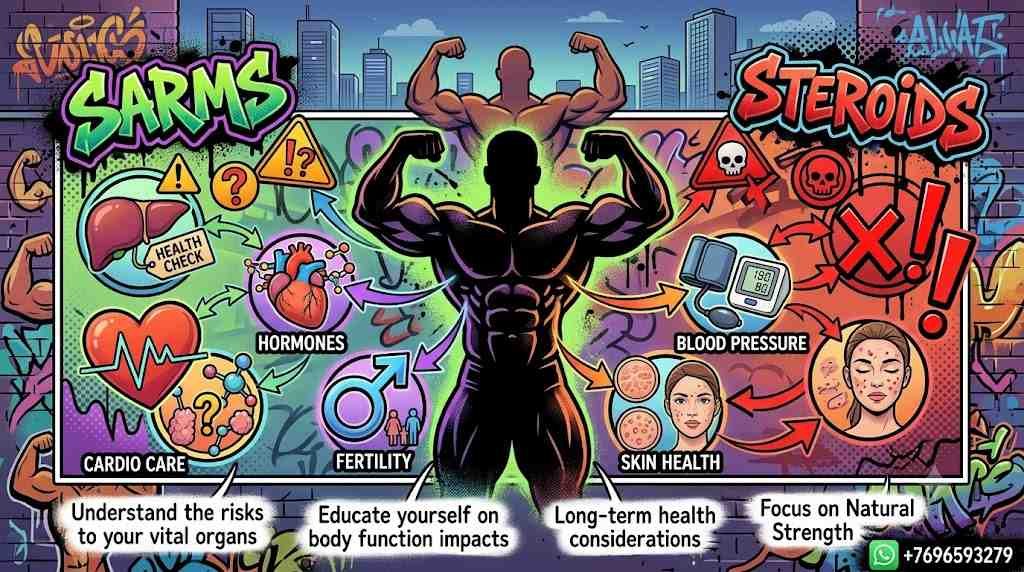
SARMs can produce adverse effects, and the FDA has specifically warned about serious problems associated with products containing SARMs. These include liver injury, sexual dysfunction, infertility, testicular shrinkage and potential increased risk of heart attack or stroke.
A systematic review of SARM safety in healthy adults identified reports of drug-induced liver injury, tendon rupture, rhabdomyolysis and elevated liver enzymes among the available evidence. The researchers also emphasized that the available safety data are limited.
Anabolic steroids can also affect multiple systems.
Potential problems associated with anabolic-androgenic steroid exposure include:
- Suppression of natural testosterone production
- Changes in cholesterol and cardiovascular risk factors
- Increased blood pressure
- Acne and oily skin
- Hair loss in genetically susceptible individuals
- Changes in fertility
- Testicular shrinkage
- Mood and behavioral changes
- Liver problems with certain compounds
- Cardiovascular complications
The FDA has also linked steroid and steroid-like bodybuilding products with serious problems including liver injury, kidney damage, heart attack, stroke and blood clots.
So, in the SARMs vs Steroids discussion, “less androgenic” does not mean “risk-free.”
SARMs vs Steroids: Testosterone Suppression
Hormonal suppression is another important difference to understand.
The body’s endocrine system is based on feedback loops. When external androgenic activity increases, the body can reduce its own production of reproductive hormones.
This can happen with anabolic steroids, but SARMs can also suppress components of the reproductive hormone axis.
That is one reason the idea that SARMs are simply “side-effect-free muscle builders” is misleading.
The extent of hormonal effects can vary substantially depending on the compound, exposure and individual factors. Research on SARMs has documented endocrine-related concerns, while anabolic steroids are well established to suppress endogenous testosterone production.
This is particularly important for younger users who may assume that a SARM is harmless because it comes in a capsule and is marketed as a research compound. Types of SARMs: Benefits, Uses, Research, and Safety
SARMs vs Steroids: Liver Health
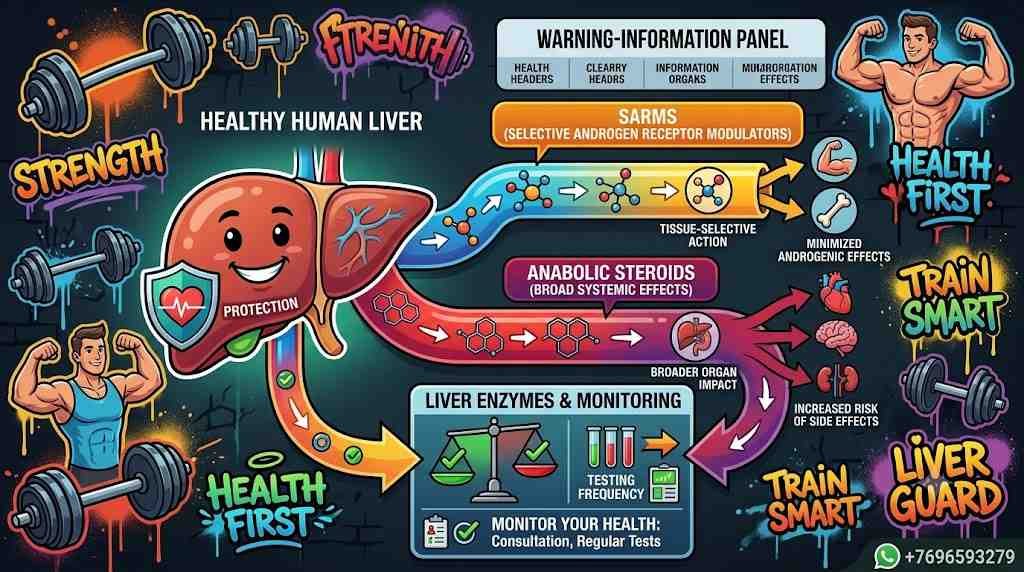
Liver health is another area where the SARMs vs Steroids conversation gets misunderstood.
Some people believe SARMs cannot affect the liver because they are not traditional steroids.
That is incorrect.
The FDA has reported cases of serious liver injury associated with products containing SARMs, including cases requiring hospitalization.
A systematic review of SARM safety also identified multiple reports of drug-induced liver injury and elevated liver enzymes.
Certain anabolic steroids can also cause liver problems, particularly some orally active compounds.
This is why the route of administration alone should never be used as a simple safety ranking.
“Oral” does not automatically mean more dangerous, and “SARM” does not automatically mean liver-safe.
SARMs vs Steroids: Heart and Cholesterol Risks
The cardiovascular side of SARMs vs Steroids deserves attention because bodybuilding discussions often focus almost entirely on muscle.
Androgenic compounds can influence lipid levels, blood pressure and other cardiovascular risk factors.
The FDA has warned that SARMs may increase the risk of heart attack or stroke.
Anabolic steroids can also negatively affect cardiovascular health, including changes involving cholesterol and blood pressure. Severe cardiovascular events have been reported in association with steroid and steroid-like bodybuilding products.
The important point is that looking muscular on the outside does not tell you what is happening internally.
SARMs vs Steroids: Are SARMs Really Safer?
This is probably the biggest question people have when researching SARMs vs Steroids.
The honest answer is that SARMs should not be treated as a guaranteed safe alternative to anabolic steroids.
The original scientific concept behind SARMs is interesting. Researchers wanted compounds that could produce anabolic activity with greater tissue selectivity.
But the real-world picture is more complicated.
A recent critical appraisal of SARMs noted that strong evidence supporting clinically meaningful superiority over traditional androgenic therapies remains incomplete.
There is also another problem: recreational SARM products may not contain exactly what the label claims.
The FDA has warned that bodybuilding products marketed as SARMs can contain undeclared steroid or steroid-like substances.
So even if a person thinks they are comparing a known SARM with a known anabolic steroid, the actual product being sold online may introduce another layer of uncertainty.
SARMs vs Steroids: What About Product Quality?
Product quality is one of the biggest practical problems with recreational SARMs vs Steroids use.
Online products may be marketed using terms such as:
- Research chemical
- Research use only
- Not for human consumption
- Lab-grade compound
- Pharmaceutical-grade
These terms do not automatically prove that a product has been independently tested for purity, identity, concentration or contaminants.
The FDA has taken action against companies marketing SARMs as unapproved drugs despite “research use only” language on their labels.
This makes internet product labels a poor substitute for regulated pharmaceutical manufacturing.
SARMs vs Steroids: Are They Legal?
Legality depends heavily on the country and the specific compound.
In the United States, the FDA states that SARMs are unapproved drugs and cannot legally be marketed as dietary supplements.
Anabolic steroids are also subject to specific laws and regulations that vary by jurisdiction.
So if you are researching SARMs vs Steroids, do not assume that something being openly advertised online means it is approved, legal for human use, or safe.
Always check the regulations that apply in your own country.
SARMs vs Steroids: What About Drug Testing?
Competitive athletes have another issue to consider.
Many SARMs are prohibited in organized sport. That means an athlete can potentially face an anti-doping violation even if a product is marketed online as a supplement or research compound.
This is particularly important because contaminated or inaccurately labeled products can create additional problems for tested athletes.
Anyone competing under an anti-doping program should check the current prohibited list and applicable rules rather than relying on product advertising.
SARMs vs Steroids: Common SARMs vs Common Steroids
It helps to understand that neither category represents one single compound.
| SARMs | Anabolic Steroids |
|---|---|
| Ostarine | Testosterone |
| Ligandrol | Dianabol |
| RAD-140 | Anavar |
| Andarine | Winstrol |
| YK-11* | Deca Durabolin |
| Other investigational SARMs | Trenbolone |
*YK-11 is often marketed within the SARM category, although its pharmacology differs from many classical non-steroidal SARMs.
This table should not be interpreted as saying every compound in one column produces the same effects. They don’t.
Different compounds have different pharmacological properties, half-lives, metabolites and potential adverse effects.
SARMs vs Steroids: Which One Builds More Muscle?
This is one area where bodybuilding forums often make the discussion much more complicated than necessary.
There is no scientifically reliable rule saying:
SARMs always build less muscle than steroids.
There is also no good basis for saying:
SARMs build the same amount of muscle with none of the risks.
Different compounds behave differently, and human research on recreational bodybuilding use is limited.
Traditional anabolic steroids have a much longer history of use and research in relation to androgenic and anabolic effects. SARMs remain an evolving research area, with ongoing questions about long-term safety and clinically meaningful tissue selectivity. Natural Muscle vs Steroid Muscle: Key Differences
SARMs vs Steroids: Why Do Bodybuilders Choose SARMs?
There are several reasons SARMs became popular in bodybuilding communities.
The biggest one is the marketing concept.
SARMs are often presented as a middle ground between natural training and traditional anabolic steroids. They are commonly advertised around ideas such as:
- Increased lean mass
- Better muscle retention
- Strength improvements
- Easier oral use
- Less androgenic activity
- “Milder” side effects
Some of these claims are based on real pharmacological concepts, while others can be exaggerated by sellers.
The important thing is to separate what a compound was designed to do from what an online seller promises it will do.
SARMs vs Steroids: The Biggest Myth
The biggest myth is that SARMs are basically steroids without the side effects.
They aren’t.
SARMs and anabolic steroids both interact with androgen-related pathways, but their molecular structures, receptor activity and pharmacology differ.
SARMs were specifically designed to pursue greater tissue selectivity. However, current evidence does not establish that this concept eliminates meaningful systemic risks.
In fact, documented SARM-associated problems include liver injury, hormonal effects and potential cardiovascular complications.
SARMs vs Steroids: Which Has More Research?
Anabolic steroids have been studied for many decades in medicine, sports science and pharmacology.
SARMs are comparatively newer.
There is meaningful clinical research on several SARMs, but many compounds remain investigational, and long-term recreational bodybuilding data are limited.
A 2026 review noted that several SARMs have demonstrated increases in lean body mass in clinical trials, while consistent functional benefits and long-term safety remain unresolved.
That distinction matters.
A compound having a scientific paper behind it does not mean its recreational bodybuilding use has been proven safe.
SARMs vs Steroids: What Should Beginners Understand?
If you’re new to bodybuilding, the most important lesson from the SARMs vs Steroids debate is that neither category should be viewed through internet marketing alone.
Muscle growth comes from several basic factors:
- Progressive resistance training
- Adequate protein
- Enough total calories
- Sufficient sleep
- Consistency
- Recovery
- Time
Drugs can alter physiology, but they do not replace the fundamentals.
And if someone is considering a SARM or anabolic steroid for performance enhancement, talking with a qualified healthcare professional is important, especially because blood pressure, cardiovascular health, liver function, hormone status and other individual factors can change the risk picture.
SARMs vs Steroids: Final Takeaway
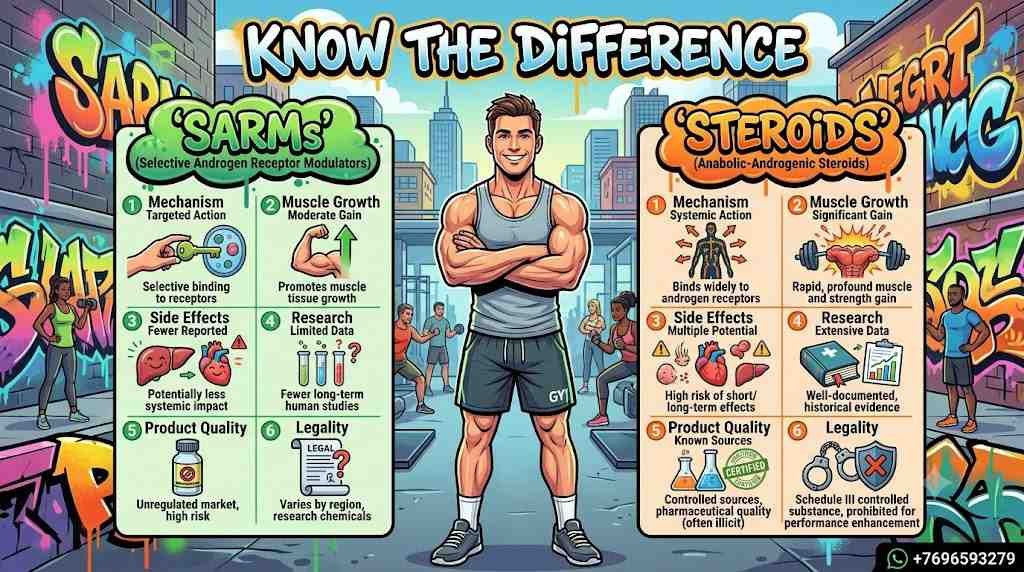
The SARMs vs Steroids debate is not simply about choosing between a “strong option” and a “safe option.”
SARMs were developed to provide more selective androgen receptor activity, while anabolic steroids are testosterone-related androgenic compounds with broader physiological effects.
SARMs may increase lean body mass in some clinical research, but their long-term safety and real-world benefits for recreational bodybuilding remain incompletely established.
Anabolic steroids have much more extensive historical research, but non-medical use can also carry significant risks involving hormones, cardiovascular health, liver function, fertility and other systems.
The biggest takeaway is simple: SARMs are not automatically safe just because they are marketed as an alternative to steroids.
If you’re researching either category, look beyond gym claims and product labels. Understand the pharmacology, the known risks, the quality of the evidence, and the laws that apply where you live. Bulking vs Cutting: Which Should You Do First?
Frequently Asked Questions About SARMs vs Steroids
Are SARMs steroids?
No. SARMs and anabolic steroids are different classes of compounds. SARMs are selective androgen receptor modulators designed to produce tissue-selective androgen receptor activity, while anabolic steroids are synthetic testosterone-related androgens.
Are SARMs safer than steroids?
It cannot be accurately stated as a blanket rule. SARMs were designed with tissue selectivity in mind, but evidence does not show that they eliminate serious risks. FDA warnings include liver injury and potential cardiovascular risks associated with SARM-containing products.
Can SARMs build muscle?
Some SARMs have increased lean body mass in clinical research. However, research outcomes do not necessarily translate directly to recreational bodybuilding, and long-term safety remains an important unanswered question.
Do SARMs suppress testosterone?
Some SARMs can affect the body’s reproductive hormone system. The degree of suppression varies by compound and exposure, but the idea that SARMs have no hormonal consequences is not supported by the available evidence.
Can SARMs damage the liver?
Yes. Liver injury has been reported in association with SARM use, and the FDA has specifically warned about serious liver injury from products containing SARMs.
Are SARMs legal?
The legal status depends on the country and compound. In the United States, FDA states that SARMs are unapproved drugs and cannot legally be marketed as dietary supplements.
Are SARMs tested in sports?
Many SARMs are prohibited under anti-doping rules. Competitive athletes should check the current rules of their governing body and the applicable prohibited-substance list.
Are steroids more powerful than SARMs?
There is no single answer because both categories contain many different compounds. Their effects vary substantially, and direct comparisons between individual compounds are not always available.
Why do people call SARMs a steroid alternative?
Because SARMs activate androgen receptors and can produce anabolic effects, they have been marketed as an alternative to traditional anabolic steroids. However, “alternative” does not mean risk-free or equivalent.
Are SARMs natural?
No. SARMs are synthetic compounds. They are not natural bodybuilding supplements simply because some are sold in capsule form.
Stay Connected With Gym Pundit
For more bodybuilding education, muscle-building information, training content, nutrition guides, SARMs research, steroid education and performance-enhancement topics, stay connected with Gym Pundit.
For questions and updates, you can contact us on WhatsApp at 7696593279.