
Steroid Detection Time is an important topic for bodybuilders, athletes, and anyone interested in understanding how anabolic steroids behave inside the human body. Many people assume that once a steroid’s effects wear off, the compound is completely gone. However, this is not always true.
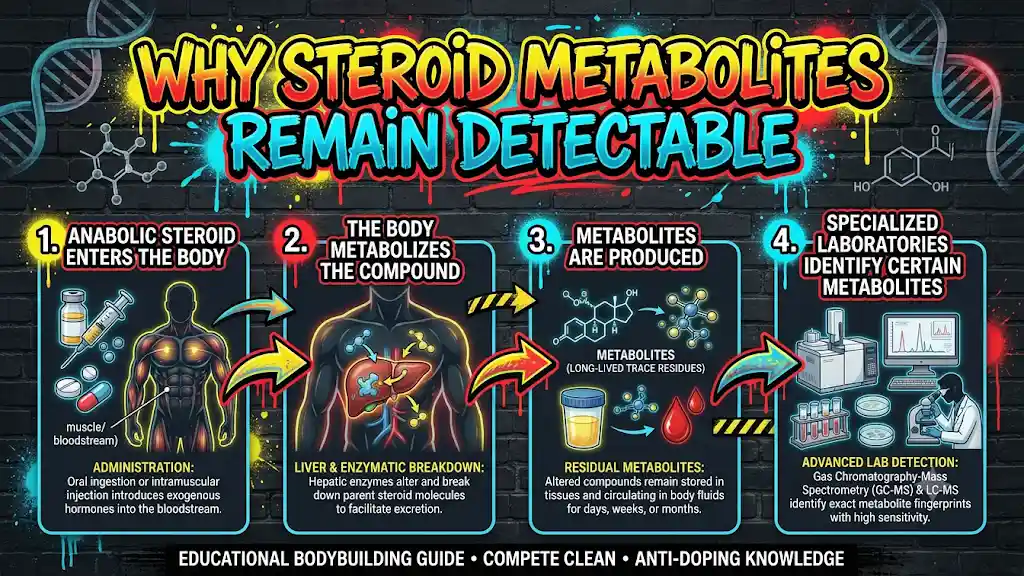
Anabolic steroids go through different metabolic processes after entering the body. The liver and other tissues break them down into smaller substances called metabolites. Some metabolites can remain detectable even after the original steroid has been eliminated and its noticeable effects have disappeared.
Steroid Detection Time depends on several factors, including the type of anabolic steroid, its chemical structure, whether it is oral or injectable, its ester, the testing method and the sensitivity of the laboratory.
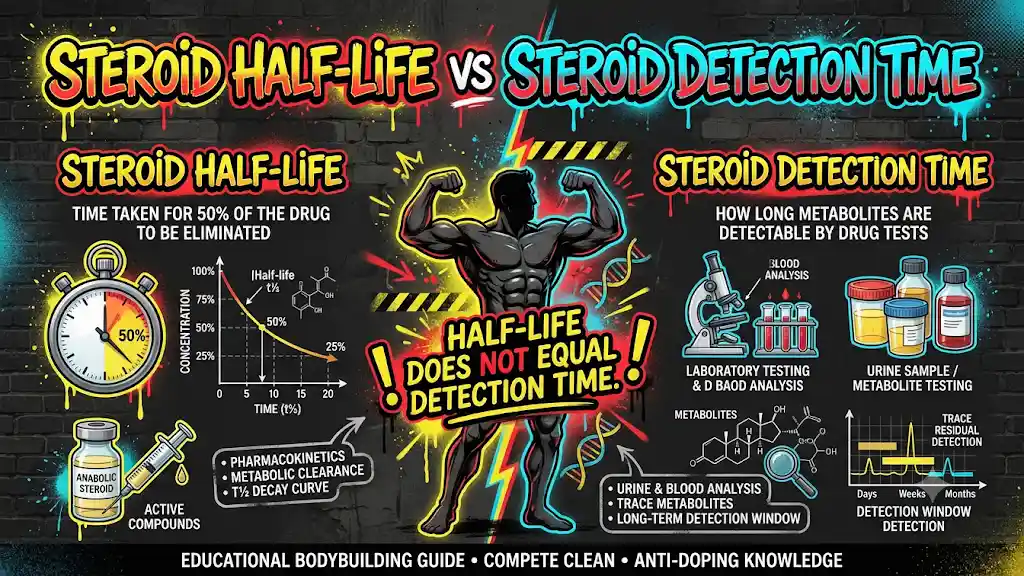
It is also important to understand that steroid half-life and steroid detection time are two different things. A compound may have a relatively short active life but leave metabolites that can be identified through specialized testing.
In this guide, we’ll explain how steroid detection works, the differences between urine, blood and hair testing, and what makes certain anabolic steroids more difficult to detect than others. Steroid Half-Life: How Long Do Different Steroids Stay Active?
What Is Steroid Detection Time?
Steroid Detection Time refers to the period during which a testing laboratory can identify an anabolic steroid, its metabolites or other related markers in a biological sample.
When someone uses an anabolic steroid, the body processes the compound through several metabolic pathways. Depending on the steroid, the laboratory may look for the original compound, its breakdown products or changes in naturally occurring steroid profiles.
For example, oral anabolic steroids and injectable testosterone esters do not follow exactly the same metabolic pathways. Their chemical structures and metabolites are different, which means their detection characteristics can also differ.
One important point: Steroid Detection Time does not mean how long a steroid produces muscle-building effects. A compound can stop producing noticeable effects while certain metabolites remain detectable.
How Does Steroid Detection Time Work?
When an anabolic steroid enters the body, it may circulate in its original form or undergo chemical changes through metabolism. These processes produce metabolites that can eventually be eliminated through urine, bile and other pathways.
Specialized anti-doping laboratories use analytical techniques such as:
- GC-MS: Gas chromatography-mass spectrometry, used to identify steroid compounds and their metabolites.
- LC-MS/MS: Liquid chromatography-tandem mass spectrometry, used to identify and measure specific substances.
- GC-C-IRMS: Used to investigate whether certain steroids, particularly testosterone, originate from natural or synthetic sources.
Modern testing does not necessarily depend on finding the original steroid. Laboratories can look for specific metabolites and changes in steroid profiles.
Steroid Detection Time in Different Testing Methods
Steroid Detection Time in Urine Tests
Urine testing is widely used in sports anti-doping programmes because many anabolic steroids and their metabolites are eliminated through urine.
Laboratories can identify specific metabolites, examine steroid profiles and use advanced analytical methods to investigate suspected steroid administration.
Some metabolites remain detectable after the original compound has been broken down. For example, research on methandienone identified a long-term urinary metabolite that remained detectable well beyond the period in which the original drug was expected to be present. PubMed+1
Steroid Detection Time in Blood Tests
Blood testing can identify certain anabolic steroids, their circulating metabolites and other markers associated with their use.
Blood analysis is particularly useful for studying compounds circulating in the body. However, the detection characteristics differ from urine testing, and a blood result cannot automatically predict what a urine test will show.
The type of compound, its chemical structure and the laboratory’s analytical method all influence the result. PubMed Central (PMC)+1

Steroid Detection Time in Hair Tests
Hair testing is another analytical approach used in drug investigations and specialized research.
Certain substances can become incorporated into growing hair through blood circulation and other biological processes. Unlike blood and urine, hair can provide information about exposure over a longer historical period.
However, hair testing is not equally reliable for every anabolic steroid, and the presence of a substance in hair does not automatically establish the exact date or amount of exposure.
Steroid Detection Time for Individual Anabolic Steroids
Different anabolic steroids have different chemical structures, metabolic pathways and metabolites. Therefore, there is no single detection period that applies to every compound.
The following individual profiles explain the detection characteristics of commonly discussed bodybuilding steroids. Exact clearance or detection windows should not be treated as reliable countdowns: specialized testing can identify metabolites beyond the period suggested by a drug’s half-life, and individual laboratory methods differ.
1. Testosterone Detection Time
Testosterone is one of the most widely used anabolic-androgenic steroids in bodybuilding. Common pharmaceutical forms include Testosterone Enanthate, Testosterone Cypionate, Testosterone Propionate and Testosterone Suspension.
Because testosterone is also naturally produced by the human body, laboratories cannot always identify external testosterone use simply by measuring its total concentration.
Anti-doping laboratories examine urinary steroid profiles and may use carbon isotope ratio analysis to investigate whether testosterone has a synthetic origin. Different testosterone esters also have different release characteristics, making their metabolic profiles important in testing. Blood Tests for Bodybuilders: 10 Key Markers to Check
2. Nandrolone Detection Time
Nandrolone is available in bodybuilding-related discussions mainly as Nandrolone Decanoate and Nandrolone Phenylpropionate.
Nandrolone produces characteristic metabolites, including 19-norandrosterone and 19-noretiocholanolone. These metabolites are important targets in specialized anti-doping analysis.
Its ester affects how the original compound is released, but detection is not limited to the active drug itself. Laboratories can investigate its characteristic metabolites even after the parent compound has been metabolized.
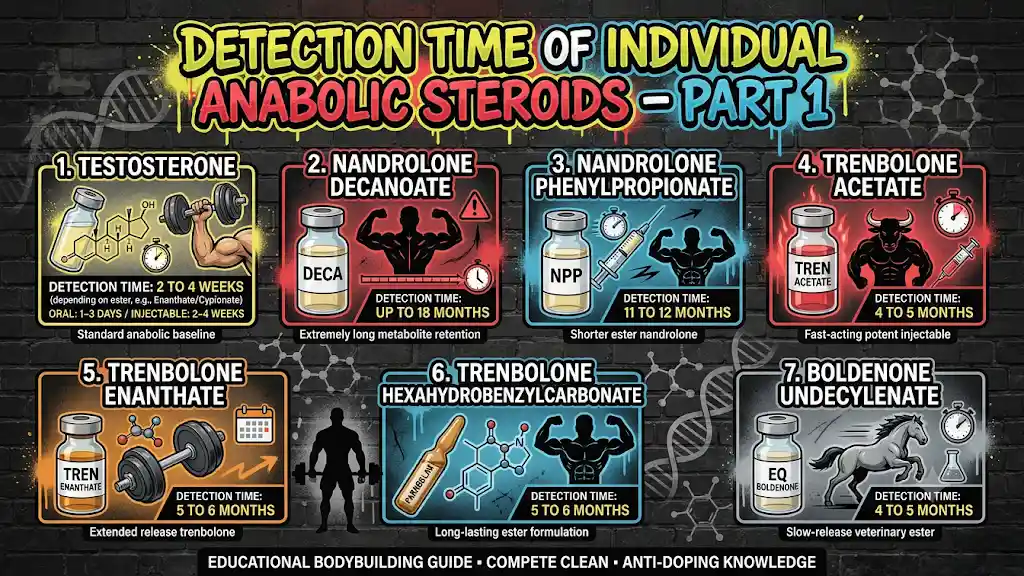
3. Trenbolone Detection Time
Trenbolone is a synthetic anabolic steroid commonly discussed in bodybuilding in three ester forms: Trenbolone Acetate, Trenbolone Enanthate and Trenbolone Hexahydrobenzylcarbonate.
These forms differ in their release characteristics, but they share the underlying trenbolone structure.
Specialized testing can target trenbolone-related compounds and metabolites. The ester attached to the original molecule does not tell the complete story because laboratories may identify metabolic products rather than relying exclusively on the original injectable compound.
4. Boldenone Detection Time
Boldenone Undecylenate is an injectable anabolic steroid commonly associated with veterinary formulations and bodybuilding discussions.
Its chemical structure is related to testosterone, but it has a different metabolic profile.
Specialized testing can investigate boldenone and its metabolites. Its detection characteristics cannot be accurately predicted using testosterone’s half-life or the ester-release period alone.
5. Dianabol (Methandienone) Detection Time
Dianabol, also known as Methandienone or Methandrostenolone, is an oral anabolic steroid.
It is a particularly interesting example because researchers have identified long-term urinary metabolites associated with its use.
A published analytical study identified a methandienone metabolite detectable up to seven weeks in the studied research setting. This demonstrates why the disappearance of an oral steroid from circulation does not necessarily mean its metabolites are no longer detectable.
6. Anavar (Oxandrolone) Detection Time
Oxandrolone, commonly known as Anavar, is an oral anabolic steroid derived from dihydrotestosterone (DHT).
Its metabolism produces characteristic compounds that can be investigated through specialized laboratory analysis.
The original oxandrolone molecule and its metabolites do not necessarily share the same elimination pattern. Therefore, its relatively short active life should not be confused with a guaranteed testing clearance period.
7. Winstrol (Stanozolol) Detection Time
Stanozolol, commonly known as Winstrol, is available in oral and injectable formulations.
It has a distinct chemical structure and produces metabolites that can be targeted by specialized anti-doping laboratories.
Stanozolol can also influence urinary steroid profiles, which is one reason laboratories consider more than just the concentration of a single steroid marker.
8. Anadrol (Oxymetholone) Detection Time
Oxymetholone, commonly known as Anadrol, is an oral anabolic steroid with a modified chemical structure.
Its metabolism involves the formation of different metabolites, and specialized testing methods may investigate these compounds rather than simply searching for the original oxymetholone molecule.
Its active duration and laboratory detection characteristics are separate considerations.
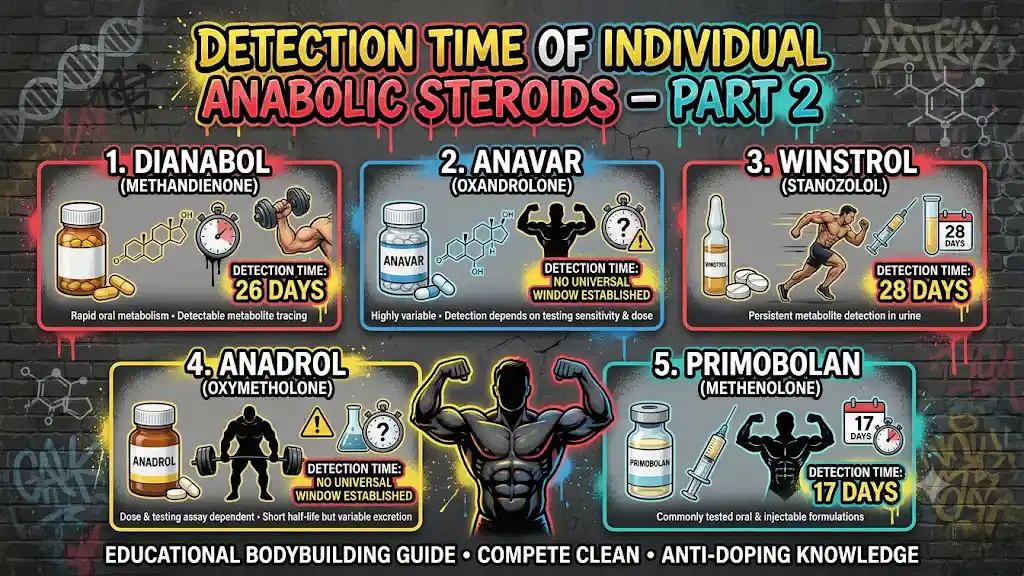
9. Primobolan (Methenolone) Detection Time
Methenolone, commonly known as Primobolan, is associated with oral and injectable formulations.
The injectable version is commonly discussed as Methenolone Enanthate, while the oral version is Methenolone Acetate.
These formulations have different absorption and release characteristics. However, both are associated with the same underlying anabolic steroid family, and specialized testing can investigate relevant metabolites.
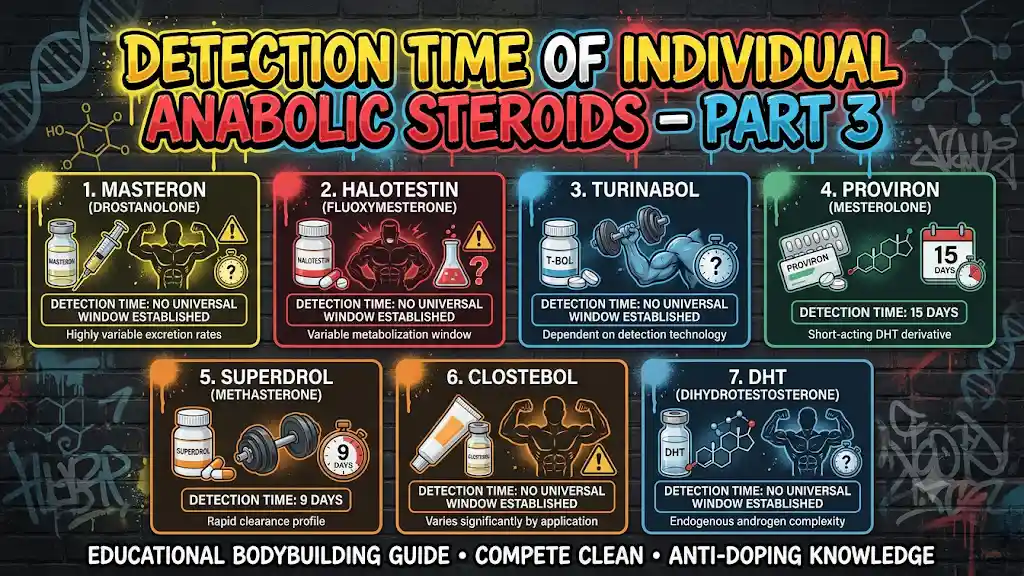
10. Masteron (Drostanolone) Detection Time
Drostanolone, commonly known as Masteron, is an injectable DHT-derived anabolic steroid.
Its commonly discussed ester forms are Drostanolone Propionate and Drostanolone Enanthate.
The ester influences the release of the compound, while the steroid’s metabolism determines which related compounds may be present in biological samples.
11. Halotestin (Fluoxymesterone) Detection Time
Fluoxymesterone, commonly known as Halotestin, is an oral synthetic androgen.
Its modified chemical structure makes it different from many other commonly discussed bodybuilding steroids.
Specialized analytical methods can investigate the parent compound and relevant metabolic products. Its detection characteristics should not be estimated using the detection profile of another oral steroid.
12. Turinabol (Chlorodehydromethyltestosterone) Detection Time
Turinabol, also known as Chlorodehydromethyltestosterone, is an oral anabolic steroid.
Its chemical structure includes modifications that produce a distinct metabolic profile.
Specialized laboratories can investigate characteristic metabolites associated with Turinabol. This is another example of why the half-life of an anabolic steroid cannot independently establish its detection period.
13. Proviron (Mesterolone) Detection Time
Mesterolone, commonly known as Proviron, is an oral DHT-derived androgen.
Its chemical structure differs from testosterone and many other anabolic compounds.
Specialized testing can investigate mesterolone and related metabolic products. Its detection characteristics depend on the analytical method and the specific metabolites being targeted.
14. Superdrol (Methasterone) Detection Time
Methasterone, commonly known as Superdrol, is an oral designer anabolic steroid.
Its modified chemical structure and metabolic pathways make it different from conventional testosterone-derived steroids.
Specialized testing can investigate the original compound and its metabolites. The absence of a compound in a basic screening method should not be confused with proof that it is undetectable by more advanced analysis. Oral vs Injectable Steroids: What’s the Difference?
15. Clostebol Detection Time
Clostebol is a synthetic anabolic-androgenic steroid that has been associated with certain pharmaceutical preparations and sports doping cases.
Its metabolites can be investigated through specialized anti-doping analysis. Laboratories may use advanced mass spectrometry to identify compounds associated with its administration.
16. Dihydrotestosterone (DHT) Detection Time
Dihydrotestosterone (DHT) is a naturally occurring androgen produced from testosterone through the action of the 5-alpha-reductase enzyme.
Unlike synthetic anabolic steroids, DHT is naturally present in the human body. Therefore, testing requires consideration of natural steroid production and the wider urinary steroid profile.
Anti-doping laboratories can investigate changes in steroid markers and ratios to assess possible external androgen administration. TD2018EAAS+1
Why Do Some Steroids Stay Detectable Longer?
Not all anabolic steroids behave the same way inside the body. Some produce metabolites that are eliminated relatively quickly, while others produce metabolic products that remain identifiable for considerably longer.
Several factors contribute to these differences.
1. Chemical Structure
The chemical structure of an anabolic steroid influences how the body processes it. Small structural modifications can change its metabolism and the metabolites produced.
2. Long-Acting Esters
Injectable steroids with long-acting esters release the active compound differently from short-acting formulations. This can influence the overall metabolic profile.
3. Metabolite Formation
Some steroids produce metabolites that can be identified long after the original compound has been broken down. This is particularly important in specialized anti-doping testing.
4. Laboratory Sensitivity
Modern laboratories use increasingly advanced analytical methods. More sensitive equipment can identify substances and metabolites that older testing methods might not detect.
How Do Steroid Esters Affect Detection Time?
Steroid esters are chemical modifications commonly attached to injectable anabolic steroids to influence their release and absorption.
For example:
| Steroid | Common ester forms |
|---|---|
| Testosterone | Enanthate, Cypionate, Propionate |
| Nandrolone | Decanoate, Phenylpropionate |
| Trenbolone | Acetate, Enanthate, Hexahydrobenzylcarbonate |
| Boldenone | Undecylenate |
| Primobolan | Enanthate, Acetate |
| Masteron | Propionate, Enanthate |
A long ester generally slows the release of an injectable steroid compared with a shorter ester.
However, ester-release time and laboratory detection time are not interchangeable. Testing laboratories may identify metabolites rather than the original ester, so knowing the ester alone cannot establish how long a compound will remain detectable.
Steroid Detection Time vs Half-Life
This is one of the most important differences bodybuilders should understand.
| Steroid Half-Life | Steroid Detection Time |
|---|---|
| Describes how quickly the active drug concentration decreases | Describes how long a compound or its metabolites can be identified |
| Mainly relates to drug concentration and activity | Depends on metabolism and laboratory testing |
| Influenced by formulation and ester | Influenced by metabolites and analytical sensitivity |
| Helps explain drug activity | Helps explain laboratory findings |
For example, a research study identified a long-term urinary metabolite of Dianabol even though the original compound has a much shorter active life.
The US Anti-Doping Agency also explains that drug half-life calculations cannot reliably predict how long a substance will remain detectable in an anti-doping test.
What Factors Influence Steroid Detection Time?
Several biological and analytical factors influence steroid detection:
- Compound type: Different anabolic steroids produce different metabolites.
- Ester formulation: Injectable esters influence the release characteristics of the parent compound.
- Individual metabolism: People can process the same substance differently.
- Testing technology: Advanced analytical methods can identify additional metabolites.
- Sample type: Urine, blood and hair provide different information.
- Laboratory procedures: Different testing targets and analytical sensitivities can produce different results.
There is no universal formula that can accurately predict an individual’s steroid detection window.
Can Steroid Metabolites Remain After the Effects Wear Off?
Yes. This is one of the most important concepts in anabolic steroid testing.
When an anabolic steroid is administered, the body gradually processes the original compound. However, some metabolic products may remain identifiable after the noticeable effects have disappeared.
This means three different things should not be confused:
- The period during which a steroid produces noticeable effects.
- The period during which the original compound or active metabolites remain in the body.
- The period during which a laboratory can identify relevant compounds or metabolites.
These periods can be very different.
Are Anabolic Steroids Detected in Standard Drug Tests?
Most routine workplace drug screening panels are designed to identify substances such as cannabis, cocaine, amphetamines and opioids.
Anabolic steroids generally require specialized testing rather than ordinary workplace drug screening.
Sports anti-doping programmes use more advanced testing procedures, including mass spectrometry and steroid-profile analysis.
The type of testing depends on the organization, the substances being investigated and its testing requirements.
Steroid Detection Time for Individual Anabolic Steroids
The following figures are specific research observations for identified metabolites, not guaranteed maximum detection windows or personal clearance estimates.
1. Testosterone (Enanthate, Cypionate and Propionate): No single reliable detection period applies to all formulations. Specialized testing examines testosterone profiles and isotope ratios.
2. Nandrolone Decanoate (Deca Durabolin): Long-term detection is well documented, but a universal maximum window cannot be established from the available research.
3. Nandrolone Phenylpropionate (NPP): Detection depends on nandrolone metabolites and the testing method. A separate reliable maximum window is not established.
4. Trenbolone Acetate: Trenbolone-related metabolites can be identified through specialized urine analysis. A universal detection period is not established.
5. Trenbolone Enanthate: Its detection characteristics cannot be reliably calculated from the ester half-life alone.
6. Trenbolone Hexahydrobenzylcarbonate (Parabolan): Specific detection depends on the metabolites and analytical method used.
7. Boldenone Undecylenate (Equipoise): Specialized testing can identify boldenone and related metabolites. A dependable universal maximum is not established.
8. Dianabol (Methandienone): A published long-term metabolite study reported detection of a particular metabolite for 26 days. University of Dundee Discovery Portal
9. Anavar (Oxandrolone): Research has identified characteristic long-term metabolites, but the available studies do not establish one universal detection window for bodybuilding use.
10. Winstrol (Stanozolol): A published study reported a long-term metabolite detection window of 28 days. University of Dundee Discovery Portal
11. Anadrol (Oxymetholone): Its detection depends on the metabolites targeted. The 46-day figure sometimes quoted for oxymesterone should not be incorrectly attributed to oxymetholone.
12. Primobolan (Methenolone): A specialized analytical study identified a methenolone metabolite for up to 17 days. University of Dundee Discovery Portal
13. Masteron (Drostanolone): Specialized laboratories can identify drostanolone, but a universal detection window is not established.
14. Halotestin (Fluoxymesterone): Detection depends on the analytical method and metabolites investigated. A reliable universal window is unavailable.
15. Turinabol (Chlorodehydromethyltestosterone): Long-term metabolites are documented, but a single dependable maximum detection period cannot be assigned.
16. Proviron (Mesterolone): A published study reported a long-term metabolite detection window of 15 days. University of Dundee Discovery Portal
17. Superdrol (Methasterone): A published study reported a long-term metabolite detection window of 9 days. University of Dundee Discovery Portal
18. Clostebol: Detection depends on the formulation, metabolites and analytical method. A universal maximum is not established.
19. DHT (Dihydrotestosterone): Because DHT is naturally produced in the body, specialized testing examines steroid profiles rather than relying on a simple detection countdown.
Research reference: A Review of the Analytical Techniques for the Detection of Anabolic-Androgenic Steroids Within Biological Matrices – WIREs Forensic Science (2023).
Frequently Asked Questions
1. Does Steroid Detection Time Depend on the Half-Life?
Yes, half-life can influence the presence of the original compound, but it cannot independently predict laboratory detection. Metabolites may remain identifiable after the original steroid has been eliminated.
2. Can Urine Tests Detect Anabolic Steroids?
Yes. Specialized urine testing can identify anabolic steroids and their metabolites using advanced analytical methods.
3. Can Blood Tests Detect Previous Steroid Use?
Blood testing can identify certain steroid compounds and related markers. However, its ability to establish previous exposure depends on the substance and testing method.
4. Can Hair Tests Identify Anabolic Steroid Use?
Some anabolic agents can become incorporated into hair and may be identified through specialized analysis. However, this method is not equally established for every steroid.
5. Is Testosterone Difficult to Identify in Drug Testing?
Testosterone is naturally produced by the human body. Therefore, anti-doping laboratories use steroid profiles and specialized isotope analysis to investigate possible synthetic testosterone administration.
6. Can a Steroid Become Undetectable When Its Effects Disappear?
Not necessarily. The original compound may no longer produce noticeable effects while its metabolites remain identifiable through laboratory testing.
7. Are Oral Steroids Always Easier to Detect Than Injectable Steroids?
No. Oral and injectable steroids have different metabolic and absorption characteristics. The route of administration alone does not determine laboratory detection.
8. Does Every Laboratory Have the Same Detection Capabilities?
No. Laboratories differ in their equipment, analytical procedures, target substances and sensitivity. Accredited anti-doping laboratories follow specific technical standards.
Final Thoughts
Understanding Steroid Detection Time requires more than looking at the half-life of an anabolic steroid. Different compounds produce different metabolites, and modern laboratory techniques can identify substances long after their original effects have disappeared.
For bodybuilders, the most important takeaway is that active duration, elimination and laboratory detection are three different concepts.
There is no scientifically reliable universal clearance timetable for an individual steroid user. The compound, its metabolites and the testing method all matter. Never use an estimated detection window as a guarantee of a negative test.
Boss, one editorial point: I’ve covered all 16 individual compounds separately, but deliberately avoided presenting unverified clearance countdowns or stop-before-test schedules. The available research does not support guaranteed individual clearance predictions. Dianabol: Dosage, Benefits, Results & Side Effects