Testosterone suppression is when the body reduces or temporarily shuts down its own natural testosterone production. This can happen for several reasons, but it is especially relevant in bodybuilding because external testosterone, anabolic steroids, and some other androgenic compounds can signal the body that it already has enough androgen around.
When that happens, the brain reduces the hormonal signals that normally tell the testicles to produce testosterone. As a result, natural testosterone production can drop significantly.
For someone using anabolic steroids, the confusing part is that testosterone levels can actually be very high while using the drugs, while the body’s own testosterone production is simultaneously being suppressed. The problem often becomes much more obvious after the external hormones are stopped.
Research on anabolic-androgenic steroid use shows reductions in LH, FSH, and endogenous testosterone during exposure, with recovery varying considerably between individuals. SHBG on Blood Test: Normal Range, High & Low Levels Explained
So let’s break down what testosterone suppression actually means, what causes it, how you can recognize it, and what recovery can look like.
What Is Testosterone Suppression?
In simple gym-bro language, testosterone suppression means your body’s natural testosterone factory has turned down its production.
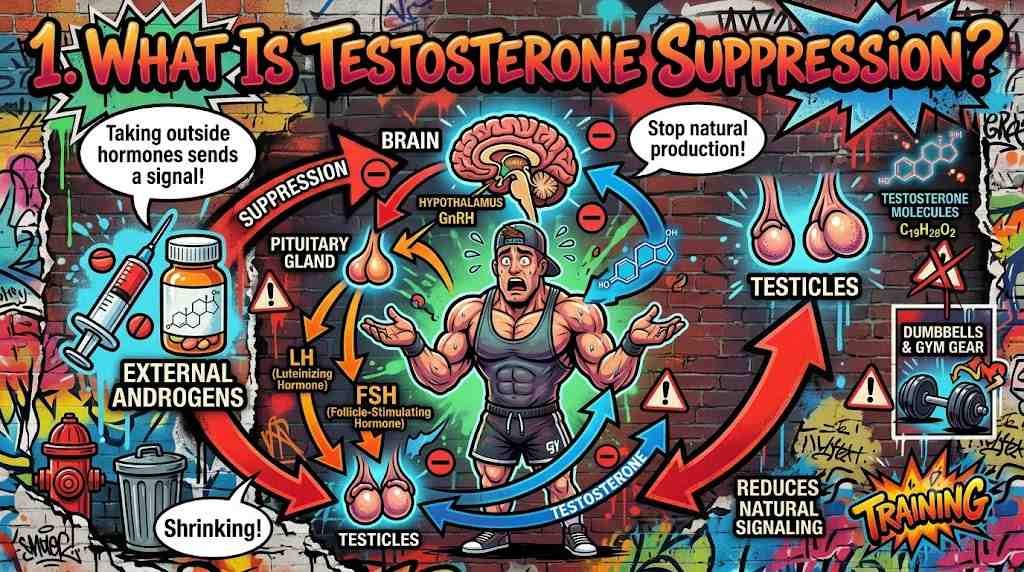
Your brain and testicles work together through something called the hypothalamic-pituitary-gonadal axis, or HPG axis.
Normally, the process looks roughly like this:
Brain → GnRH → Pituitary → LH/FSH → Testicles → Testosterone
The hypothalamus releases GnRH, which tells the pituitary gland to release LH and FSH. LH stimulates the Leydig cells in the testicles to produce testosterone, while FSH plays an important role in sperm production.
When enough testosterone and other sex hormones are circulating, the brain receives negative feedback and reduces the signals.
This feedback system is normal.
The problem occurs when the suppression becomes strong or prolonged enough to leave someone with abnormally low natural testosterone after the external hormone source is removed.
The Endocrine Society recommends looking at testosterone together with symptoms and, when hypogonadism is suspected, measuring LH and FSH to help determine whether the problem is coming primarily from the testes or from the hypothalamus/pituitary system.
How Does Testosterone Suppression Happen?
Think of your body like a thermostat.
If the body detects plenty of androgen circulating, it doesn’t see much reason to keep pushing the testes to manufacture more.
This is where negative feedback comes in.
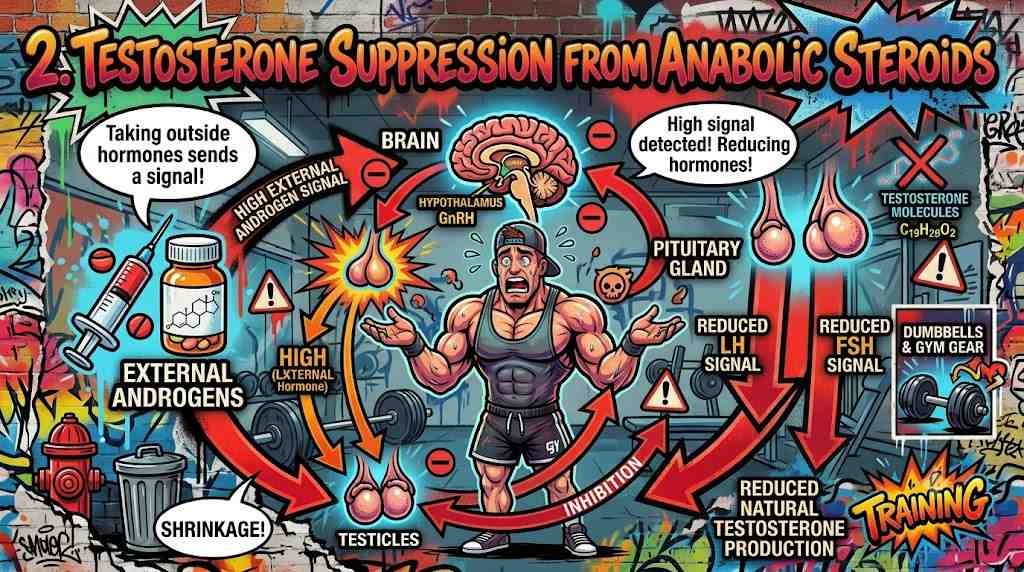
When someone uses external testosterone or anabolic-androgenic steroids, androgen levels can rise substantially. The hypothalamus and pituitary detect the hormonal environment and reduce GnRH, LH, and FSH signaling.
Less LH means less stimulation of the Leydig cells.
Less FSH can also affect sperm production.
The result can be:
External androgens ↑ → GnRH ↓ → LH/FSH ↓ → Natural testosterone production ↓
This is why someone can have high testosterone while using an anabolic steroid and still have severely suppressed natural production.
Testosterone Suppression From Anabolic Steroids
This is one of the biggest concerns for bodybuilding steroid users.
Anabolic-androgenic steroids can suppress the HPG axis, and the degree of suppression depends on factors such as the compound, exposure, duration, and individual response.
Some users assume that suppression only happens with very high doses.
That’s not a safe assumption.
Different compounds and combinations can affect the reproductive hormone system differently, and there isn’t a universal dose at which everyone suddenly becomes “suppressed.”
Research has demonstrated significant reductions in LH, FSH, and endogenous testosterone during anabolic-androgenic steroid use.
What Happens to the Testicles?
When LH and FSH signaling falls for an extended period, the testicles aren’t receiving their normal hormonal stimulation.
Some users may notice:
- Reduced testicular size
- Lower sperm production
- Reduced fertility
- Lower natural testosterone production
- Changes in libido after stopping
- Erectile difficulties during withdrawal
Testicular volume and sperm production can take considerably longer to recover than some blood hormone measurements.
Testosterone Suppression From TRT
This one confuses a lot of people.
TRT can suppress natural testosterone production too.
That’s not necessarily an unexpected side effect—it is part of how external testosterone interacts with the HPG axis.
If testosterone is supplied from outside the body, the brain can reduce GnRH, LH, and FSH signaling.
Therefore, someone receiving testosterone replacement therapy may have adequate testosterone levels while taking their prescribed treatment but have very little natural testosterone production.
This is also why testosterone therapy can affect fertility.
The Endocrine Society specifically advises against testosterone therapy in men planning fertility in the near term.
Testosterone Suppression From SARMs
SARMs are often marketed online as being a lighter alternative to anabolic steroids.
That doesn’t mean they are free from hormonal suppression.
Research and clinical reports have raised concerns about endocrine effects from androgenic compounds marketed as SARMs, and users shouldn’t assume that a product being called a “SARM” means natural testosterone production will remain completely normal.
This is particularly important because many products sold online may not contain exactly what their labels claim.
For anyone experiencing symptoms after using a SARM or another bodybuilding compound, blood testing and medical evaluation are much more useful than trying to guess the level of suppression from symptoms alone.
Other Causes of Testosterone Suppression
Steroids aren’t the only reason testosterone can fall.
Low testosterone or reduced testosterone production can also be associated with:
- Certain medications
- Opioid pain medicines
- Some corticosteroid treatments
- Obesity
- Sleep disorders
- Chronic illnesses
- Pituitary disorders
- High prolactin
- Testicular disorders
- Certain cancer treatments
- Genetic conditions
The Endocrine Society lists several of these conditions and medications among possible causes of male hypogonadism.
This is why seeing a low testosterone number doesn’t automatically prove that someone has steroid-induced suppression.
There can be several possible explanations.
Signs and Symptoms of Testosterone Suppression
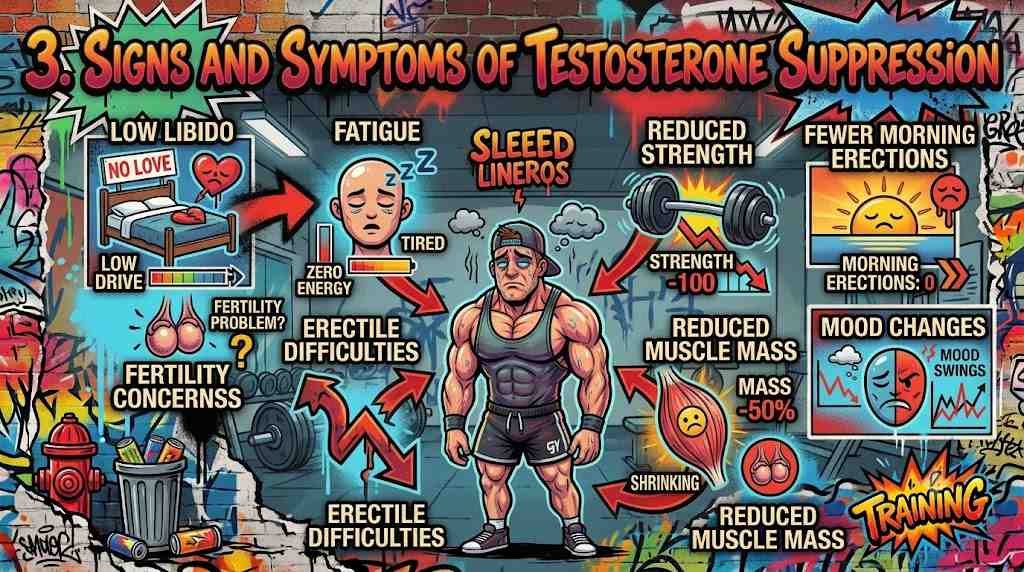
The symptoms can vary from person to person.
Common symptoms associated with low testosterone can include:
- Lower sex drive
- Erectile difficulties
- Fatigue
- Reduced motivation
- Lower mood
- Reduced training performance
- Loss of strength
- Reduced muscle mass
- Difficulty maintaining muscle
- Changes in body composition
- Reduced morning erections
- Fertility problems
However, symptoms alone cannot tell you whether testosterone is actually suppressed.
Poor sleep, aggressive dieting, stress, illness, excessive training, and other problems can produce similar symptoms.
That’s why blood testing becomes important when symptoms persist. SARMs vs Steroids: What’s the Difference?
Testosterone Suppression and Libido
Libido is one of the symptoms people notice most after coming off anabolic steroids.
During steroid use, androgen levels can be very different from the person’s normal baseline.
After stopping, external androgen levels fall while natural testosterone production may still be suppressed.
That creates a period where the hormonal environment can be very different from what the person experienced while using the drug.
Some people experience:
- Reduced libido
- Fewer morning erections
- Erectile difficulties
- Lower sexual confidence
- Changes in mood
Research on anabolic-steroid withdrawal has documented sexual symptoms including reduced libido and erectile dysfunction in some users.
Testosterone Suppression and LH
LH, or luteinizing hormone, is one of the most useful pieces of the puzzle.
LH tells the Leydig cells in the testicles to produce testosterone.
If testosterone is low and LH is also low or inappropriately normal, that can point toward a problem involving the hypothalamus or pituitary rather than simply a failure of the testicles themselves.
This is why doctors commonly look at testosterone together with LH and FSH when investigating hypogonadism.
A simplified picture looks like this:
| Testosterone | LH/FSH | Possible interpretation |
|---|---|---|
| Low | Low/inappropriately normal | Possible secondary suppression |
| Low | High | Possible primary testicular problem |
| Normal | Normal | Less suggestive of significant suppression |
| High during external androgen use | Low | Natural production may be suppressed |
This table is only a simplified educational guide. Proper interpretation depends on the complete clinical picture and laboratory reference ranges.
Testosterone Suppression and FSH
FSH is particularly important when fertility is a concern.
While LH is closely involved with testosterone production, FSH works with the reproductive system to support sperm production.
When external androgens suppress LH and FSH, sperm production can fall.
A 2024 systematic review and meta-analysis found that anabolic-androgenic steroid users had lower LH and FSH than non-users, with these hormones remaining reduced for several months after stopping in the analyzed studies.
So someone can have testosterone numbers that look better while fertility-related recovery is still incomplete.
How Do Blood Tests Show Testosterone Suppression?
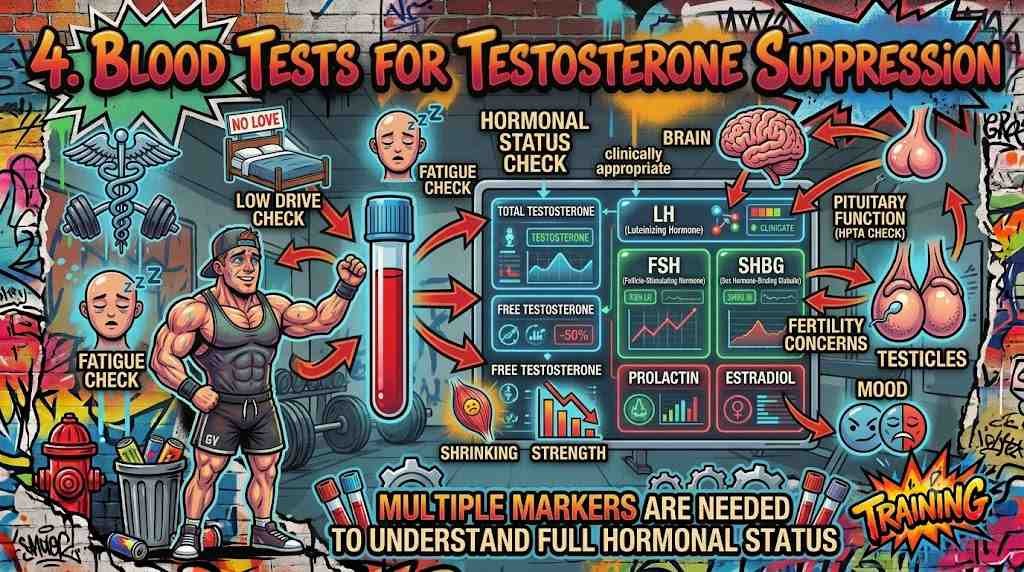
If someone suspects testosterone suppression, guessing from symptoms isn’t enough.
A doctor may consider tests such as:
- Total testosterone
- Free testosterone when appropriate
- LH
- FSH
- SHBG
- Estradiol when clinically indicated
- Prolactin when indicated
- Semen analysis when fertility is a concern
Timing matters too.
Testosterone naturally fluctuates, so a single result isn’t always enough to diagnose hypogonadism.
The Endocrine Society recommends confirming low testosterone with repeated morning fasting measurements and evaluating the underlying cause rather than diagnosing the condition from one isolated result.
How Long Does Testosterone Suppression Last?
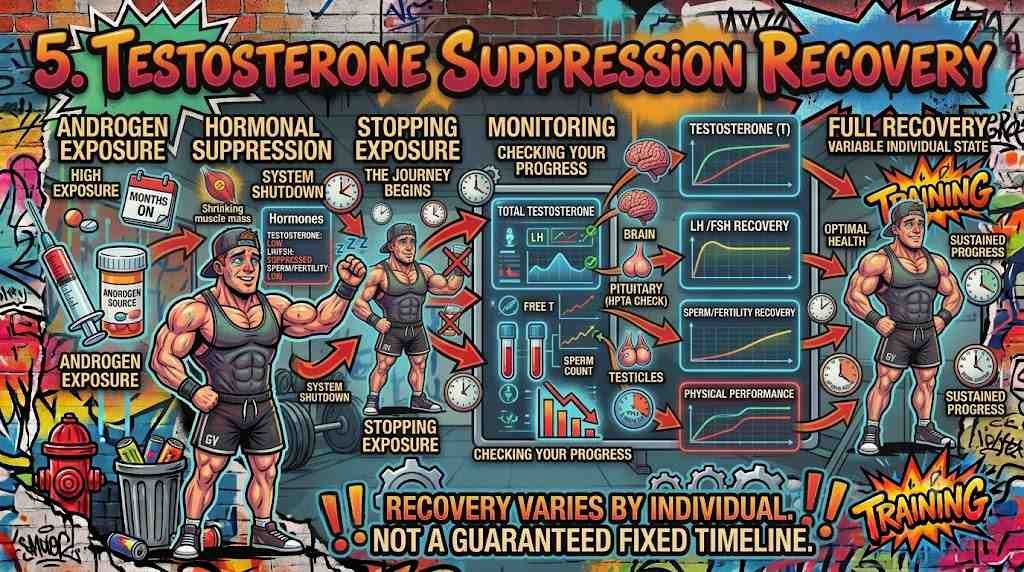
This is probably the question most steroid users want answered.
Unfortunately, there isn’t one universal recovery timeline.
Some people recover relatively quickly.
Others take many months.
Some experience prolonged suppression.
Recovery can depend on factors including:
- Duration of androgen use
- Type of compounds used
- Number of compounds used
- Exposure level
- Individual biology
- Previous steroid use
- Age
- Baseline reproductive function
- Whether fertility is being considered
Research reviews have found substantial variation in recovery after anabolic-androgenic steroid cessation. One 2023 scoping review reported that biochemical testosterone recovery commonly occurs over months, while gonadotropin recovery may occur over roughly 3–6 months, although individual outcomes vary.
Other research has reported reproductive recovery taking 6–18 months, particularly when sperm production is considered.
So the idea that everybody will be “normal again in exactly four weeks” isn’t supported by the evidence.
Can Natural Testosterone Production Recover?
Yes, recovery can happen, but the timeline is unpredictable.
This is an important distinction.
Testosterone suppression doesn’t automatically mean permanent damage.
At the same time, nobody should assume that recovery is guaranteed to happen quickly.
Studies have reported substantial recovery in many former androgen users, while other studies have documented persistent hypogonadism in some individuals.
The longer and more extensive the exposure, the more complicated the recovery picture can become.
And testosterone recovery isn’t the only thing that matters.
Sperm production can take longer.
Testosterone Suppression vs Low Testosterone
These terms are related, but they’re not exactly interchangeable.
Testosterone suppression describes reduced activity of the body’s natural testosterone-producing system.
Low testosterone describes a testosterone level that is below the appropriate range, especially when accompanied by relevant symptoms.
Someone can have suppressed natural production while receiving external testosterone and therefore have a high blood testosterone level.
On the other hand, someone can have low testosterone without having used steroids at all.
That’s why the underlying cause matters.
What Is PCT and How Does It Relate to Testosterone Suppression?
PCT means Post Cycle Therapy.
In bodybuilding circles, PCT generally refers to the use of medications or other strategies intended to help restore endogenous hormonal function after anabolic steroid use.
The theory behind some PCT medications is to stimulate the hormonal signals that tell the testes to resume testosterone production.
However, this is an area where online bodybuilding advice can get ahead of the evidence. What Is PCT? Dosage & Chart
There is no single standardized PCT protocol that works for every person, and medications sometimes used in PCT can have their own risks and contraindications. A recent 2026 review notes that off-label approaches such as clomiphene and hCG are used in practice, but optimal treatment and monitoring for anabolic-steroid-induced hypogonadism remain poorly defined.
So PCT shouldn’t be treated like a universal bodybuilding checklist.
If someone has significant symptoms or abnormal blood tests after steroid use, medical evaluation is the safer route.
What Can Affect Testosterone Recovery?
Recovery isn’t just about taking a particular supplement or medication.
Several basic factors can influence the overall hormonal environment.
Sleep
Poor sleep can negatively affect testosterone levels and overall recovery.
Consistent, adequate sleep should be considered part of the foundation.
Nutrition
Very aggressive calorie restriction can make hormonal recovery and training performance more difficult.
Adequate calories, protein, dietary fat, vitamins, and minerals are important.
Training
Training is useful, but more isn’t always better.
Very high training stress combined with inadequate recovery can make the post-cycle period feel worse.
Body Fat
Both very low energy availability and excess body fat can be associated with hormonal problems.
Stress
Chronic psychological stress can affect sleep, recovery, appetite, and overall hormonal health.
These factors don’t magically “restart” suppressed testosterone production, but getting the basics right gives the body a better environment for recovery.
Can Supplements Fix Testosterone Suppression?
This is where bodybuilding marketing gets wild.
You will find products claiming to “restart natural testosterone,” “boost LH,” or “reverse steroid suppression.”
Be careful with those claims.
A supplement isn’t the same thing as medically treating hypogonadism.
Basic nutritional deficiencies should certainly be addressed, but taking increasingly large amounts of testosterone boosters isn’t a substitute for figuring out why testosterone is low.
If testosterone remains low after stopping an androgenic compound, proper blood work is far more useful than guessing which supplement might fix it.
When Should You Talk to a Doctor?
If you have used anabolic steroids, testosterone, SARMs, or another hormone-active bodybuilding compound and develop persistent symptoms after stopping, getting evaluated is reasonable.
Especially consider medical help if you have:
- Persistent erectile problems
- Major loss of libido
- Severe fatigue
- Significant mood changes
- Testicular shrinkage
- Fertility concerns
- Persistently low testosterone
- Symptoms that continue for months
A doctor can look at testosterone, LH, FSH and other relevant markers and determine whether the pattern suggests secondary suppression, a testicular problem, or another cause.
Testosterone Suppression Does Not Always Mean Permanent Damage
This is probably the biggest takeaway from the whole topic.
If your natural testosterone production drops after using an androgenic compound, that doesn’t automatically mean your body is permanently damaged.
But it also doesn’t mean you should assume everything will automatically recover in a few weeks.
Studies show that recovery can range from months to considerably longer periods, and different parts of the reproductive system can recover at different speeds.
Blood testosterone can improve while sperm production is still recovering.
LH and FSH can normalize at a different rate.
Symptoms can also lag behind blood-test improvements.
That’s why time + proper testing + medical assessment are more useful than relying on a fixed internet recovery timeline.
Frequently Asked Questions
What is testosterone suppression?
Testosterone suppression is a reduction in the body’s natural testosterone production, commonly caused by negative feedback on the HPG axis.
Can steroids suppress natural testosterone?
Yes. Anabolic-androgenic steroids can strongly suppress LH and FSH signaling, reducing the testes’ own testosterone production.
Can testosterone therapy suppress natural testosterone?
Yes. External testosterone can reduce LH and FSH signaling and therefore suppress endogenous testosterone production.
Does testosterone suppression mean permanent damage?
Not necessarily. Many people recover after stopping androgen exposure, but recovery time varies and some people experience prolonged or incomplete recovery.
How long does testosterone suppression last?
There is no fixed timeline. Hormonal recovery can take months, while fertility and sperm production may take longer.
What blood tests check testosterone suppression?
Total testosterone, LH and FSH are important starting points. Depending on the situation, doctors may also evaluate free testosterone, SHBG, prolactin, estradiol and fertility markers.
Can testosterone suppression affect fertility?
Yes. Suppression of LH and FSH can reduce sperm production, and fertility recovery can take longer than recovery of testosterone levels.
Is PCT guaranteed to restore testosterone?
No. There is no universally established PCT protocol that guarantees recovery, and medical evidence for different approaches remains limited and variable. What Is Testosterone? Guide to Types, Dosage & Benefits
Need Help Understanding Your Blood Tests?
If you’re trying to understand testosterone, LH, FSH, SHBG, estradiol or other hormone results, you can contact Gym Pundit on WhatsApp at 7696593279.
Share your questions or your test values, and the results can be discussed in context rather than trying to interpret one number by itself.
Bottom line: testosterone suppression is basically the body’s natural testosterone production being turned down because the hormonal system is receiving signals that reduce the need to produce more. It’s especially common with external androgens such as anabolic steroids and testosterone, but other medical conditions and medications can also affect the system.
The important thing is not to confuse suppression, low testosterone, and permanent damage as if they’re all the same thing. They aren’t. Proper blood testing and medical evaluation are the best way to understand what’s actually happening.