BPC-157 dosage is one of the first things people search for when they start researching this experimental peptide. Bodybuilders, athletes, and people interested in recovery often discuss BPC-157 in connection with muscles, tendons, joints, gut health, and general recovery. But there is an important point to understand before looking at any numbers: there is currently no established, approved human BPC-157 dosage that can be considered medically proven or universally safe.
That hasn’t stopped BPC-157 from becoming one of the most talked-about peptides in fitness and recovery circles. Online discussions commonly mention different amounts, routes of administration, and cycle lengths. The problem is that these protocols can vary considerably, and much of the enthusiasm around BPC-157 comes from experimental research and anecdotal reports rather than large, high-quality human clinical trials.
So, what does BPC-157 dosage actually look like in the protocols people discuss? How do oral and injectable approaches differ? How long is it commonly used? And what does the available research really tell us? Peptides for Muscle Growth: Which Ones Are Actually Studied?
Let’s break it down.
What Is BPC-157?
BPC-157 is a synthetic peptide consisting of 15 amino acids. Its name comes from Body Protection Compound, and it has attracted interest because researchers have investigated its potential effects on tissue repair, inflammation, the gastrointestinal system, and other biological processes.
In bodybuilding and athletic communities, BPC-157 is particularly associated with recovery. You’ll often see discussions involving tendons, ligaments, muscles, joints, and training-related injuries.
However, there is a big difference between research interest and proven medical effectiveness.
A large portion of the BPC-157 research has involved laboratory and animal models. Results from these studies can help researchers understand how a compound might work, but they don’t automatically establish that the same effects occur in humans.
That’s also why there isn’t a universally accepted BPC-157 dosage for people.
Why Is BPC-157 Dosage So Difficult to Establish?
With an approved medication, dosing is normally determined through a long process involving pharmacokinetic studies, clinical trials, safety testing, and regulatory review.
BPC-157 doesn’t have that same level of established human evidence.
This creates a problem for anyone searching for a simple answer such as:
“What is the correct BPC-157 dosage?”
There isn’t one scientifically established answer.
You’ll find websites, peptide vendors, forums, and fitness communities discussing different protocols. Some mention lower daily amounts, while others describe splitting the amount throughout the day. Some discuss subcutaneous injections, while others discuss oral or sublingual administration.
These should be viewed as experimental or anecdotal protocols rather than proven treatment recommendations.
BPC-157 Dosage Commonly Discussed Online
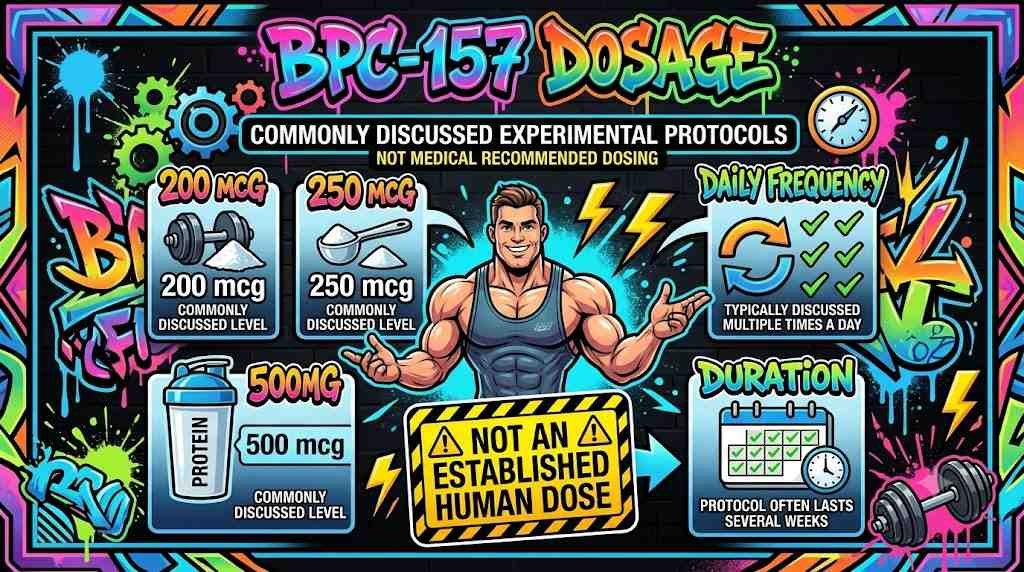
One of the ranges frequently mentioned in peptide and bodybuilding discussions is approximately 200–500 mcg per day.
Some online protocols describe taking the amount once daily, while others split it into two administrations.
However, this doesn’t mean that 200–500 mcg is an established therapeutic range. There isn’t enough high-quality human clinical evidence to say that this range is safe or effective for treating a particular injury or condition.
The numbers are best understood as commonly discussed experimental ranges.
Another thing to keep in mind is that online protocols sometimes recommend adjusting the amount according to body weight, goals, or the type of injury being discussed. These adjustments aren’t supported by a standardized medical dosing guideline.
Quick BPC-157 Dosage Reference
| Route | Commonly Discussed Amount | Frequency Discussed | Duration Discussed | Context |
|---|---|---|---|---|
| Subcutaneous | 250–500 mcg/day | 1–2× daily | 4–6 weeks | Recovery discussions |
| Oral/Sublingual | 200–500 mcg/day | 1–2× daily | 6–8 weeks | Gut-related discussions |
| Intramuscular | 250–500 mcg/day | 1× daily | 4–6 weeks | Localized recovery discussions |
Important: The figures above represent amounts and schedules commonly discussed in experimental, research-peptide, and online fitness communities. They are not established human treatment doses, and the safety and effectiveness of these protocols have not been adequately confirmed through clinical trials.
BPC-157 Dosage and Body Weight
A common question is whether BPC-157 dosage should be calculated according to body weight.
You may see online protocols suggesting that heavier individuals need more peptide and lighter individuals need less. But there isn’t a validated human weight-based BPC-157 dosing formula.
This is important because you shouldn’t assume that increasing the amount automatically produces better results.
With experimental compounds, more isn’t necessarily better. Increasing exposure can potentially increase uncertainty around side effects without providing any proven additional benefit.
For that reason, body weight shouldn’t be used to create your own mathematical BPC-157 dosing formula. GLP-1 for Weight Loss: Benefits, Side Effects & Muscle Loss
BPC-157 Dosage and Frequency
Another major difference between online protocols is frequency.
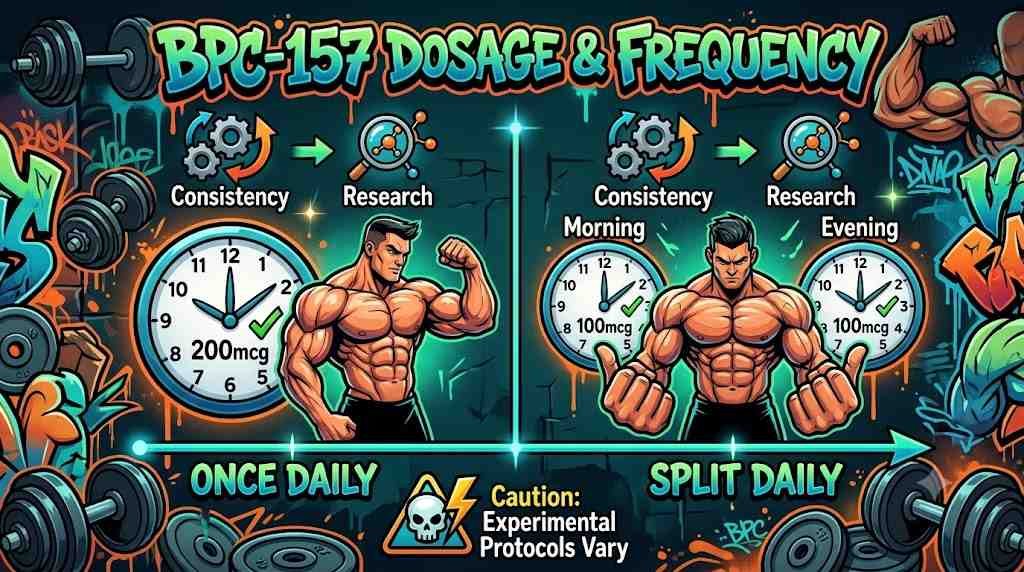
Some discussions describe taking the entire daily amount once per day. Others split the total daily amount into two administrations.
For example, a person discussing a 400 mcg daily protocol might describe dividing it into two smaller administrations rather than taking the entire amount at once.
But again, this is an experimental approach, not a clinically established requirement.
There isn’t sufficient human evidence showing that splitting BPC-157 into multiple daily doses produces better results than a single administration.
BPC-157 Injection Dosage
Injectable BPC-157 is especially popular in bodybuilding and peptide communities.
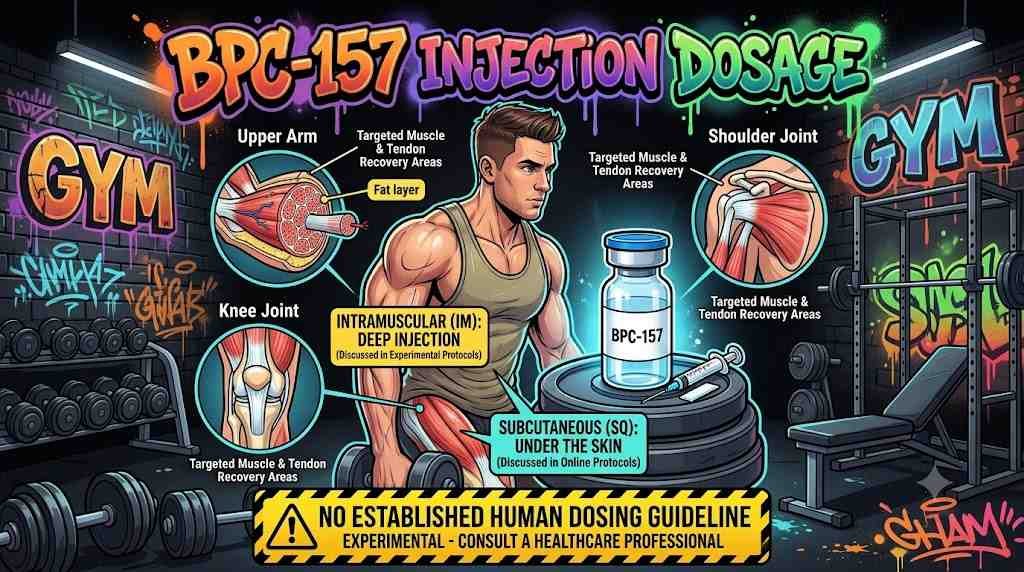
The most commonly discussed injectable approach involves subcutaneous administration, meaning the peptide is injected into the tissue underneath the skin.
Online protocols often mention amounts in the 250–500 mcg per day range and sometimes describe dividing the daily amount.
You may also encounter discussions about intramuscular administration, particularly when people are interested in a particular area of recovery.
But there is an important misconception here.
Injecting a peptide near an injury doesn’t automatically mean that the peptide will act specifically on that location.
The idea of “localized” peptide administration is common in online fitness discussions, but it shouldn’t be confused with a clinically proven targeted-delivery system.
BPC-157 for Oral Use
BPC-157 is also discussed in oral and sublingual forms.
Some online protocols mention approximately 200–500 mcg per day, sometimes divided into two administrations.
People particularly interested in gastrointestinal effects often discuss oral administration.
The problem is that questions remain around absorption, bioavailability, formulation, product quality, and the amount of human research available.
So while you’ll find plenty of online claims about oral BPC-157, these claims shouldn’t be treated as proof that a particular oral dose is effective.
How Long Do People Use?
Cycle length is another area where online protocols vary.
You’ll commonly see discussions involving 2–4 weeks, while some protocols extend to 4–6 weeks or longer.
The table above reflects examples of durations that are frequently discussed online, but there is no clinically established “BPC-157 cycle length.”
That’s an important distinction.
Someone may report feeling better after several weeks of using BPC-157, but an individual experience doesn’t establish the ideal duration for everyone.
The appropriate duration would depend on factors such as the underlying problem, overall health, other medications or supplements, and whether the symptoms actually require medical evaluation.
Muscle Recovery
Muscle recovery is one of the biggest reasons BPC-157 appears in bodybuilding conversations.
Hard training creates temporary muscle damage, inflammation, fatigue, and soreness. Naturally, athletes are interested in anything that might help them recover faster.
BPC-157 has generated interest because experimental research has investigated biological processes related to tissue repair and healing.
But it’s important not to oversell this.
BPC-157 has not been established as a proven muscle-recovery treatment in humans.
If you’re constantly sore, losing strength, or experiencing persistent pain, simply increasing training supplements—or adding an experimental peptide—isn’t necessarily the answer.
Training volume, sleep, calories, protein intake, hydration, stress, and injury management all matter.
Tendon and Ligament Recovery
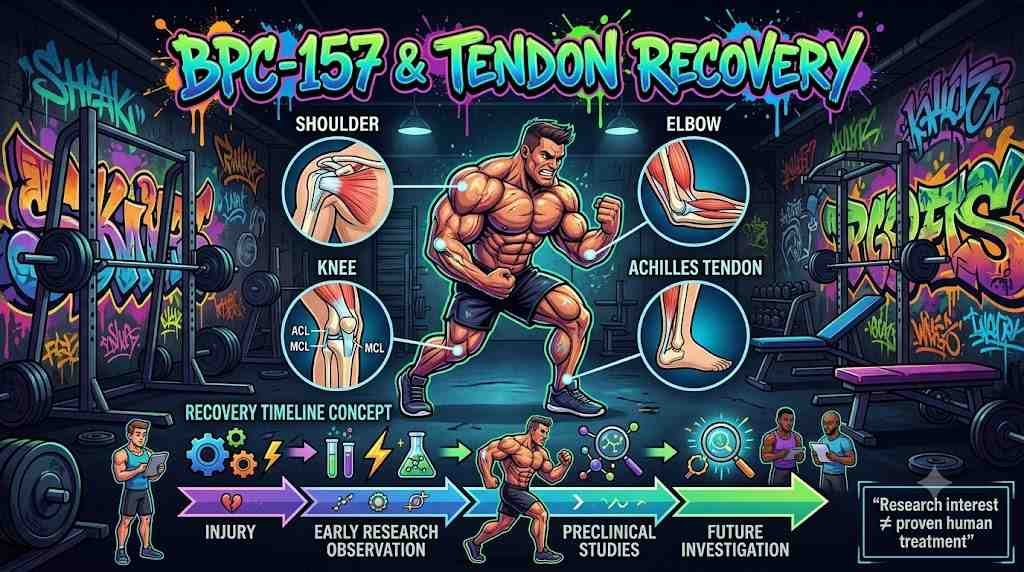
Tendons and ligaments are another major reason athletes discuss BPC-157.
These tissues can be frustrating because they often recover more slowly than muscles. A lifter may feel strong enough to train while the underlying tendon is still irritated.
This is where BPC-157 discussions become particularly popular.
Experimental studies have investigated BPC-157 in relation to various healing processes, but evidence from animals cannot be treated as proof of a specific effective human dose.
So claims such as “500 mcg is the best tendon-healing dose” should be treated cautiously.
There isn’t enough clinical evidence to make that statement.
BPC-157 for Gut Health
The gastrointestinal system is another area frequently associated with BPC-157.
Research has investigated the peptide in experimental models involving the gastrointestinal tract and related biological processes.
This has led to online discussions about BPC-157 for gut health, inflammation, and digestive problems.
But digestive symptoms can have many different causes.
If someone has persistent abdominal pain, blood in the stool, unexplained weight loss, ongoing diarrhea, severe reflux, or another concerning symptom, experimenting with a peptide shouldn’t replace proper medical evaluation. TB500 + BPC157: Benefits, Dosage, Safety & Research Guide
Does a Higher Dosage Work Better?
This is one of the biggest mistakes people can make with experimental peptides.
Higher doesn’t automatically mean better.
There is no established human dose-response relationship demonstrating that increasing BPC-157 produces proportionally greater recovery.
Someone might see an online protocol using 250 mcg and another using 500 mcg and assume that 500 mcg must work twice as well.
That’s not how pharmacology works.
Without adequate human dose-finding studies, there is no reliable way to assume that doubling the amount doubles the benefit.
BPC-157 Side Effects
Another reason dosage matters is safety.
Because human clinical data are limited, the complete safety profile of BPC-157 isn’t well established.
Online reports may mention relatively minor issues, but anecdotal reports can’t tell us how frequently an adverse effect occurs or whether the peptide itself caused it.
Potential concerns also include the quality and purity of products sold through the research-peptide market.
A product labeled BPC-157 may not necessarily contain exactly what the label claims. Contamination, incorrect concentration, improper storage, and sterility problems are additional concerns with injectable products.
That’s an important part of the BPC-157 conversation that often gets ignored.
BPC-157 and Product Quality
Even if someone focuses entirely on the dosage, there’s another variable: what is actually in the vial or product?
For an experimental peptide purchased outside an approved pharmaceutical supply chain, the stated concentration may not be independently verified.
That means a person could think they’re taking a particular amount while actually being exposed to something different.
With injectable products, sterility becomes an additional concern because contamination can potentially cause serious infection.
So BPC-157 dosage isn’t the only issue. Product identity, purity, concentration, storage, and administration technique also matter.
What Does the Research Actually Tell Us?
This is where we need to separate internet claims from scientific evidence.
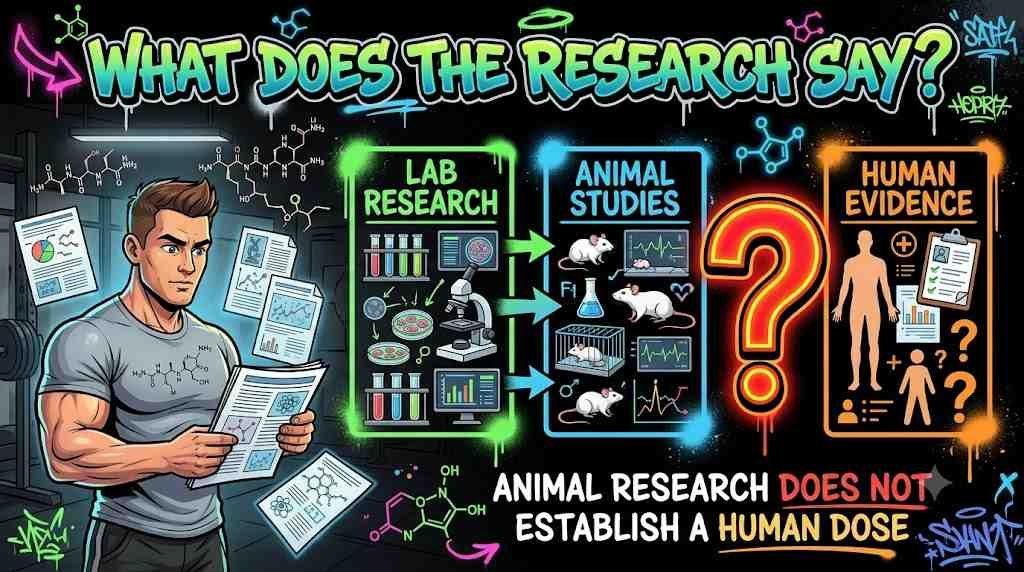
Research on BPC-157 has produced interesting findings in laboratory and animal models. Those findings are one reason the peptide has attracted so much attention.
But animal research is an early stage of scientific investigation.
A positive result in a rat or other laboratory model doesn’t establish:
- the same effect in humans
- the correct human dose
- the safest duration
- long-term safety
- whether the compound actually improves athletic recovery
- whether it treats a particular human injury
That’s why it’s misleading to take an animal research dose and simply convert it into a bodybuilding dosage.
Human dosing requires human evidence.
BPC-157 vs TB-500
BPC-157 and TB-500 are often mentioned together because both have become popular in online recovery discussions.
They’re different peptides, however.
BPC-157 is a synthetic peptide derived from a sequence associated with body-protection-compound research, while TB-500 is commonly associated with thymosin beta-4-related research.
Both have generated interest around tissue repair and recovery, but neither should be treated as a proven shortcut for recovering from injuries.
The same rule applies to dosing: online protocols don’t equal clinically validated dosing guidelines.
Should You Use BPC-157?
This is ultimately a personal health decision that shouldn’t be based solely on a dosage chart found online.
If you’re dealing with an injury, persistent pain, digestive symptoms, or another health problem, getting the underlying issue properly assessed is much more useful than simply searching for the strongest peptide protocol.
For athletes, the decision also needs to consider competition rules. Some experimental peptides may create anti-doping concerns depending on the sport and governing organization.
In other words, don’t look only at “How much BPC-157 should I take?” CJC 1295: Benefits, DAC vs No DAC, Ipamorelin, Dosage
Also ask:
“Why am I considering it, what evidence supports it, and what are the risks?”
BPC-157: Common Questions
What is the most commonly discussed BPC-157 dosage?
Online peptide and bodybuilding discussions commonly mention approximately 200–500 mcg per day, although protocols vary. This should not be interpreted as an established human treatment dose.
How long do people commonly use BPC-157?
Online protocols commonly discuss periods ranging from 2–4 weeks to 4–6 weeks or longer. There is no scientifically established universal cycle length for human use.
Is BPC-157 dosage based on body weight?
Some online protocols suggest adjusting dosage according to body weight, but there is no validated human weight-based dosing formula.
Is BPC-157 taken once or twice a day?
Both approaches are discussed online. Some protocols divide the total daily amount into two administrations. There isn’t enough human evidence to establish that one schedule is superior.
Is oral BPC-157 better than injectable BPC-157?
There isn’t enough high-quality human evidence to confidently say that one route is better for a particular purpose. Absorption and formulation are important variables.
Is 500 mcg of BPC-157 safe?
There isn’t enough high-quality human clinical evidence to describe 500 mcg as a proven safe dose. A commonly discussed amount online should not automatically be considered medically established.
Final Thoughts
BPC-157 dosage is widely discussed because the peptide has become popular among athletes, bodybuilders, and people interested in recovery. Online protocols frequently mention amounts around 200–500 mcg daily, different administration frequencies, and several-week cycles.
But popularity isn’t the same thing as clinical evidence.
The biggest takeaway is that BPC-157 remains an experimental peptide, and there isn’t an established human dosage that has been proven safe and effective for injury recovery, muscle growth, tendon healing, or gut health.
If you’re researching BPC-157, don’t focus only on finding the highest or most popular number. Look at the quality of the evidence, understand the uncertainty around human dosing, and consider the potential risks of both the compound and the products being sold.
That gives you a much better picture of BPC-157 than a simple “take X mcg for X weeks” chart ever could.
Have Questions?
Still confused about BPC-157 dosage, peptide protocols, or the difference between oral and injectable forms?
If you’re researching BPC-157 and want to discuss your options, you can contact the Gym Pundit team on WhatsApp.
WhatsApp: 7696593279
You can ask about BPC-157, other peptides, SARMs, anabolic steroids, supplements, and bodybuilding-related topics.
Gym Pundit — Making bodybuilding information easier to understand.