When you’re trying to gain size, it’s easy to get lost in the supplement market. Every brand claims its powder, capsule, or formula will help you build more muscle, recover faster, or gain weight. But the truth is much simpler. The best supplements for bulking are the ones that help you cover your protein, calorie, training, and recovery needs without replacing a proper diet.
You don’t need a shelf full of supplements to bulk successfully. A few well-chosen products can make things easier, especially when you’re struggling to eat enough food or hit your daily protein target.
The biggest question is: which supplements actually help you gain muscle and weight, and which ones are mostly hype?
Let’s break it down in simple gym-bro language. Creatine Monohydrate vs Creatine HCL: What’s the Difference?
Best Supplements for Bulking: Start With the Basics
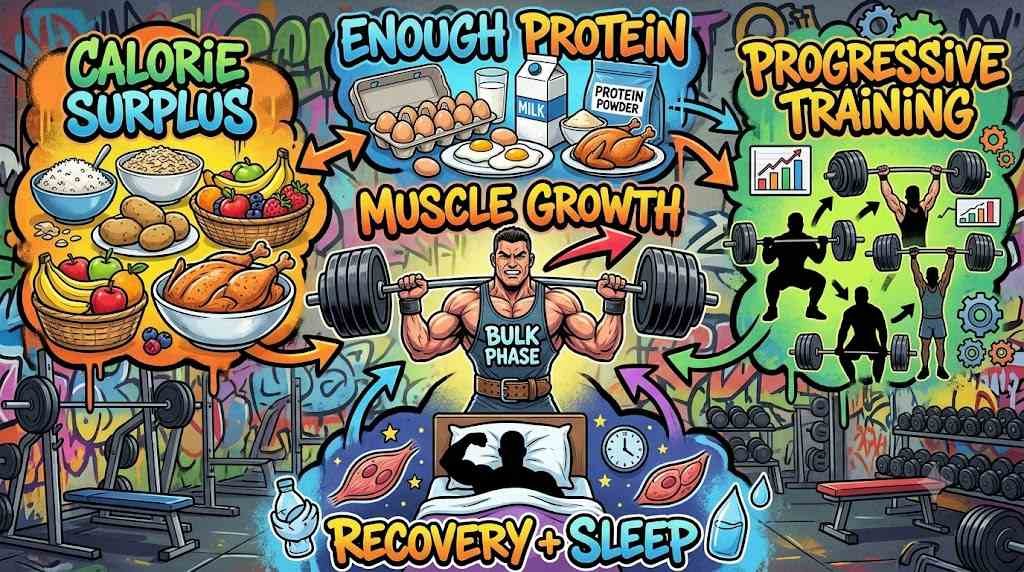
Before buying anything, understand what actually drives a successful bulk.
You generally need three things working together:
- A consistent calorie surplus
- Enough daily protein
- Progressive resistance training
Sleep and recovery matter too.
If you’re eating too little, training randomly, and sleeping five hours a night, adding five different supplements isn’t going to magically fix the problem.
Think of supplements as tools. They can make the process easier, but your diet and training are still doing most of the heavy lifting.
Best Supplements for Bulking: Whey Protein
Whey protein is probably the most practical supplement for someone trying to build muscle.
The important thing isn’t that whey is somehow magical. It’s simply an easy way to get high-quality protein without having to cook another chicken breast, eggs, or other protein-rich meal.
Protein provides amino acids that your body needs for muscle protein synthesis and recovery.
For most people who lift regularly, getting roughly 1.6–2.2 grams of protein per kilogram of body weight per day is a useful target range.
For example, someone weighing 70 kg might aim for around 112–154 grams of protein per day.
If you’re already reaching your protein target through food, you don’t necessarily need whey. But if you’re consistently falling short, whey can be extremely convenient.
Whey Concentrate vs Whey Isolate for Bulking
Both can work.
Whey concentrate is usually cheaper and still provides plenty of protein.
Whey isolate generally contains a higher percentage of protein and less lactose and other components.
For a normal bulk, you don’t need to obsess over the difference. Choose the one that fits your budget, digestion, and daily protein needs.
Best Supplements for Bulking: Creatine Monohydrate
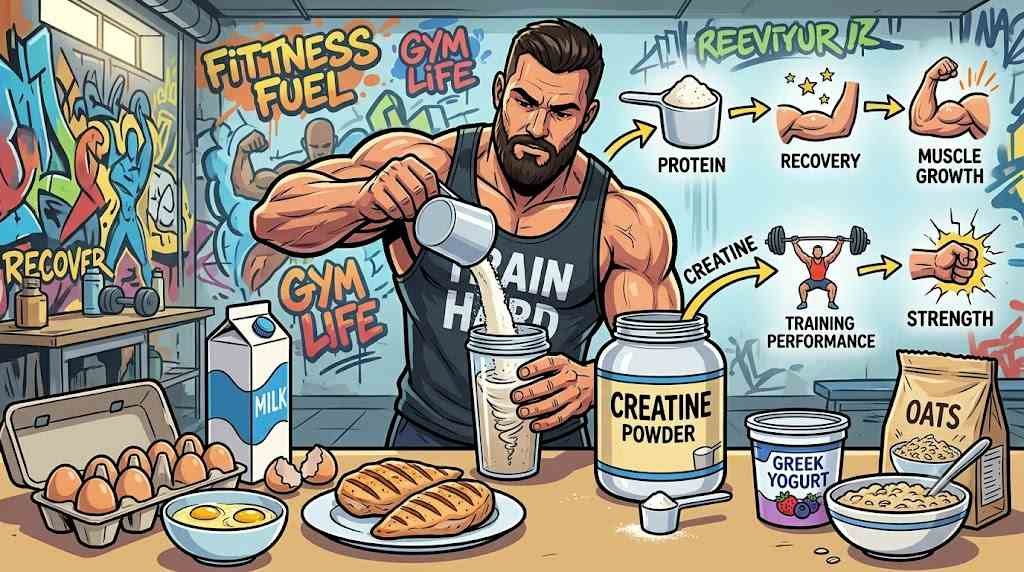
If there’s one supplement that deserves a permanent place on the list, it’s creatine monohydrate.
Creatine is one of the most researched sports supplements and can help improve performance during high-intensity exercise. Over time, better training performance can support greater gains in strength and muscle.
It can also increase water stored within muscle cells, so some people notice the scale moving upward relatively quickly after starting it.
That initial weight increase isn’t the same thing as suddenly gaining several pounds of new muscle. Don’t confuse increased muscle water with actual muscle tissue.
A simple approach is 3–5 grams of creatine monohydrate daily.
You don’t need to cycle it, and you don’t have to take it immediately before your workout. Consistency matters much more than timing.
Do You Need a Creatine Loading Phase?
Not necessarily.
Some people use a loading phase to saturate their muscle creatine stores faster, but it’s optional.
Taking a smaller daily amount consistently will also work; it simply takes longer to reach full saturation.
For most lifters, there’s no need to make things complicated.
Best Supplements for Bulking: Mass Gainer
Mass gainers can be useful, but they’re also one of the most misunderstood supplements in bodybuilding.
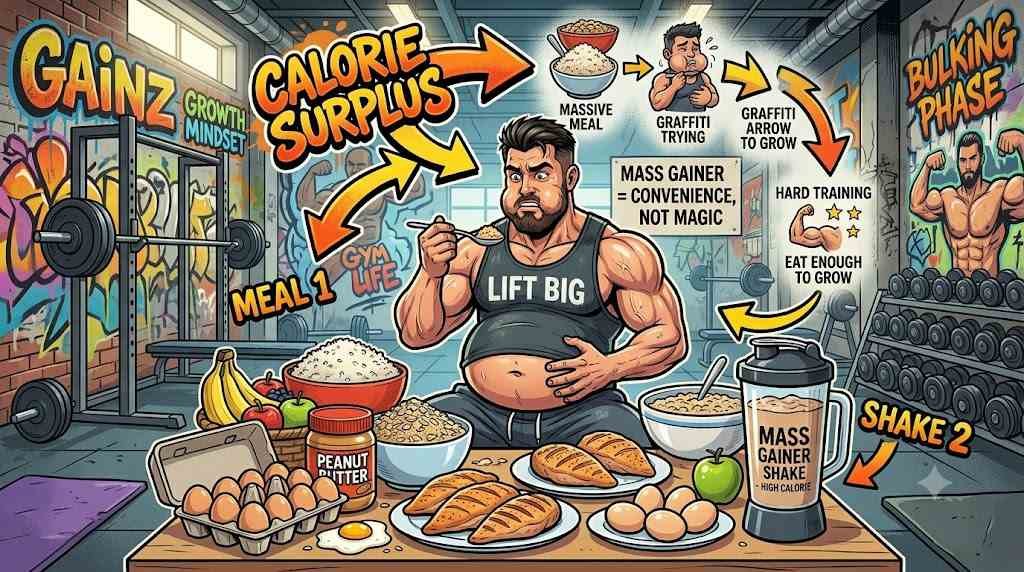
A mass gainer is basically a convenient way to consume a lot of calories, usually from a combination of protein and carbohydrates.
That’s useful if you’re someone who says:
“Boss, I know I need to eat more, but I simply can’t finish another meal.”
In that situation, a mass gainer can make a calorie surplus easier.
But a mass gainer isn’t automatically better than food.
You can make your own high-calorie shake using milk, oats, banana, peanut butter, yogurt, whey, and other ingredients.
The important factor is your total calorie intake, not whether the calories came from a fancy powder.
Who Actually Needs a Mass Gainer?
A mass gainer may make sense if:
- You struggle to eat enough calories
- You have a low appetite
- You have a busy schedule
- You need an easy post-workout or between-meal option
- You’re naturally eating too little during a bulk
If you’re already gaining weight consistently from normal food, there’s no special reason to add one.
Best Supplements for Bulking: Carbohydrate Powders
Carbohydrates are important for hard training because they provide energy and help replenish muscle glycogen.
Most people can easily get enough carbs from foods such as rice, potatoes, oats, bread, pasta, fruit, and other carbohydrate sources.
But carbohydrate powders can be convenient around training, particularly for athletes or people doing high-volume training.
They’re basically a convenience product.
Don’t think of them as a secret muscle-building supplement.
If you can eat a bowl of rice or oats instead, that’s perfectly fine. Creatine and Whey Protein: Do You Need Both?
Best Supplements for Bulking: Pre-Workout and Caffeine
Pre-workout supplements can help you feel more energized and focused during training, particularly if they contain caffeine.
Caffeine can improve alertness and exercise performance for many people.
But you don’t necessarily need an expensive pre-workout formula.
For some lifters, a simple coffee before training is enough.
The bigger issue is tolerance and timing. Taking large amounts of caffeine late in the day can interfere with sleep, and poor sleep can hurt recovery and training performance.
So don’t sacrifice your sleep just to squeeze a little more intensity out of your workout.
Best Supplements for Bulking: Omega-3s
Omega-3 fatty acids are another supplement worth considering, particularly if you don’t regularly eat fatty fish.
However, omega-3s shouldn’t be viewed as a direct muscle-building supplement.
They’re more about supporting overall nutrition and health.
If your diet already contains suitable sources of omega-3s, you may not need an additional supplement.
Always look at your overall diet first rather than automatically adding another capsule.
Best Supplements for Bulking: Vitamin D and Other Micronutrients
Vitamins and minerals aren’t anabolic shortcuts.
But nutritional deficiencies can negatively affect general health, energy, and normal body function.
Vitamin D, iron, magnesium, zinc, and other nutrients all have important roles in the body.
The smart approach isn’t to randomly take huge doses of everything.
Instead, focus on a balanced diet and address confirmed deficiencies appropriately.
If you suspect you’re deficient in something, testing and professional guidance are much more useful than guessing.
Best Supplements for Bulking: BCAAs
BCAAs are one of those supplements that became extremely popular in gyms.
But if you’re already eating enough complete protein every day, especially from foods such as meat, eggs, dairy, or whey protein, adding BCAAs usually isn’t necessary.
Your complete protein sources already provide branched-chain amino acids.
So instead of spending money on another flavored powder, you can usually put that money toward your actual protein intake.
Best Supplements for Bulking: Glutamine
Glutamine is another popular bodybuilding supplement, but it isn’t a must-have for muscle growth.
Your body naturally contains plenty of glutamine, and you get it through normal dietary protein.
That doesn’t mean glutamine has no biological role. It simply means that healthy lifters eating enough protein shouldn’t expect it to transform their bulk.
For most people, creatine and adequate protein deserve a much higher priority.
Best Supplements for Bulking: Testosterone Boosters
This category deserves some skepticism.
You’ll find countless products marketed as “natural testosterone boosters,” often promising more testosterone, strength, muscle, energy, and recovery.
The problem is that the evidence behind many of these products is inconsistent or much weaker than the marketing suggests.
If your testosterone is genuinely low, buying a random supplement isn’t the right solution.
Sleep, adequate calorie intake, resistance training, healthy body composition, and addressing actual medical issues are far more important.
Don’t confuse a supplement company’s marketing claims with proven muscle-building results.
Best Supplements for Bulking: Protein vs Mass Gainer
This is a common question.
The answer depends on what you’re missing.
If you’re eating enough calories but struggling to reach your protein target, whey protein makes more sense.
If you’re getting enough protein but can’t consume enough total calories, a mass gainer can be more useful.
If you’re struggling with both, either can be incorporated depending on your diet.
The key is to look at your actual numbers instead of buying a supplement simply because someone at the gym recommended it.
Bulking Supplement Dosage Chart
| Supplement | Typical Amount for Bulking | Best Time to Take | Main Purpose |
|---|---|---|---|
| Whey Protein | 20–40 g per serving | Any time; convenient after training | Helps reach daily protein target |
| Creatine Monohydrate | 3–5 g daily | Any time of day | Supports strength, training performance and muscle gain |
| Mass Gainer | 1 serving according to calories needed | Between meals or post-workout | Helps increase total calorie intake |
| Carbohydrate Powder | 30–60 g around training | Before/during/after workout | Convenient source of training carbs |
| Caffeine / Pre-Workout | 1–3 mg/kg to start; higher doses may be used by experienced users | ~30–60 min pre-workout | Energy, alertness and training performance |
| Omega-3 (Fish Oil) | Follow product’s EPA + DHA amount; commonly used with meals | With a meal | Helps cover omega-3 intake |
| Vitamin D | Depends on blood levels and individual needs | With a meal containing fat | Corrects/prevents deficiency |
| BCAAs | Usually not required if protein intake is adequate | — | Generally unnecessary when total protein is sufficient |
| Glutamine | Usually not required specifically for muscle gain | — | Not a priority for most bulking lifters |
| Testosterone Boosters | No standard evidence-based bulking dose | — | Generally not recommended as a core bulking supplement |
Best Supplements for Bulking: How Many Do You Really Need?
For most natural lifters, you can keep the supplement stack surprisingly small.
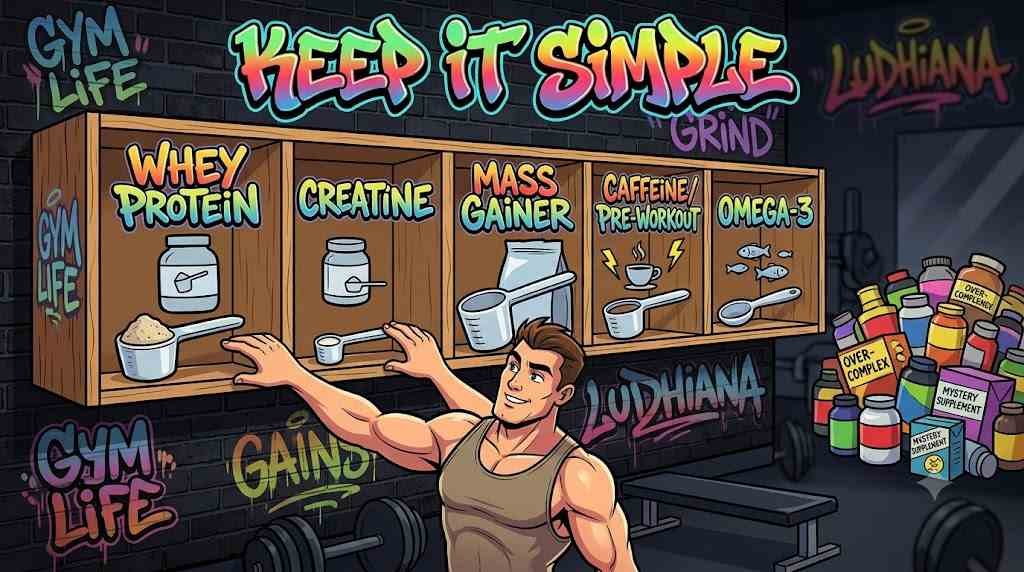
A basic setup might look like:
1. Whey protein — if needed to reach your daily protein target.
2. Creatine monohydrate — 3–5 grams daily.
3. Mass gainer or homemade calorie shake — if you struggle to eat enough calories.
4. Caffeine/pre-workout — optional for training performance and energy.
5. Omega-3 or specific vitamins/minerals — based on diet and individual needs.
That’s already enough for most people.
You don’t need ten different tubs sitting beside your protein shaker.
Best Supplements for Bulking: What About Weight Gain?
Remember that bulking isn’t simply about watching the number on the weighing scale increase.
If you’re gaining weight extremely quickly, a significant portion may be body fat.
If you’re not gaining anything for several weeks, you’re probably not eating enough.
A practical strategy is to monitor your body weight regularly and adjust calories gradually.
Your goal should be to gain weight at a controlled pace while getting stronger in the gym.
That usually produces a better bulk than simply trying to eat as much as humanly possible.
The Importance of Calories
This is where many beginners get confused.
You can take the best protein powder, creatine, pre-workout, and mass gainer in the world, but if your overall calorie intake isn’t high enough, gaining weight will remain difficult.
A calorie surplus gives your body additional energy to support growth.
That doesn’t mean you need to eat junk food all day. How Long Should You Rest Between Sets?
Build your diet around foods such as:
- Rice
- Oats
- Potatoes
- Whole-grain or regular bread
- Eggs
- Chicken
- Fish
- Lean meat
- Milk
- Yogurt
- Nuts and nut butter
- Fruits
- Vegetables
- Legumes
Then use supplements to fill the gaps.
Don’t Forget Sleep
Here’s the boring part that many gym bros ignore.
Sleep.
You can have the perfect supplement stack and still make disappointing progress if you’re constantly sleeping five hours a night.
Recovery is part of the muscle-building process.
Try to maintain a consistent sleep schedule and get enough sleep to recover properly from your training.
Better recovery also helps you train harder and more consistently.
Supplements You Can Skip
If your budget is limited, don’t feel pressured to buy every bodybuilding supplement you see online.
You can usually put lower priority on:
- BCAAs when protein intake is already adequate
- Glutamine for general muscle growth
- Complicated “anabolic” blends
- Most testosterone boosters
- Detox products
- Fat burners during a bulk
- Extremely expensive proprietary formulas
Spend your money where it actually makes a difference.
Food, protein, creatine, training, and recovery should come first.
A Simple Beginner Stack
If you’re completely new to bodybuilding, keep it simple.
A practical beginner setup could be:
Morning: Normal breakfast and food-based nutrition.
During the day: Regular meals providing enough calories and protein.
Pre-workout: Coffee or a modest caffeine-containing pre-workout if you tolerate caffeine.
Post-workout: Whey protein if needed to reach your daily protein target.
Any convenient time: 3–5 grams of creatine monohydrate every day.
Between meals: A homemade high-calorie shake or mass gainer if you’re struggling to reach your calorie target.
That’s it.
You don’t need a complicated supplement schedule.
The Bottom Line
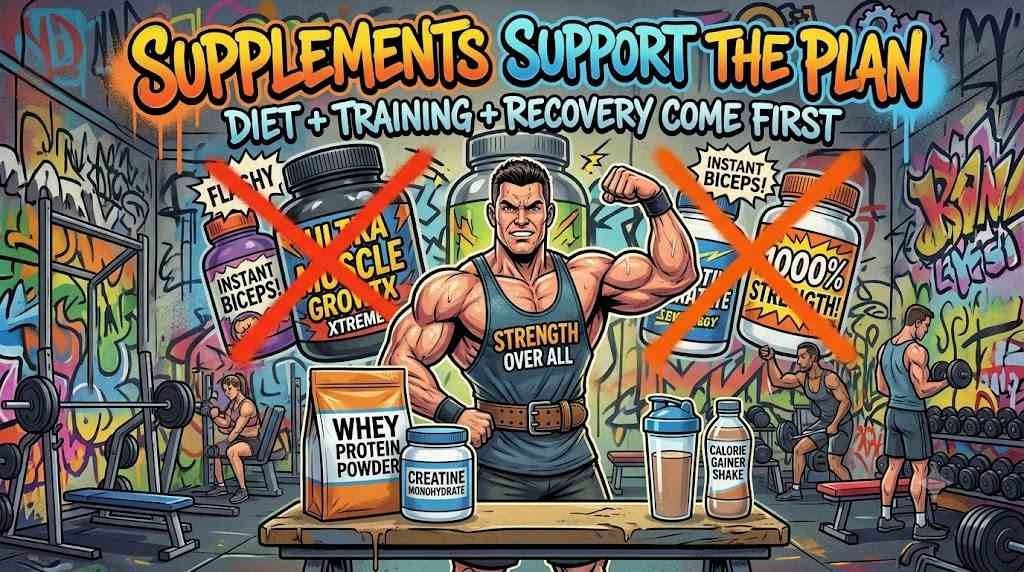
The best supplements for bulking aren’t necessarily the most expensive or the ones with the longest ingredient list.
For most lifters, whey protein and creatine monohydrate are the two easiest supplements to justify. A mass gainer can be useful when eating enough calories is difficult, while caffeine or pre-workout can help some people train with more energy.
Everything else depends heavily on your individual diet and situation. Whey Protein vs Mass Gainer: Which Is Better?
The real formula for a successful bulk is still pretty simple:
Calorie surplus + enough protein + progressive training + recovery + consistency.
Supplements can make that formula easier, but they can’t replace it.
Frequently Asked Questions
What is the best supplement for bulking?
Creatine monohydrate and protein supplements are among the most useful options for people who lift regularly. A mass gainer can also help if reaching a calorie surplus through food is difficult.
Is whey protein good for bulking?
Yes. Whey protein is a convenient way to increase daily protein intake. It can support muscle growth when combined with adequate calories and resistance training.
Is creatine good for bulking?
Yes. Creatine monohydrate can improve high-intensity exercise performance and can contribute to increased muscle mass over time when combined with resistance training.
Do I need a mass gainer to bulk?
No. You can bulk without a mass gainer. It is mainly a convenient calorie source for people who struggle to eat enough food.
Can I bulk with only food and no supplements?
Absolutely. Supplements are optional. You can gain muscle with a well-planned diet, sufficient protein, progressive resistance training, and proper recovery.
Should I take creatine every day?
Yes. A common approach is 3–5 grams of creatine monohydrate daily. You don’t have to take it only on workout days.
Are BCAAs necessary for bulking?
Usually not if you’re already consuming enough complete protein. Protein-rich foods and whey already provide BCAAs.
Are testosterone boosters necessary for bulking?
No. Most lifters don’t need testosterone-boosting supplements. If you suspect a hormone problem, it’s better to speak with a qualified healthcare professional rather than relying on a random supplement.
How quickly should I gain weight while bulking?
A controlled rate of weight gain is generally preferable to gaining as quickly as possible. Track your weight and gym performance and adjust your calorie intake based on your progress.
What is more important: supplements or diet?
Diet is more important. Supplements are there to fill gaps and make your nutrition more convenient. They cannot compensate for an inadequate calorie intake, poor protein intake, bad training, or poor recovery.
WhatsApp Help for Your Bulking Plan
Confused about what supplements you actually need for your bulk?
If you want help choosing a protein, creatine, mass gainer, or a simple supplement stack based on your diet and training goals, you can contact our team on WhatsApp at 7696593279.
Don’t waste money on ten different products just because someone at the gym told you that you need them. Start with the basics, track your progress, and build your stack around what your body and diet actually need.