If you’re researching estrogen on steroids, you’ve probably heard bodybuilders talk about high estrogen, water retention, puffy nipples, and aromatase inhibitors. Some lifters worry that estrogen is ruining their gains, while others try to push it as low as possible to get a harder, drier look.
But here’s the thing: estrogen isn’t the enemy, and lower estrogen doesn’t automatically mean better bodybuilding results.
Estrogen plays an important role in male sexual health, bone strength, libido, and other body functions. When someone uses testosterone or certain anabolic steroids, hormone levels can change significantly. Both excessively high and excessively low estrogen can create problems.
In this guide, we’ll break down how estrogen works in men, why anabolic steroid use can affect it, the signs associated with high and low levels, how blood tests help, and what bodybuilders should understand about estrogen management.
The goal is to separate bodybuilding myths from useful health information without turning hormone management into guesswork. Blood Tests for Bodybuilders: 10 Key Markers to Check
What Is Estrogen, and Why Do Men Need It?
Estrogen is a group of hormones found in both men and women. In men, the most important form to understand is estradiol (E2).
Men produce much of their estradiol by converting testosterone and other related hormones through an enzyme called aromatase. This process is known as aromatization.
Aromatase is present in several tissues, including fat tissue, muscle, and the brain. That means estrogen production isn’t limited to one part of the body.
Although estrogen is often associated with female physiology, men need it too.
What does estrogen do in male bodybuilders?
- Bone health: Estradiol helps maintain bone density and normal bone remodeling.
- Sexual function: Appropriate estrogen levels contribute to normal libido and sexual function.
- Joint and connective tissue health: Estrogen participates in processes involved in musculoskeletal health, although joint pain has many possible causes.
- Body composition: Estrogen interacts with other hormones and metabolic processes that influence how the body stores and uses energy.
- Brain and mood: Estradiol plays a role in brain function and can influence mood and well-being.
- Reproductive health: Estrogen signaling contributes to normal male reproductive physiology.
For someone who trains hard, these functions matter. Your goal isn’t simply to maximize testosterone or minimize estrogen. It’s to maintain a hormonal environment that supports health and performance.
Why Does Estrogen Rise on Anabolic Steroids?
The main reason estrogen rises in some bodybuilders using anabolic steroids is aromatization.
Your body contains an enzyme called aromatase, which converts testosterone into estradiol. When testosterone levels increase significantly, more testosterone may become available for conversion into estradiol.
This is particularly relevant when someone uses testosterone at levels above the normal physiological range.
1. Testosterone can convert into estrogen
Testosterone is an androgen, but some of it can be converted into estradiol. This is a normal biological process, not a mistake made by the body.
When testosterone exposure increases, estradiol may also rise. How much it rises depends on several factors, including the amount of testosterone available, aromatase activity, body composition, and individual differences.
2. Body fat can influence estrogen production
Fat tissue contains aromatase, so body composition can influence the conversion of androgens into estrogens.
However, this doesn’t mean that every heavier bodybuilder will have high estrogen or that every lean bodybuilder will have low estrogen. Hormone levels depend on multiple factors, including drug exposure and individual physiology.
3. Not every anabolic steroid behaves the same way
Different anabolic-androgenic steroids have different chemical structures and metabolic pathways.
- Testosterone: Can be converted into estradiol through aromatase.
- Nandrolone: Has different metabolic characteristics from testosterone; its hormonal effects cannot be predicted from estrogen alone.
- Non-aromatizing steroids: These do not directly convert into estrogen through aromatase, but they can still affect the body’s hormonal balance and suppress natural hormone production.
This distinction matters because people sometimes assume that every anabolic steroid raises estrogen in the same way. That is incorrect.
Anabolic steroid use can also suppress the body’s natural testosterone production, affecting the wider hormonal system.
Estrogen on Steroids: High Estrogen Symptoms in Bodybuilders
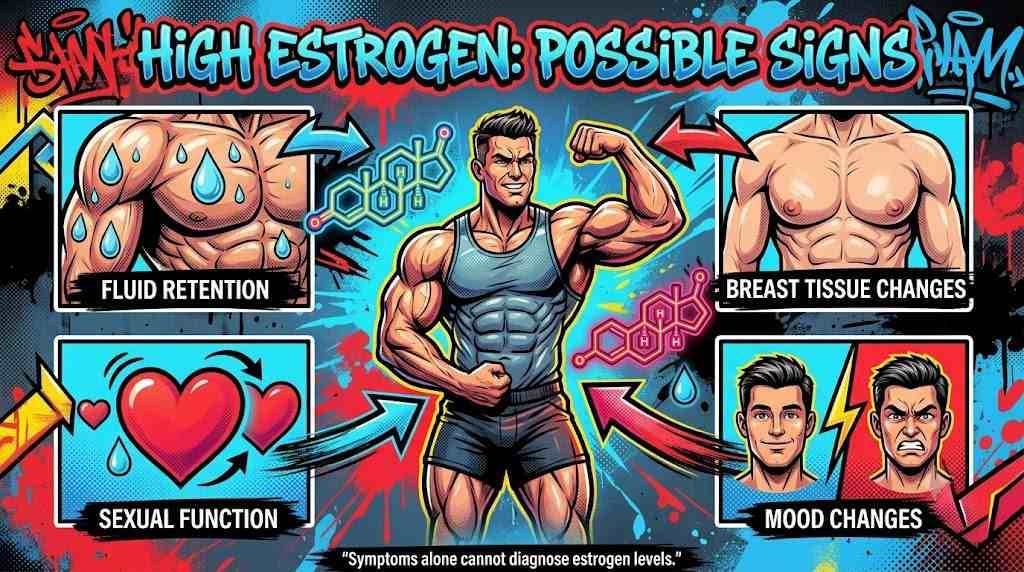
High estradiol doesn’t always cause obvious symptoms. Some people may have elevated results on a blood test without noticeable problems, while others develop symptoms that require medical assessment.
In bodybuilding discussions, the phrase “high estrogen” is often used to explain almost everything from a softer physique to reduced libido. The reality is more complicated.
1. Water retention and a fuller appearance
Some bodybuilders associate elevated estrogen with water retention, a fuller face, or a softer appearance.
Fluid balance is influenced by multiple hormones, diet, sodium intake, kidney function, and other factors. Therefore, looking watery doesn’t prove that estrogen is elevated.
A sudden increase in body weight may reflect water, glycogen, food intake, or actual tissue gain. Appearance alone cannot distinguish these possibilities reliably.
2. Gynecomastia or breast tissue growth
Gynecomastia is the development of glandular breast tissue in males. It may present as a firm or rubbery area beneath the nipple, sometimes accompanied by tenderness.
Hormonal imbalance can contribute to gynecomastia, and anabolic steroid use is a recognized risk factor. However, gynecomastia is not simply a matter of one estrogen number being too high. The balance of hormonal signals, medication exposure, and other medical conditions can all matter.
It’s also important to distinguish gynecomastia from chest fat, which does not represent the same type of tissue growth.
3. Changes in sexual function
Some men experiencing hormonal disturbances report changes in libido or erectile function.
But low libido doesn’t automatically mean high estrogen. Low testosterone after steroid-related suppression, psychological stress, poor sleep, other medications, and several medical conditions can produce similar symptoms.
4. Estrogen on Steroids: Mood and general well-being
Mood changes can occur in people using anabolic steroids, but the cause is not always clear. Hormonal fluctuations, the direct effects of androgens, sleep disruption, and other factors may contribute.
If mood changes are severe or persistent, it’s better to seek professional help than to assume estrogen is responsible.
The takeaway: Symptoms can raise a question about hormone health, but they cannot diagnose high estrogen by themselves. Steroid Cycle Recovery: What Actually Happens After a Cycle?
Estrogen on Steroids: Low Estrogen Symptoms in Men
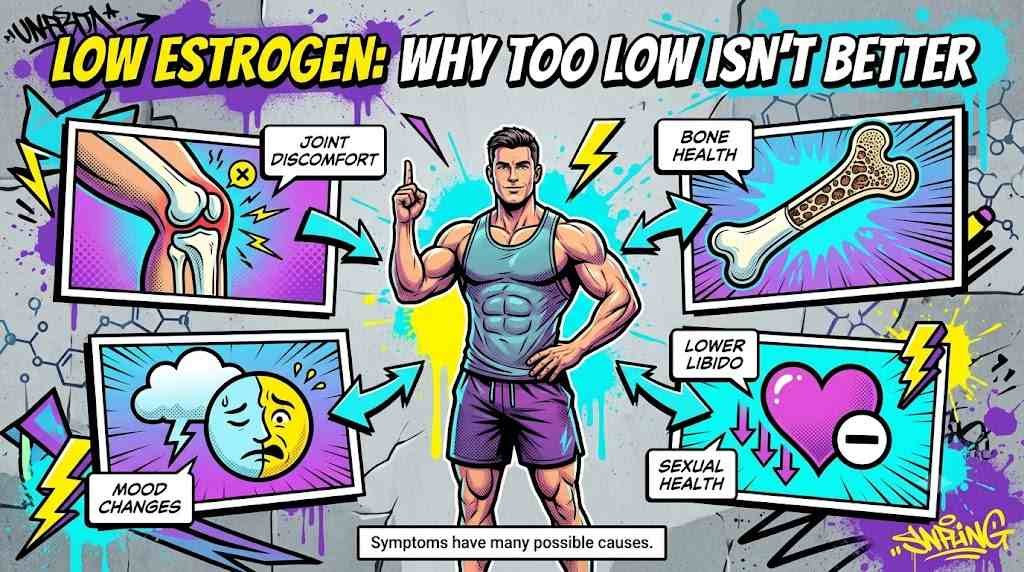
Now let’s talk about the other side of the problem.
Some bodybuilders become so concerned about estrogen-related side effects that they try to suppress estrogen aggressively. This can backfire, because estradiol is essential for normal male physiology.
Low estradiol can be particularly concerning when it results from excessive suppression of aromatase activity.
1. Joint discomfort
Bodybuilders often describe low estrogen as making their joints feel dry or painful. That expression is not a medical diagnosis, but low estrogen can affect musculoskeletal health.
If joint discomfort develops after starting a hormone-altering medication, it deserves attention. Training load, technique, injury, and recovery problems are also possible explanations.
2. Reduced libido and sexual problems
Adequate estradiol is important for male sexual function. Excessive suppression can contribute to reduced sexual desire and erectile difficulties in some men.
This is one reason that automatically treating every suspected estrogen-related symptom with an estrogen-lowering drug is a poor approach.
3. Mood changes and fatigue
Low estradiol may be associated with changes in mood and well-being. However, fatigue and low mood are nonspecific symptoms, meaning they can have many causes.
For someone who has used anabolic steroids, suppression of natural testosterone production may be another important factor.
4. Bone health concerns
Estradiol plays a major role in maintaining bone density in men. Persistently low levels can contribute to bone loss and increase the risk of osteoporosis over time.
This risk may not be visible in the mirror or obvious during a workout. Feeling strong in the gym doesn’t guarantee that bone health is normal.
5. Changes in body composition
Estradiol influences body composition and metabolic regulation. Excessively low levels may be associated with unfavorable changes in body fat and other metabolic measures.
The effects vary between individuals, and body composition is also influenced by nutrition, activity, testosterone levels, and many other variables.
Research on anabolic steroid use highlights why both hormonal suppression and attempts to manipulate hormone levels require care.
High vs Low Estrogen: What’s the Difference?
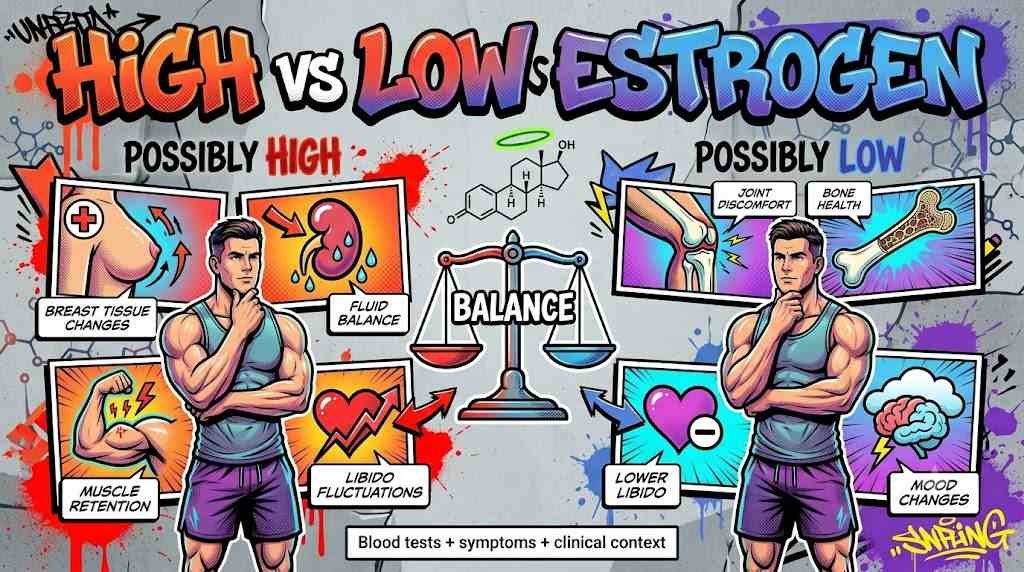
Here’s a quick comparison of the possible signs associated with high and low estradiol in men.
| Feature | Possible high estradiol effects | Possible low estradiol effects |
|---|---|---|
| Breast tissue | Gynecomastia may develop | Not a typical defining symptom |
| Fluid balance | Water retention may occur | Not reliably predicted by estradiol alone |
| Libido | May change | May decrease |
| Sexual function | May be affected | May be affected |
| Joints | Symptoms are not specific | Joint discomfort may occur |
| Mood | Mood changes may occur | Mood changes may occur |
| Bone health | Depends on the broader clinical picture | Persistently low levels can harm bone density |
| Body composition | Effects vary | Unfavorable changes may occur |
| Diagnosis | Blood tests and clinical assessment | Blood tests and clinical assessment |
These are possible associations, not a checklist for diagnosing your hormone levels. Many symptoms overlap, and a person can have symptoms without having an abnormal estradiol result.
The practical lesson: Don’t try to identify your estrogen level by looking at your nipples, judging your water retention, or checking how your joints feel.
Estrogen on Steroids: How Does Estrogen Affect Muscle Growth and Strength?
Estrogen isn’t just a hormone bodybuilders need to monitor for side effects. It also participates in processes involved in muscle function, metabolism, and overall health.
Does high estrogen reduce muscle gains?
Not automatically.
A bodybuilder can have elevated estradiol and continue to gain muscle. Muscle growth depends on resistance training, adequate nutrition, sleep, androgen exposure, recovery, and individual biology.
If elevated estrogen is associated with a medical problem, that problem deserves attention. But the idea that any estradiol above a particular number will stop muscle growth is an oversimplification.
Estrogen on Steroids: Does low estrogen make you look harder?
Some bodybuilders try to lower estrogen because they associate it with a leaner, drier appearance.
Even if changes in fluid balance temporarily alter appearance, that doesn’t mean low estrogen improves actual muscle growth or long-term physique outcomes.
A harder-looking physique and a healthier hormonal environment are not the same thing.
Does estrogen help preserve muscle?
Estradiol has biological effects in skeletal muscle and interacts with other systems involved in muscle function. However, its effects cannot be reduced to a simple rule that more estrogen builds more muscle.
The best approach is to distinguish actual muscle tissue from temporary changes in water and glycogen, while avoiding unnecessary hormonal manipulation.
Estrogen and Gynecomastia: What Bodybuilders Should Know
Gynecomastia is one of the most concerning estrogen-related problems for bodybuilders because glandular tissue can persist even after the original hormonal trigger has changed.
What causes steroid-related gynecomastia?
Gynecomastia can occur when hormonal signaling favors breast glandular tissue development. Testosterone can be converted into estradiol, and some anabolic steroid regimens can significantly disturb the normal balance of sex hormones.
Other medications and health conditions can also contribute, so steroid use shouldn’t be assumed to be the only possible cause.
Estrogen on Steroids: Is every puffy nipple gynecomastia?
No. A puffy appearance can result from chest fat, skin structure, or glandular tissue.
A clinician can assess whether there is actual glandular enlargement and whether further investigation is needed. New breast lumps should not automatically be attributed to anabolic steroid use.
Estrogen on Steroids: Can gynecomastia disappear on its own?
It depends on the cause, how long it has been present, and the nature of the tissue changes.
Some cases improve when the underlying cause is addressed. Long-standing gynecomastia may be less likely to resolve without treatment. A healthcare professional can discuss appropriate options based on the examination and clinical history.
Seek prompt medical assessment for a hard or fixed lump, nipple discharge, skin changes, or a rapidly enlarging breast.
Estradiol Blood Tests: What Should Bodybuilders Check?
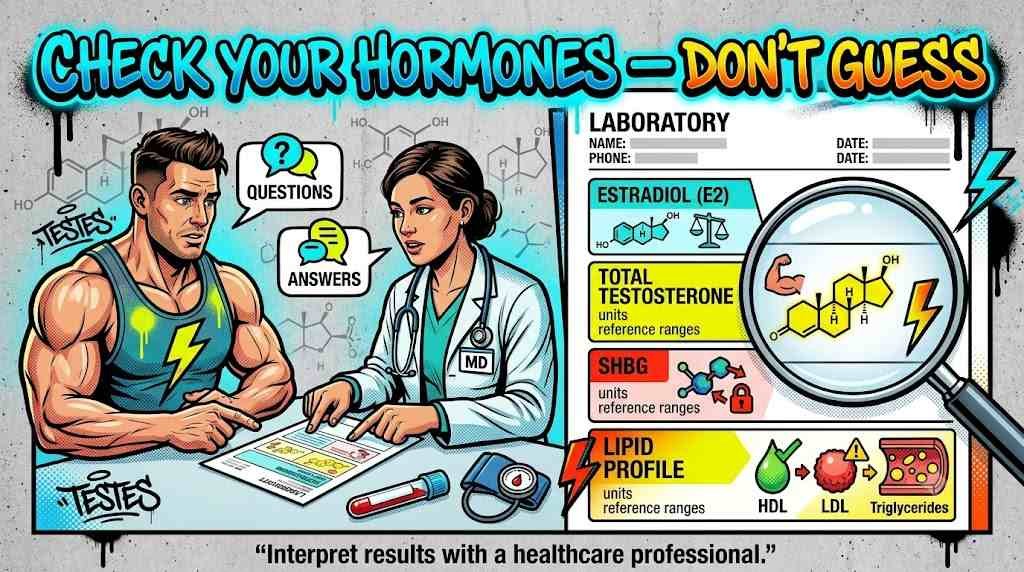
If someone using anabolic steroids develops possible hormonal symptoms, blood testing can provide useful information. It should be interpreted alongside the symptoms, medications, exposure history, and other health findings.
1. Estradiol (E2)
Estradiol is the main estrogen measurement commonly considered when assessing male hormonal health.
Depending on the laboratory, an estradiol test designed for the lower concentrations found in men may provide more useful accuracy than a less suitable assay. Your clinician can help select an appropriate method.
2. Total testosterone
Total testosterone provides information about circulating testosterone. During or after anabolic steroid use, results can be difficult to interpret because some substances suppress natural production and may not be measured accurately by routine testosterone assays.
3. SHBG and other hormone tests
Sex hormone-binding globulin (SHBG) helps transport sex hormones in the blood and affects how total testosterone relates to its free fraction.
Depending on the situation, a clinician may also consider luteinizing hormone (LH), follicle-stimulating hormone (FSH), prolactin, thyroid tests, or other investigations. The correct panel depends on the symptoms and clinical question.
4. Estrogen on Steroids: Other health checks
Estradiol isn’t the only health marker worth considering in someone using anabolic steroids. A medical assessment may also include blood pressure, a complete blood count, lipid profile, and liver or kidney tests, depending on the compounds used and individual risks.
Anabolic steroid use can affect several organ systems, so a normal estradiol result does not establish that steroid use is safe.
Estrogen on Steroids: What is a normal estradiol level for men?
There isn’t one universal result that can be applied to every man in every situation. Reference intervals vary by laboratory and assay, and a result must be interpreted in context.
A number that falls inside a laboratory’s reference range doesn’t necessarily explain every symptom. Likewise, a result outside the range doesn’t automatically mean that medication is required.
Don’t chase a bodybuilding-specific estrogen number without medical guidance. The goal is to understand the whole clinical picture, not to force a lab result into an arbitrary target.
Aromatase Inhibitors: What Bodybuilders Should Know
Aromatase inhibitors (AIs) are medications that reduce the conversion of androgens into estrogens. They have legitimate medical uses, but using them to manipulate hormone levels during nonmedical steroid use is a different situation.
Some bodybuilders use these drugs because they fear gynecomastia or water retention. The problem is that unnecessary treatment can push estradiol too low and introduce additional health risks.
Estrogen on Steroids: Why lowering estrogen too much can backfire
Estradiol contributes to bone health and sexual function. Excessive suppression can lead to problems such as reduced libido, sexual dysfunction, and loss of bone mineral density.
It may also fail to solve the actual problem if symptoms are caused by something else.
Should bodybuilders use an AI whenever taking testosterone?
There is no universal rule that everyone using testosterone needs an aromatase inhibitor.
The decision to use any hormone-altering medication should be based on a proper medical assessment, not simply the presence of testosterone in a regimen or a fear of possible side effects.
If symptoms develop, a clinician can investigate their cause and determine whether treatment is appropriate. Self-prescribing an AI or repeatedly adjusting it based on appearance can create avoidable problems.
Estrogen Control Medicines Bodybuilders Commonly Use
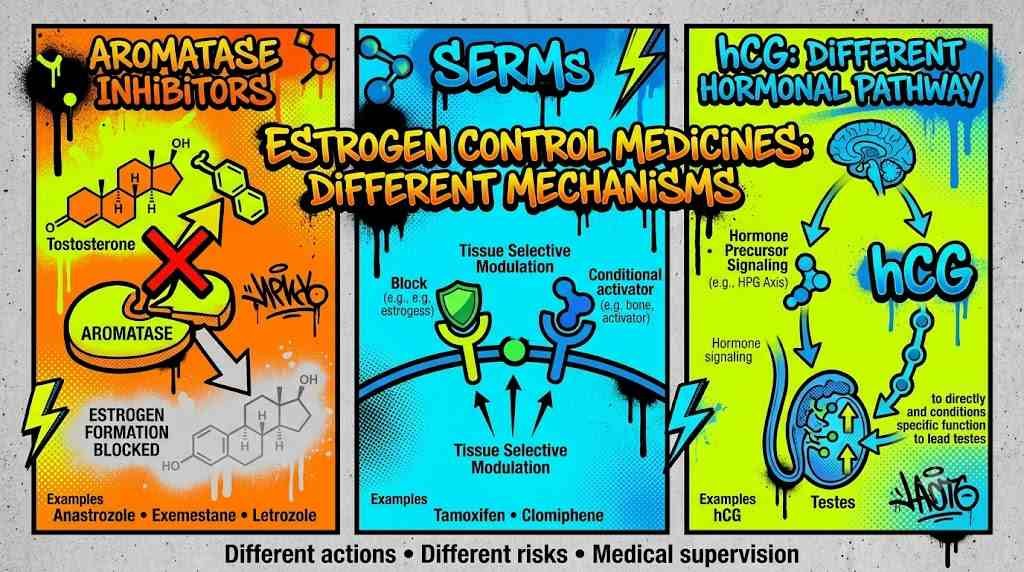
When discussing estrogen on steroids, certain medicines come up regularly in bodybuilding communities. Some are used to lower estrogen production, while others act on estrogen receptors or are discussed in relation to testosterone recovery after anabolic steroid use.
However, these medicines work differently. They are not interchangeable, and using the wrong one can make hormonal problems worse rather than better. Best Supplements for Bulking: What Actually Helps?
1. Anastrozole (Arimidex)
Anastrozole is an aromatase inhibitor, a type of medicine that reduces the conversion of androgens into estrogen. It is commonly discussed among bodybuilders using testosterone who are concerned about elevated estradiol.
The main thing to understand is that lowering estrogen too much can cause problems of its own. Excessive suppression may contribute to joint discomfort, reduced libido, sexual dysfunction, and long-term bone health concerns. Anastrozole should not be used simply because someone notices water retention or assumes their estrogen is high.
2. Exemestane (Aromasin)
Exemestane is another aromatase inhibitor. Unlike anastrozole, it irreversibly inactivates the aromatase enzyme, but its overall purpose is also to reduce estrogen production.
Some bodybuilders discuss exemestane as an alternative to other aromatase inhibitors. However, it can still cause excessively low estrogen levels and related adverse effects. The fact that a medicine works differently does not automatically make it safer for unsupervised bodybuilding use.
3. Letrozole (Femara)
Letrozole is a potent aromatase inhibitor used medically for specific hormone-sensitive conditions. It is also discussed in bodybuilding circles as an estrogen-lowering drug.
Because it can suppress estrogen substantially, unsupervised use is particularly concerning. Trying to eliminate water retention or quickly change physical appearance is not a reliable reason to use it. A leaner-looking physique does not necessarily mean better health or better muscle growth.
4. Tamoxifen (Nolvadex)
Tamoxifen belongs to a different group of medicines called selective estrogen receptor modulators (SERMs). Instead of directly reducing estrogen production, it changes how estrogen receptors respond in certain tissues.
It is often discussed in connection with gynecomastia, which involves the development of glandular breast tissue in males. Tamoxifen is not an aromatase inhibitor, and it does not simply lower the amount of estrogen circulating in the blood. Whether it is appropriate for a particular case depends on the diagnosis and medical assessment.
5. Clomiphene (Clomid)
Clomiphene is another SERM that acts on estrogen feedback mechanisms. In selected clinical situations, it can stimulate signals involved in the body’s own testosterone production.
Bodybuilders sometimes discuss clomiphene in the context of post-cycle recovery. However, recovery after anabolic steroid use varies considerably, and clomiphene is not a guaranteed solution for testosterone suppression or fertility problems. It can also cause adverse effects and requires appropriate medical supervision.
6. Human Chorionic Gonadotropin (hCG)
Human chorionic gonadotropin, commonly called hCG, is a hormone medication that acts on receptors involved in testicular function. It has medical uses in certain reproductive and hormonal conditions.
Some bodybuilders discuss it in relation to testicular function and recovery after steroid use. However, hCG is not an estrogen blocker. By stimulating testosterone production in the testes, it can also increase the amount of testosterone available for conversion into estradiol.
Its use therefore requires an understanding of the wider hormonal picture rather than focusing on estrogen alone.
Which Medicine Lowers Estrogen, and Which Does Not?
The following table summarizes the key differences.
| Medicine | Main action | Directly lowers estrogen production? |
|---|---|---|
| Anastrozole | Inhibits aromatase | Yes |
| Exemestane | Inactivates aromatase | Yes |
| Letrozole | Inhibits aromatase | Yes |
| Tamoxifen | Modifies estrogen receptor activity | No |
| Clomiphene | Modifies estrogen feedback signaling | No |
| hCG | Stimulates testicular hormone production | No; estradiol may rise |
Should Bodybuilders Use These Medicines During a Steroid Cycle?
Not automatically. Taking testosterone or another anabolic steroid does not mean everyone needs an estrogen-lowering medicine. Symptoms such as water retention, reduced libido, and breast changes can have several causes, and they cannot reliably establish whether estradiol is high or low.
A healthcare professional may consider estradiol testing, testosterone levels, other laboratory results, symptoms, and the substances used before deciding whether treatment is appropriate.
The bottom line: Aromatase inhibitors reduce estrogen production, while SERMs change estrogen receptor signaling. hCG works through a different hormonal pathway altogether. These medicines have distinct effects and risks, so they should not be combined or adjusted based on gym advice alone. Maintaining hormonal health is more important than chasing the lowest possible estrogen level. SHBG on Blood Test: Normal Range, High & Low Levels Explained
Estrogen on Steroids: Common Estrogen Myths in Bodybuilding
Let’s clear up a few misconceptions that regularly appear in gym conversations.
Myth 1: Estrogen is a female hormone, so men should keep it as low as possible.
Reality: Men need estradiol for normal sexual function, bone health, and other physiological processes.
Myth 2: Water retention always means high estrogen.
Reality: Fluid retention has multiple possible causes. Diet, kidney function, medications, and other hormonal systems can influence it.
Myth 3: Low estrogen always means a leaner physique.
Reality: Temporary changes in fluid balance may affect appearance, but excessive estrogen suppression can harm health and doesn’t guarantee better muscle gains.
Myth 4: Puffy nipples always mean high estrogen.
Reality: Breast appearance alone cannot establish estradiol levels or confirm gynecomastia.
Myth 5: Every anabolic steroid raises estrogen.
Reality: Different compounds have different metabolic pathways. Some can be converted into estrogen, while others cannot undergo that direct conversion.
Myth 6: If estrogen is high, an aromatase inhibitor is always the answer.
Reality: The underlying cause, symptoms, test results, and individual medical circumstances matter. Treatment isn’t a one-size-fits-all decision.
Myth 7: Normal estrogen means anabolic steroid use is safe.
Reality: Anabolic steroids can affect cardiovascular health, fertility, natural hormone production, the liver, and other systems independently of estradiol.
Estrogen on Steroids: When Should You Seek Medical Help?
Don’t ignore persistent symptoms or assume they can all be fixed by changing estrogen.
Arrange a medical assessment if you experience:
- New or growing breast tissue, especially if painful.
- Persistent loss of libido or erectile difficulties.
- Unexplained fatigue or significant mood changes.
- Ongoing joint symptoms after starting a hormone-altering medication.
- Fertility concerns or testicular changes.
A hard breast lump, nipple discharge, or significant skin changes deserve prompt assessment. Chest pain, severe shortness of breath, fainting, or sudden neurological symptoms require emergency medical care.
If you are using anabolic steroids, tell your healthcare professional what you have taken and when. Accurate information helps them interpret blood tests and assess potential complications.
If you are considering stopping after prolonged use, seek medical support rather than trying to manage hormone recovery through an improvised combination of drugs. Recovery varies between individuals, and evidence for many self-directed steroid withdrawal protocols remains limited. What Is PCT? Dosage & Chart
Frequently Asked Questions about Estrogen on Steroids
1. Estrogen on Steroids: What happens to estrogen when you take anabolic steroids?
It depends on the compound. Testosterone can convert into estradiol through aromatase, potentially increasing estrogen levels. Other anabolic steroids have different metabolic effects and may disrupt the body’s natural hormone production without directly converting into estrogen.
2. What are the signs of high estrogen in male bodybuilders?
Possible signs include breast tissue enlargement, breast tenderness, and changes in sexual function. Fluid retention may also occur, but symptoms alone cannot confirm elevated estradiol. Blood tests and clinical assessment help clarify the cause.
3. What are the symptoms of low estrogen in men?
Possible symptoms include reduced libido, sexual difficulties, mood changes, and joint discomfort. Persistently low estradiol can also negatively affect bone density.
4. Does high estrogen stop muscle growth?
No. Elevated estradiol does not automatically prevent muscle growth. Training quality, nutrition, recovery, genetics, and overall hormonal health all contribute to results.
5. Can low estrogen affect libido?
Yes. Estradiol plays an important role in male sexual function, and excessive suppression may contribute to reduced libido or erectile difficulties. Other causes, including low testosterone, should also be considered.
6. Estrogen on Steroids: Can estrogen cause gynecomastia during a steroid cycle?
Hormonal changes associated with anabolic steroid use can contribute to gynecomastia. However, breast enlargement has other possible causes, and symptoms should be assessed rather than treated based on assumptions.
7. Which blood test checks estrogen in men?
An estradiol (E2) blood test measures the principal estrogen relevant to male hormonal assessment. A clinician may also recommend testosterone, SHBG, LH, FSH, and other tests depending on the circumstances.
8. Should bodybuilders lower estrogen to get a dry look?
Not automatically. Appearance isn’t a reliable indicator of estradiol levels, and excessive estrogen suppression can cause health problems. Persistent water retention should be investigated rather than treated by guesswork.
9. Estrogen on Steroids: Do all anabolic steroids increase estrogen?
No. Testosterone can be converted into estradiol through aromatase, but non-aromatizing compounds do not undergo that same direct conversion. They can still cause significant hormonal disturbances and other adverse effects.
10. Can estrogen levels return to normal after stopping steroids?
Hormone recovery varies according to the substances used, exposure duration, individual physiology, and other health factors. Some people recover over time, while others experience prolonged suppression or reproductive problems requiring medical evaluation.
Need Help Understanding Your Blood Tests?
Gym Pundit — Bodybuilding Education
If you’re confused about estradiol, testosterone, SHBG, or other blood-test markers, seek guidance from a qualified healthcare professional who understands hormone health and anabolic steroid exposure.
For general bodybuilding product and educational enquiries, contact Gym Pundit on WhatsApp.
WhatsApp: +91 76965 93279 Contact on WhatsApp
Final Thoughts on Estrogen on Steroids
Estrogen is one of the most misunderstood hormones in bodybuilding. Some lifters worry about high estrogen, while others try to eliminate it completely. Neither approach reflects how male hormonal health actually works.
The important point is that both high and low estradiol can be problematic, and neither can be diagnosed reliably from appearance alone.
If you’re using or have used anabolic steroids, pay attention to persistent symptoms, get appropriate medical assessments, and avoid self-prescribing hormone-altering medications based on gym advice.
Your goal should be to build muscle while protecting your long-term health—not to chase a particular hormone number at any cost.