Whey Protein vs Mass Gainer is a common question among people who are trying to build muscle, gain weight, or simply improve their daily nutrition. Both products can help, but they do completely different jobs. Whey protein mainly helps you increase your protein intake, while a mass gainer is designed to provide a much larger amount of calories, carbohydrates, and protein in one serving.
So, which one should you choose?
The answer depends on your diet, calorie intake, bodyweight, training routine, and your actual goal. If you already eat enough calories but struggle to hit your protein target, whey protein may be all you need. If you struggle to eat enough food and cannot maintain a calorie surplus, a mass gainer can make getting those extra calories much easier.
Let’s break down Whey Protein vs Mass Gainer in simple gym language. Best Foods for Muscle Growth: Diet Plans Added
What Is Whey Protein?
Whey protein is a protein supplement made from milk. It is commonly used by people who train regularly because it provides a convenient way to increase daily protein intake.
Most whey products contain a relatively high percentage of protein with comparatively fewer calories, although the exact nutrition depends on the product.
A typical serving may provide around 20–30 grams of protein, while calories can vary depending on the brand and formulation.
The main purpose of whey is simple:
It helps you reach your daily protein requirement.
Your muscles need protein to repair and rebuild after resistance training. However, whey protein is not magic. It does not automatically build muscle just because you drink it. Your overall diet, training, recovery, and total calorie intake still matter.
What Is a Mass Gainer?
A mass gainer is a high-calorie supplement designed for people who have difficulty consuming enough calories from normal meals.
Compared with ordinary whey protein, mass gainers usually contain much more carbohydrate and total calories. Many products also contain protein, making them a combination of protein and calorie supplementation.
Depending on the product, one serving can contain several hundred calories and sometimes well over 1,000 calories.
The basic idea is:
More calories + enough protein = easier weight gain when combined with proper training.
This can be useful for people with high calorie requirements or people who simply struggle to eat large amounts of food every day.
Whey Protein vs Mass Gainer: The Main Difference
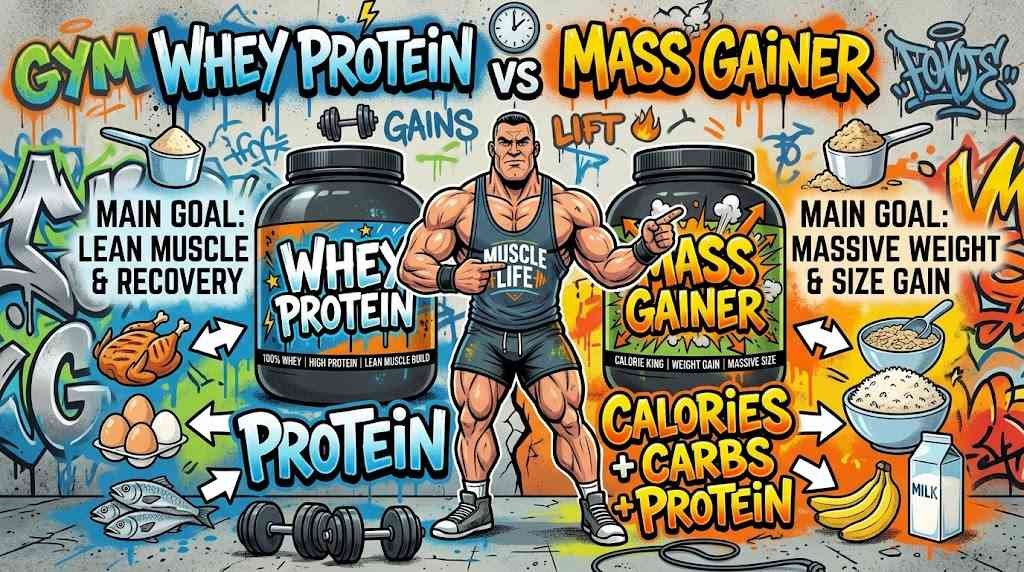
The easiest way to understand Whey Protein vs Mass Gainer is to look at what each supplement is mainly trying to solve.
Whey protein: Helps you increase protein intake.
Mass gainer: Helps you increase total calorie intake while also providing protein.
For example, imagine someone needs 2,800 calories and 150 grams of protein every day.
If they are already eating around 2,700–2,800 calories but only getting 110 grams of protein, whey protein could be useful.
Now imagine another person needs 2,800 calories but can only manage around 2,200 calories from regular food because they have a small appetite or a busy schedule. A mass gainer could make it easier to add the missing calories.
That is why there isn’t one universal answer to the Whey Protein vs Mass Gainer debate.
Whey Protein vs Mass Gainer for Muscle Growth
When the goal is muscle growth, both products can potentially fit into a good diet.
But neither supplement directly replaces proper resistance training.
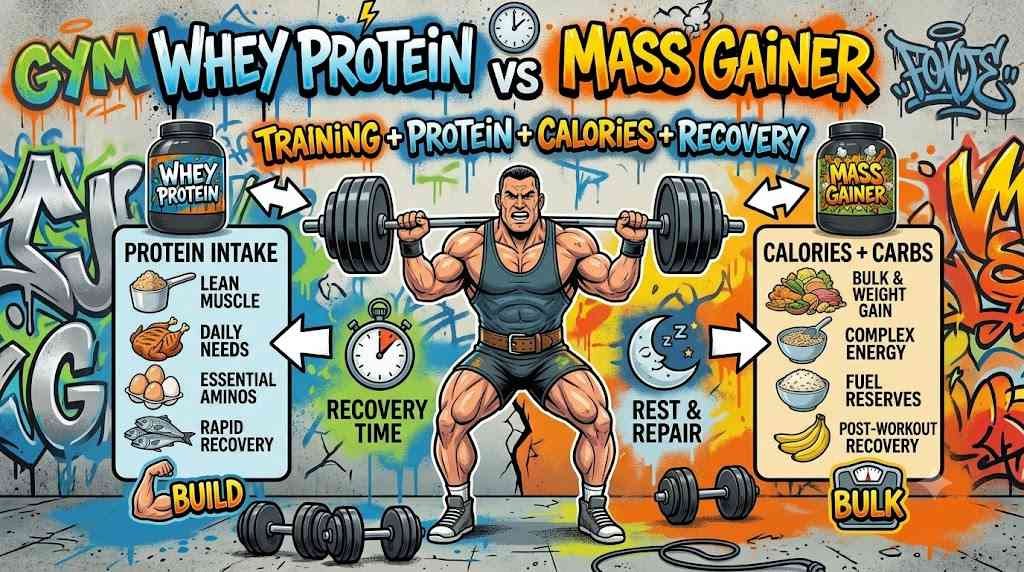
Muscle growth requires a combination of progressive resistance training, adequate protein, sufficient calories, recovery, and consistency.
Whey protein can make it easier to hit your protein target. A mass gainer can make it easier to hit your calorie target.
If your calorie intake is already sufficient, adding a huge amount of extra calories from a mass gainer may not be necessary.
On the other hand, if you cannot consistently eat enough calories, a mass gainer can be convenient.
This is one of the most important points when comparing Whey Protein vs Mass Gainer:
Choose the supplement that solves the problem your diet actually has.
Whey Protein vs Mass Gainer for Weight Gain
If your main goal is to increase bodyweight, calories become extremely important.
You need to consume enough total energy to support weight gain. Simply drinking whey protein does not guarantee that your bodyweight will increase.
Whey can contain relatively few calories compared with a full mass-gainer serving.
A mass gainer, meanwhile, is specifically designed to make calorie consumption easier.
For someone who struggles to eat enough food, drinking a calorie-dense shake can be much easier than forcing down another large meal.
However, gaining weight quickly does not necessarily mean gaining muscle quickly.
A very large calorie surplus can also increase body fat.
That’s why weight gain should still be controlled and monitored.
Whey Protein vs Mass Gainer for Skinny People
A common question is whether skinny people should automatically use a mass gainer.
Not necessarily.
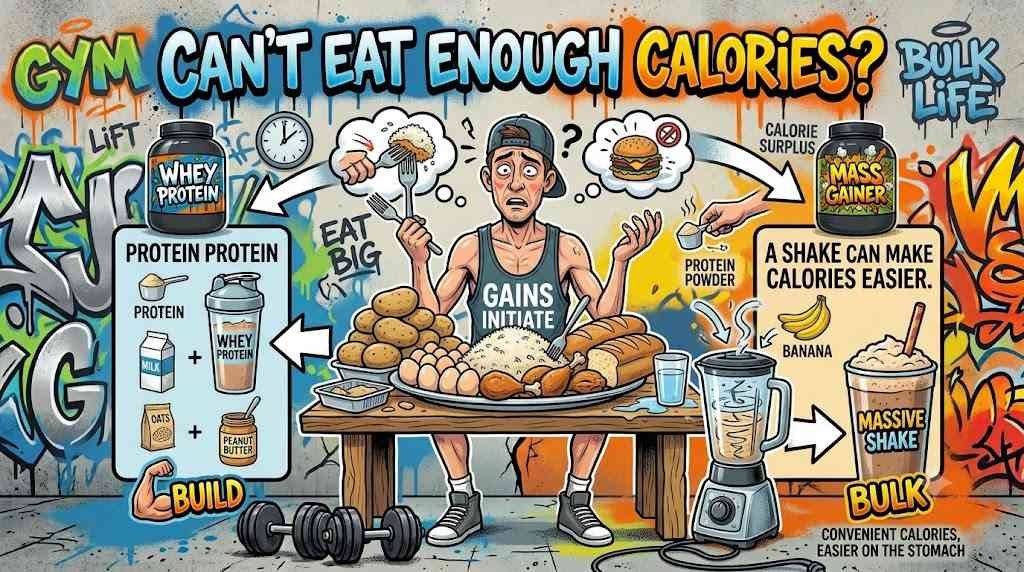
Being naturally thin does not automatically mean you need a mass gainer. First, look at your normal food intake.
If you are eating enough calories and protein but still need a convenient protein source, whey may be sufficient.
If you consistently struggle to eat enough calories, a mass gainer may be more practical.
For example, someone who has a low appetite might find it easier to drink a calorie-rich shake between meals than add another large plate of food.
But the foundation should still be normal food.
Rice, oats, potatoes, bread, dairy, eggs, chicken, fish, legumes, nuts, fruits, and other nutrient-rich foods can all contribute to a calorie-surplus diet.
Whey Protein vs Mass Gainer for People Who Gain Fat Easily
The situation is different for people who gain body fat quickly.
If you already consume enough calories, adding a large mass-gainer shake on top of your existing diet may push your calorie intake much higher than necessary.
In this situation, whey protein can be more convenient because you can increase protein intake without adding as many calories.
Your total daily calorie intake matters much more than whether a product is marketed as a “muscle gainer.”
So if your goal is to build muscle while keeping unnecessary calorie intake under control, calculate your overall diet first.
Whey Protein vs Mass Gainer: Protein Content
Protein is one of the biggest differences between these products.
Whey protein is specifically concentrated around protein. Depending on the formulation, a serving commonly provides around 20–30 grams of protein.
Mass gainers also contain protein, but they usually contain a significant amount of carbohydrates and calories alongside it.
This means you should not compare products only by the scoop size.
A huge scoop of mass gainer may weigh considerably more than a scoop of whey because it contains carbohydrates, fats, protein, and other ingredients.
Always look at the nutrition label.
Check:
- Total calories
- Protein
- Carbohydrates
- Fat
- Sugar
- Serving size
- Number of servings
- Ingredients
This makes the Whey Protein vs Mass Gainer comparison much more useful than simply looking at the size of the container. How to Gain Muscle Without Gaining Too Much Fat
Whey Protein vs Mass Gainer: Calories
Calories are where mass gainers really separate themselves from whey protein.
A whey shake can provide protein without adding a huge number of calories.
A mass gainer is usually much more calorie-dense.
This can be helpful if you have a high calorie requirement.
For example, someone trying to consume 3,500 calories every day may find it difficult to get everything from regular meals. A calorie-dense shake can make the diet easier to manage.
But remember that the calories still count.
If your body needs 2,500 calories and you are already eating 3,000 calories, adding another 1,000-calorie shake may simply make the surplus larger.
Whey Protein vs Mass Gainer: Carbohydrates
Mass gainers usually contain considerably more carbohydrates than regular whey protein.
Carbohydrates are an important source of energy and can support hard training.
They can also make it easier to increase total calorie intake.
However, you don’t need a mass gainer simply because carbohydrates are useful.
You can also get carbohydrates from normal foods such as:
- Rice
- Oats
- Potatoes
- Pasta
- Bread
- Fruits
- Cereals
- Beans and other legumes
A mass gainer is mainly a convenience tool.
Can You Use Whey Protein and Mass Gainer Together?
Yes, but you may not need both.
Using both products makes sense only if they help you meet your nutritional targets.
For example, someone with a very high calorie requirement might use a mass gainer to help reach their calorie target while using whey separately when additional protein is needed.
But there is also a simpler approach.
You can make your own high-calorie shake using whey protein, milk or another suitable liquid, oats, banana, peanut butter, and other foods.
This can give you protein and calories while allowing you to control the ingredients and portion sizes.
The important thing is not how many supplements you use.
The important thing is whether your overall diet supports your goal.
Whey Protein vs Mass Gainer: Which Is Better for Beginners?
Beginners often think supplements are the most important part of gaining muscle.
They aren’t.
If you’re new to training, focus first on:
- A consistent resistance-training routine
- Enough total calories
- Adequate daily protein
- Quality carbohydrates and fats
- Good sleep
- Hydration
- Progressive overload
- Consistency
Once those basics are under control, supplements can make certain parts of the diet more convenient.
For many beginners, whey protein is easier to understand because its main purpose is straightforward: increase protein intake.
A mass gainer becomes more useful when calories are the bigger problem.
Whey Protein vs Mass Gainer: Which One Should You Choose?
Here’s a simple way to think about it.
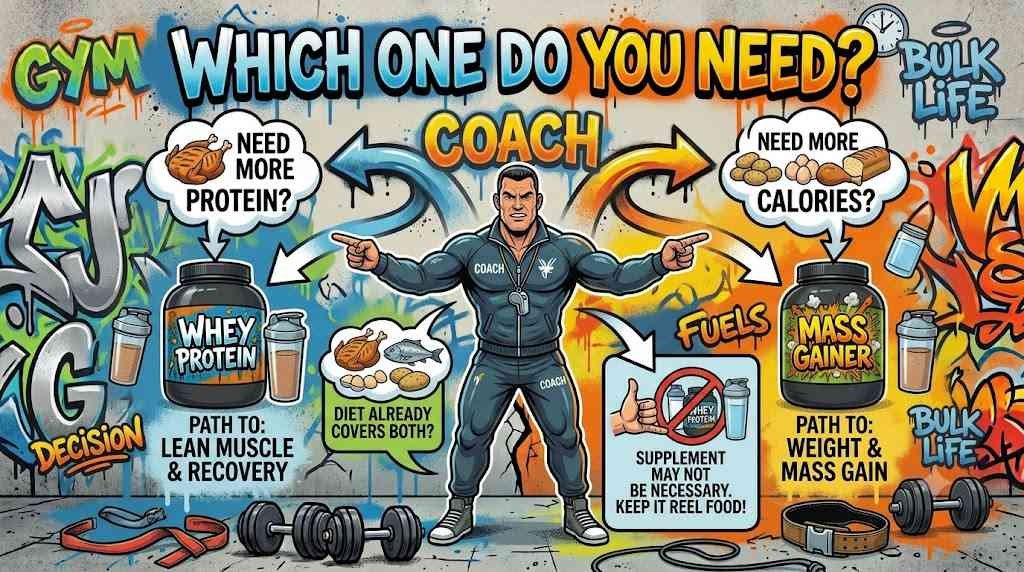
Choose Whey Protein If:
- You already eat enough calories.
- You struggle to reach your daily protein target.
- You want a convenient post-workout protein source.
- You want more control over your calorie intake.
- You are trying to gain muscle without unnecessarily increasing calories.
- You already get plenty of carbohydrates from normal food.
Consider a Mass Gainer If:
- You struggle to eat enough calories.
- You have a low appetite.
- You need a convenient way to add calories between meals.
- You have a high calorie requirement.
- Your bodyweight is not increasing despite consistently trying to eat more.
- You prefer drinking some of your calories instead of eating another large meal.
The key is to choose based on your diet rather than choosing based on advertising.
Can Mass Gainers Make You Fat?
A mass gainer does not automatically make someone fat.
But consuming more calories than your body needs over time can lead to increased bodyweight, including body fat.
This is why portion size matters.
Someone who needs an additional 300–500 calories may not need the entire serving recommended on the label.
You can adjust the serving based on your nutritional requirements.
The same principle applies to any calorie-dense food.
The product itself isn’t the only factor. Your total calorie intake over time matters. Protein for Muscle Gain: How Much Do You Really Need?
Can Whey Protein Make You Gain Weight?
Whey protein can contribute to weight gain because it contains calories and protein.
But a normal whey serving is generally much less calorie-dense than a mass gainer.
If your overall calorie intake remains below what your body needs, simply adding whey may not produce significant weight gain.
For muscle growth, you need adequate total nutrition rather than just extra protein.
Think of whey as a convenient protein food rather than a magic weight-gain product.
Is a Homemade Mass Gainer Better?
You don’t necessarily need a commercial mass gainer.
A homemade shake can be a very practical option.
For example, you could combine:
- Whey protein
- Oats
- Banana
- Milk
- Peanut butter
This gives you a combination of protein, carbohydrates, fats, and calories.
You can increase or decrease the ingredients depending on your calorie needs.
The advantage is control.
You know exactly what you are adding and can adjust the shake according to your diet.
Commercial mass gainers are mainly about convenience.
Common Mistakes When Choosing Between Whey Protein and Mass Gainer
One common mistake is choosing a supplement before calculating your diet.
People often buy a mass gainer because they want to gain weight, even though they are already eating enough calories.
Another mistake is assuming that more calories automatically mean more muscle.
Muscle growth has limits. Extra calories beyond what you need can increase body fat rather than dramatically accelerating muscle growth.
Another mistake is ignoring the nutrition label.
Don’t judge a product only by the words “mass,” “muscle,” or “high protein” on the front of the package.
Look at the actual nutrition facts.
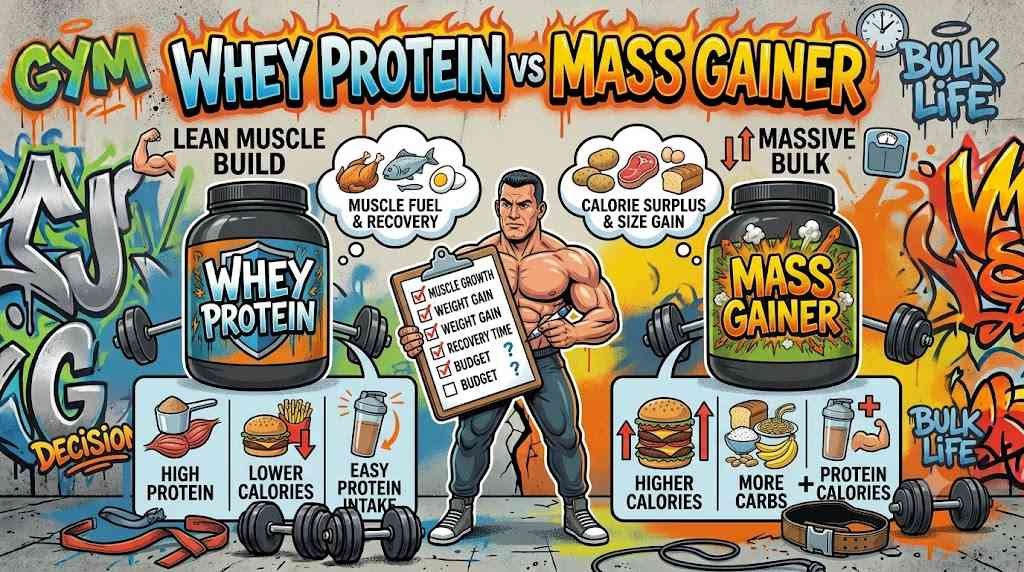
Whey Protein vs Mass Gainer: A Simple Comparison
| Feature | Whey Protein | Mass Gainer |
|---|---|---|
| Main purpose | Increase protein intake | Increase calories and protein |
| Protein | High relative to calories | Moderate to high |
| Calories | Usually lower | Usually much higher |
| Carbohydrates | Usually lower | Usually higher |
| Best suited for | Protein supplementation | Calorie supplementation |
| Weight gain | Not specifically designed for it | Specifically designed to make calorie surplus easier |
| Appetite issues | May not solve the problem | Can be useful |
| Calorie control | Easier | Requires more attention |
| Convenience | High | High |
The exact numbers vary between brands, so always check the individual product label.
Whey Protein vs Mass Gainer: What About Post-Workout?
Both can be used around workouts, but you don’t have to drink either one immediately after your last set.
Your overall daily nutrition is more important than obsessing over a tiny post-workout window.
Whey can be convenient after training because it provides a substantial amount of protein without requiring a large meal.
A mass gainer can also be used after training if you need additional calories and find it difficult to eat enough food.
The better choice depends on what your daily diet is missing.
Whey Protein vs Mass Gainer: Do You Really Need Either?
No.
Supplements are optional.
You can build muscle and gain weight using normal foods if you can consistently meet your calorie and protein requirements.
Whey protein and mass gainers are simply convenient tools.
Think of them as shortcuts for nutrition—not replacements for nutrition.
If you can get enough protein from eggs, chicken, fish, dairy, meat, legumes, and other foods, you don’t necessarily need whey.
If you can get enough calories from regular meals, you don’t necessarily need a mass gainer.
Final Verdict on Whey Protein vs Mass Gainer
The Whey Protein vs Mass Gainer debate becomes much easier once you understand what your diet is missing.
If your main problem is protein, whey protein can be a simple solution.
If your main problem is calories, especially when you struggle to eat enough food, a mass gainer can be more useful.
Neither product is automatically better for everyone.
For muscle growth, the foundation remains the same: progressive resistance training, enough protein, sufficient calories, good recovery, and consistency.
Use supplements to fill nutritional gaps instead of building your entire diet around them.
In simple gym language:
Need more protein? Think whey.
Need more calories? Think mass gainer.
Need both? You may be able to use either a mass gainer or a homemade high-calorie protein shake depending on your diet.
The best choice is the one that helps you consistently hit your nutritional targets without making your diet unnecessarily complicated. Oral Steroids for Beginners: Complete Guide
Frequently Asked Questions About Whey Protein vs Mass Gainer
Is whey protein better than mass gainer?
Neither is universally better. Whey protein is mainly useful for increasing protein intake, while mass gainers are designed to provide significantly more calories along with protein.
Can I take whey protein instead of a mass gainer?
Yes. If you can get enough calories from normal food but need additional protein, whey may be all you need. If you cannot eat enough calories, whey alone may not solve the problem.
Is mass gainer good for skinny people?
It can be useful for someone who struggles to consume enough calories. However, being skinny does not automatically mean you need a mass gainer. Your total calorie intake should be considered first.
Can I take whey protein and mass gainer together?
You can, but there may be no need to use both. Look at your daily calorie and protein requirements first and use supplements to fill the gaps.
Does mass gainer build muscle?
A mass gainer does not directly build muscle. It can help provide calories and protein that support a muscle-building diet when combined with appropriate resistance training.
Does whey protein increase bodyweight?
It can contribute to weight gain if it increases your overall calorie intake. However, whey is generally more focused on protein than calories.
Can I make my own mass gainer?
Yes. A homemade shake containing whey, oats, milk, banana, peanut butter, or similar foods can provide substantial calories and protein while allowing you to control the ingredients.
Which is better for lean muscle gain?
The answer depends on your overall diet. If you already consume enough calories but need protein, whey can be convenient. If you cannot reach your calorie target, a controlled amount of a mass gainer may be useful.
Should beginners use a mass gainer?
Beginners do not automatically need a mass gainer. Start by establishing a consistent diet and training routine. Use a mass gainer if you genuinely struggle to consume enough calories.
How do I decide between whey protein and mass gainer?
Look at your diet first. If protein is lacking, consider whey. If calories are lacking, consider a mass gainer. If neither is lacking, you may not need either supplement.
Final Takeaway
When it comes to Whey Protein vs Mass Gainer, don’t let supplement marketing make the decision for you.
First figure out what your body and diet actually need.
Protein problem? Whey can help.
Calorie problem? A mass gainer can help.
No nutrition problem? You may not need either.
Build your diet around real food, train consistently, recover properly, and use supplements as convenient tools when necessary.
Need Help Choosing Between Whey Protein and Mass Gainer?
Still confused about whether whey protein or a mass gainer fits your diet? Your calorie needs, protein intake, bodyweight, training routine, and goal all make a difference.
If you want help understanding which type of supplement may fit your nutrition plan, you can contact the Gym Pundit team on WhatsApp.
WhatsApp: 7696593279
Share your current bodyweight, height, training routine, daily diet, and goal, and you can get guidance on how to structure your nutrition and supplement choices around your routine.