Steroid Half-Life is an important concept for anyone interested in anabolic steroids, bodybuilding pharmacology, and understanding how different compounds behave inside the human body. Some anabolic steroids have relatively short elimination half-lives, while others have much longer release and elimination profiles.
For example, oral steroids such as Anavar and Dianabol generally have elimination half-lives measured in hours. On the other hand, injectable testosterone esters such as Enanthate and Cypionate have much longer pharmacokinetic profiles.
The main reason behind these differences is the chemical structure of each compound, the presence of an ester, and how the body absorbs, metabolizes, and eliminates the drug.
Understanding Steroid Half-Life also helps explain why two steroids based on the same parent hormone can behave differently. Testosterone Propionate and Testosterone Enanthate both deliver testosterone, but their release characteristics are not the same.
In this article, we will explain Steroid Half-Life in simple language, compare commonly discussed oral and injectable anabolic steroids, discuss their approximate elimination profiles, and explain the difference between half-life, active duration, and detection time. Where to Buy Anabolic Steroids: Authenticity Guide
1. What Is Steroid Half-Life?
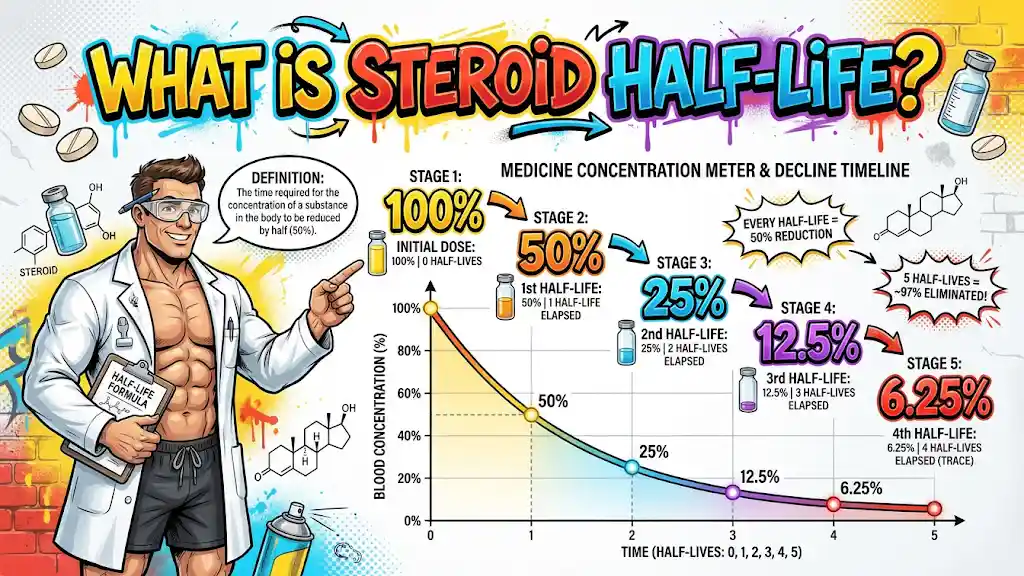
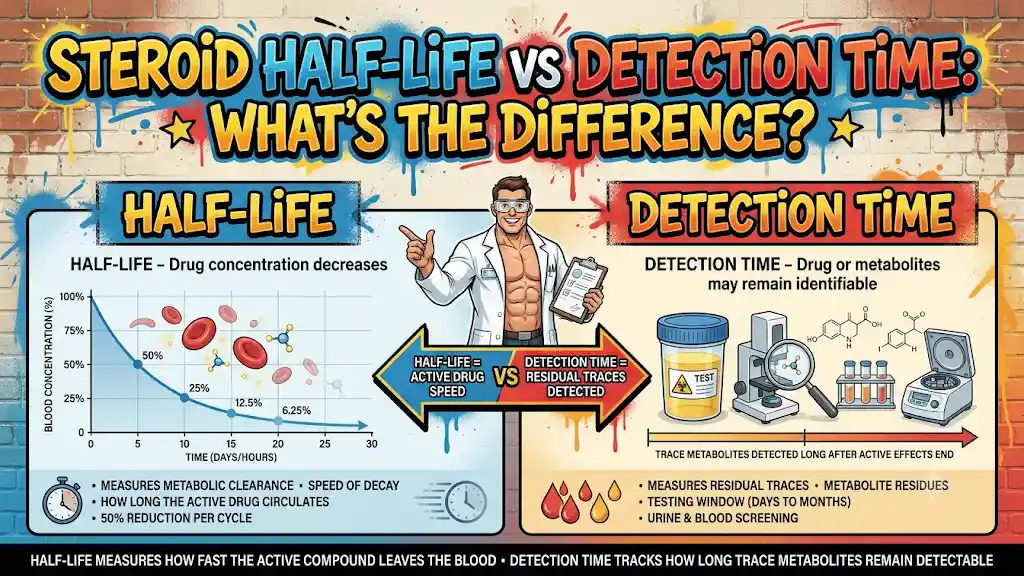
Steroid Half-Life refers to the time required for the concentration of a drug in the bloodstream to decrease by approximately 50% during its elimination phase.
In simple words, imagine that a particular steroid has reached a concentration of 100 units in the bloodstream. After one half-life, approximately 50 units remain. After another half-life, around 25 units remain.
This process continues until the concentration becomes very small.
It is important to understand that half-life does not mean the steroid becomes completely inactive once that period passes. Some of the compound can remain in the body after several half-lives, and its biological effects may continue even as its blood concentration decreases.
Steroid Half-Life: Understanding the 50% Rule
| Elapsed half-lives | Approximate amount remaining |
|---|---|
| 0 | 100% |
| 1 | 50% |
| 2 | 25% |
| 3 | 12.5% |
| 4 | 6.25% |
| 5 | 3.125% |
This is a simplified elimination model. Actual steroid pharmacokinetics can be more complicated, particularly with injectable oil-based preparations.
2. How Does Steroid Half-Life Work?
The body processes anabolic steroids through several stages, including absorption, distribution, metabolism, and elimination.
When an oral steroid is swallowed, it passes through the digestive system and is absorbed into the bloodstream. It then undergoes metabolism, particularly in the liver.
Injectable steroids work differently. Many injectable anabolic steroids are dissolved in oil and contain an attached ester. After administration, the compound is gradually released from the oil depot into circulation.
The ester is subsequently removed by enzymes called esterases, releasing the active parent steroid.
This explains why some injectable steroids have much longer apparent half-lives than oral steroids.
Four Important Stages of Steroid Half-Life
1. Absorption
This is how the compound enters the bloodstream. Oral and injectable steroids have different absorption processes.
2. Distribution
After entering circulation, the compound travels through the bloodstream and reaches different tissues.
3. Metabolism
The body chemically processes the steroid, particularly through enzymes in the liver and other tissues.
4. Elimination
The body removes the compound and its metabolites through different elimination pathways.
These processes collectively determine the drug’s concentration over time.
3. Why Does Steroid Half-Life Differ Between Compounds?
Not all anabolic steroids have the same chemical structure. Even when two compounds are based on testosterone, small chemical modifications can significantly change their pharmacokinetic properties.
Some steroids are designed to be absorbed and eliminated relatively quickly, while others are modified to provide slower release.
The following factors play an important role.
Factors Affecting Steroid Half-Life
1. Ester Attachment
Injectable testosterone and other steroid esters contain chemical attachments that influence how quickly the compound is released from the injection site.
2. Molecular Structure
Chemical modifications can change how a steroid is absorbed, metabolized, and eliminated.
3. Oral or Injectable Formulation
Oral steroids generally have different absorption and metabolism patterns compared with oil-based injectable steroids.
4. Oil Depot Characteristics
The oil vehicle, injection site, and formulation can influence the release of an injectable steroid.
5. Individual Differences
Body composition, liver function, metabolism, and other physiological factors can influence drug exposure and elimination.
4. Steroid Half-Life: Short Ester vs Long Ester
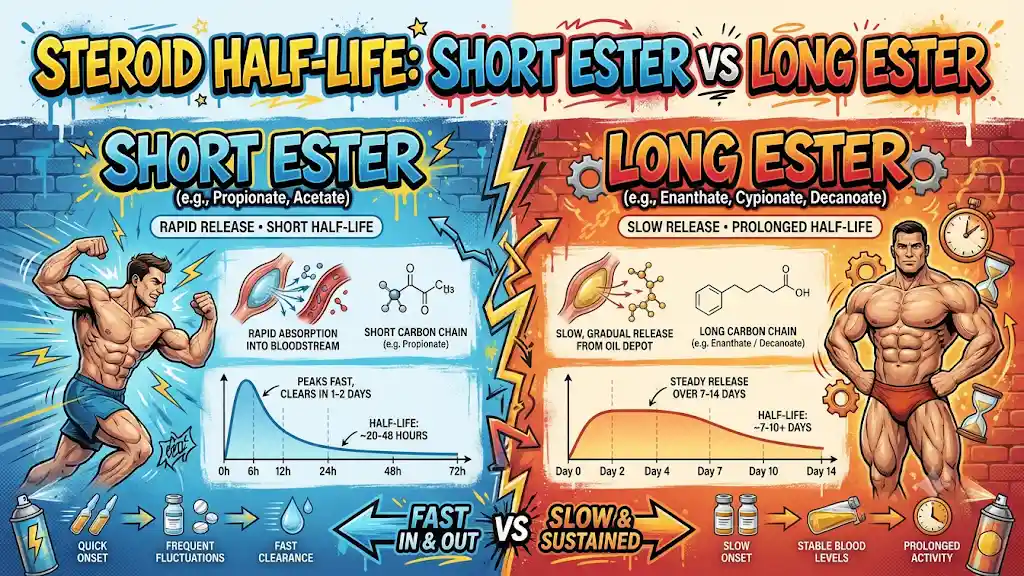
One of the most important differences in injectable anabolic steroids is the ester attached to the steroid molecule.
An ester is a chemical modification that generally makes an injectable steroid more oil-soluble and slows its release from the injection site.
Short Ester Steroid Half-Life
Short ester steroids generally have a faster release profile compared with longer ester versions of the same parent compound.
Testosterone Propionate is a common example.
Its shorter ester chain generally allows it to leave the oil depot more quickly than longer testosterone esters.
Long Ester Steroid Half-Life
Long ester steroids are designed for slower release from the injection site.
Testosterone Enanthate and Testosterone Cypionate are common examples.
Their longer ester structures increase their oil solubility and generally produce a more prolonged release profile. Beginner Cutting Cycle: Fat Loss, Muscle Retention, and Results
Short Ester vs Long Ester Comparison Chart
| Feature | Short ester | Long ester |
|---|---|---|
| Release pattern | Relatively faster | Relatively slower |
| Depot release | Shorter | Longer |
| Concentration changes | Generally faster | Generally slower |
| Elimination profile | Usually shorter | Usually longer |
| Example | Testosterone Propionate | Testosterone Enanthate |
Remember that ester length is not the only factor determining half-life. The parent steroid, formulation, and absorption characteristics also matter.
5. Injectable Steroid Half-Life: Common Anabolic Steroids
Injectable anabolic steroids are available in different ester forms. Their pharmacokinetic profiles can vary considerably, even when the active hormone is similar.
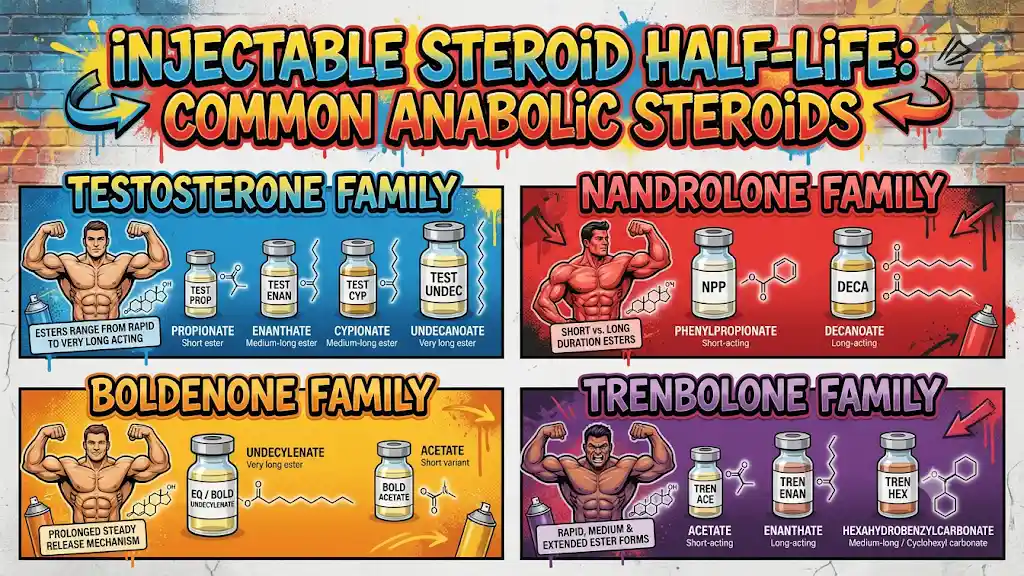
Testosterone Steroid Half-Life
Testosterone is available in several ester forms:
- Testosterone Propionate
- Testosterone Enanthate
- Testosterone Cypionate
- Testosterone Undecanoate
The ester changes the release characteristics, while the active hormone released is testosterone.
Nandrolone Steroid Half-Life
Nandrolone is commonly associated with two ester forms:
- Nandrolone Phenylpropionate (NPP)
- Nandrolone Decanoate (Deca Durabolin)
The phenylpropionate ester has a shorter release profile than the decanoate ester.
Boldenone Steroid Half-Life
Boldenone Undecylenate is an oil-based injectable ester with a prolonged release profile.
Its long ester chain contributes to slower release from the injection depot.
Trenbolone Steroid Half-Life
Trenbolone is available in different ester forms, including:
- Trenbolone Acetate
- Trenbolone Enanthate
- Trenbolone Hexahydrobenzylcarbonate
These forms differ in their release and elimination characteristics.
It is worth noting that half-life figures reported for injectable steroids can vary between studies. A published estimate for a drug’s terminal elimination half-life should not automatically be treated as its exact duration of biological activity.
6. Oral Steroid Half-Life: Common Anabolic Steroids
Oral anabolic steroids generally have different elimination half-lives from long-acting injectable ester preparations.
Many commonly discussed oral anabolic steroids are chemically modified to survive digestion and first-pass metabolism in the liver. However, these modifications can also introduce particular health risks, especially liver toxicity and negative changes in cholesterol levels.
Anavar Steroid Half-Life
Anavar (Oxandrolone) has a reported elimination half-life of approximately 9–13 hours, depending on the study and population.
It is an orally active anabolic steroid with a relatively well-documented pharmacokinetic profile.
Dianabol Steroid Half-Life
Dianabol (Methandrostenolone) has a reported half-life of approximately 3.2–4.5 hours.
Its relatively short elimination half-life is one of its distinguishing pharmacokinetic characteristics.
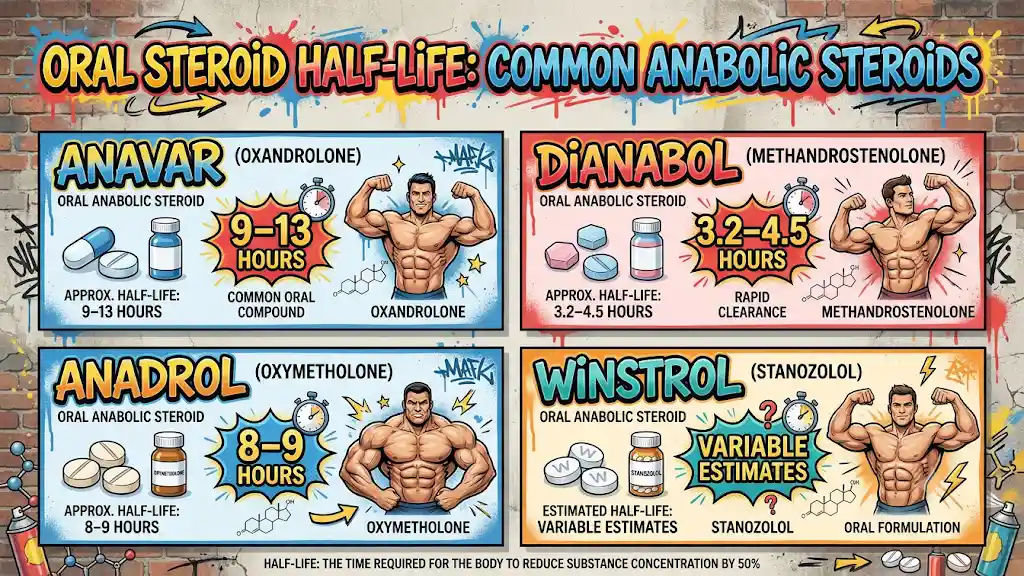
Anadrol Steroid Half-Life
Anadrol (Oxymetholone) has a reported elimination half-life of approximately 8–9 hours in pharmacological literature.
Winstrol Steroid Half-Life
Winstrol (Stanozolol) has different pharmacokinetic profiles depending on the formulation and route of administration.
Reported figures are not completely consistent across references, so it is better not to treat one number as universal.
7. Steroid Half-Life Comparison Chart
Here is a quick comparison of selected anabolic steroids and their commonly reported pharmacokinetic estimates.
Injectable Steroid Half-Life Chart
| Injectable steroid | Reported half-life or profile |
|---|---|
| Testosterone Propionate | Around 1 day in one review |
| Testosterone Enanthate | Around 4–5 days |
| Testosterone Cypionate | Around 8 days in some references |
| Testosterone Undecanoate | Very long-acting |
| Nandrolone Decanoate | Approximately 6–12 days; estimates vary |
| Nandrolone Phenylpropionate | Shorter than Decanoate |
| Boldenone Undecylenate | Long-acting depot |
| Trenbolone Acetate | Shorter-acting ester |
| Trenbolone Enanthate | Longer-acting ester |
| Methenolone Enanthate | Long-acting ester |
Oral Steroid Half-Life Chart
| Oral steroid | Reported elimination half-life |
|---|---|
| Dianabol | 3.2–4.5 hours |
| Anavar | 9–13 hours |
| Anadrol | 8–9 hours |
| Stanozolol | Variable; estimates differ |
| Fluoxymesterone | Around 9 hours |
These are approximate literature figures, not dosing or injection-interval recommendations. Injectable values are particularly dependent on the formulation and study methodology.
The testosterone ester estimates are not perfectly interchangeable. Different pharmacological references can report different values depending on the formulation and measurement method. Anadrol vs Superdrol: Strength, Size, Water Retention and Risks
8. How Long Do Steroids Stay Active in the Body?
This is one of the most common questions among bodybuilding enthusiasts.
A steroid’s half-life and its total time in the body are two different things.
If a compound has a half-life of 10 hours, it does not mean that the compound completely disappears after 10 hours. Approximately half of the measured amount remains after that period.
In a simplified model, approximately five half-lives are needed for the concentration to fall to around 3% of its initial level.
However, this does not mean that all biological effects stop after five half-lives.
Some anabolic steroids can continue influencing hormonal activity even after their blood concentrations have decreased considerably.
Why Steroid Half-Life Is Not the Same as Active Duration
- Blood concentration does not always reflect total drug remaining in the body.
- Active metabolites may remain after the parent compound decreases.
- Hormonal suppression can continue after the steroid itself has substantially declined.
- Injectable steroids can continue entering circulation from the injection depot.
Therefore, the time required for a steroid’s concentration to decline and the time required for its biological effects to disappear are not necessarily the same.
9. Steroid Half-Life vs Detection Time: What’s the Difference?
This is an important distinction that many people misunderstand.
Half-life tells us how quickly the concentration of a compound decreases in the body.
Detection time refers to how long a drug or its metabolites can be identified through laboratory testing.
These are not the same measurement.
For example, an anabolic steroid might have a relatively short blood half-life, but its metabolites may remain detectable in urine for a considerably longer period.
Modern anti-doping laboratories use advanced analytical techniques to identify steroid metabolites and other markers of exogenous steroid use.
Factors Affecting Steroid Detection Time
- The specific steroid and its metabolites.
- The amount and duration of exposure.
- The type of biological sample.
- The sensitivity of the laboratory method.
- Individual metabolic differences.
Therefore, it is not possible to calculate an exact detection window simply by multiplying a steroid’s half-life.
10. Factors That Affect Steroid Half-Life in the Human Body
Although pharmacological references provide estimated half-life values, individual results can differ.
Important Factors Affecting Steroid Half-Life
1. Ester Structure
The length and chemical structure of an ester can influence the release and elimination profile of injectable steroids.
2. Drug Formulation
Different oil vehicles, concentrations, and pharmaceutical preparations can influence absorption from an injection depot.
3. Liver Function
The liver plays an important role in metabolizing many anabolic steroids. Changes in liver function can affect drug metabolism.
4. Kidney Function
The kidneys help eliminate various drug metabolites and other waste products.
5. Individual Metabolism
Genetics, enzyme activity, age, and other physiological differences can contribute to variations in drug processing.
6. Active Metabolites
Some steroids produce metabolites that have their own elimination profiles, meaning their presence may continue after the parent compound has declined.
11. Why Understanding Steroid Half-Life Matters in Bodybuilding
Understanding Steroid Half-Life is useful because it helps explain several aspects of anabolic steroid pharmacology.
Understanding Different Ester Forms
It explains why Testosterone Propionate and Testosterone Enanthate have different release characteristics despite delivering the same parent hormone.
Understanding Hormonal Suppression
Anabolic steroids can suppress the body’s natural testosterone production. This suppression does not necessarily disappear as soon as circulating steroid concentrations decrease.
Understanding Post-Cycle Recovery
Hormonal recovery after anabolic steroid exposure depends on several factors, including the compounds used, exposure duration, and individual endocrine function. It cannot be predicted from half-life alone.
Understanding Health Monitoring
Different anabolic steroids can affect cholesterol, blood pressure, liver function, red blood cell production, and natural hormone production.
A shorter half-life does not mean a steroid is safer, and a longer half-life does not automatically mean it produces better muscle-building results.
The overall health risks depend on the compound, exposure, individual susceptibility, and other factors.
12. Frequently Asked Questions About Steroid Half-Life
1. Which anabolic steroid has the shortest half-life?
Among the examples discussed, Dianabol has a relatively short reported elimination half-life of approximately 3.2–4.5 hours. However, comparisons between oral compounds and injectable esters require care because their pharmacokinetic profiles differ.
2. Which testosterone ester has the longest duration of action?
Testosterone Undecanoate is a long-acting testosterone ester. Its pharmaceutical depot formulations can provide prolonged testosterone release compared with shorter testosterone esters.
3. Does a short Steroid Half-Life mean a steroid works faster?
Not necessarily. Half-life describes elimination, not the complete onset of biological effects. Absorption, receptor activity, formulation, and other pharmacological factors also matter.
4. Does a long Steroid Half-Life mean better muscle gains?
No. A longer half-life does not automatically produce greater muscle growth. Muscle development depends on several factors, including training, nutrition, genetics, and hormonal activity.
5. Is Steroid Half-Life the same as detection time?
No. Half-life measures the decline in drug concentration, whereas detection time refers to how long a compound or its metabolites can be identified by laboratory testing.
6. Do oral steroids have shorter half-lives than injectable steroids?
Many commonly used oral anabolic steroids have shorter elimination half-lives than long-acting injectable ester preparations. However, this is not a universal rule for every compound and formulation.
7. Does Steroid Half-Life affect natural testosterone recovery?
It can influence the timing of ongoing drug exposure, but recovery also depends on the degree of hormonal suppression, duration of exposure, and individual endocrine function.
8. Can steroids remain in the body after five half-lives?
Yes. In a simplified elimination model, approximately 3% of the original concentration remains after five half-lives. Active metabolites, depot release, and laboratory detection can complicate this calculation.
9. Are injectable steroids always longer-lasting than oral steroids?
No. Some injectable preparations have relatively short release profiles, while oral drugs can have different elimination characteristics. The chemical structure and formulation are more important than the route alone.
10. Does Steroid Half-Life determine injection frequency?
Half-life is one pharmacokinetic consideration, but it does not independently establish a safe or appropriate injection schedule. Medical indications, formulation, blood concentrations, and individual health must also be considered. Steroid Cycle Recovery: What Actually Happens After a Cycle?
Conclusion
Steroid Half-Life is one of the most useful concepts for understanding how different anabolic steroids behave inside the human body.
Oral compounds such as Anavar, Dianabol, and Anadrol generally have elimination half-lives measured in hours, whereas injectable testosterone esters and other oil-based preparations can have much longer release and elimination profiles.
The biggest takeaway is that half-life, active duration, and detection time are three different things. Understanding these differences gives bodybuilding enthusiasts a clearer picture of steroid pharmacology without confusing drug elimination with the duration of its effects.
Anabolic steroids also carry significant health risks, including hormonal suppression, cardiovascular complications, adverse cholesterol changes, and liver injury. Understanding their pharmacology should go hand in hand with understanding these risks.
Need Help With Anabolic Steroids or Bodybuilding Products?
Understanding steroid half-life, ester differences, and how different anabolic steroids behave in the body is important for every bodybuilding enthusiast. Whether you are researching oral steroids, injectable steroids, testosterone esters, or other bodybuilding products, having reliable product information matters.
At Gym Pundit, we have been serving the bodybuilding community since 2014, providing information and access to bodybuilding products.
For product inquiries, availability, pricing, or general assistance, contact our team directly through WhatsApp.
WhatsApp: +91 7696593279