You train your arms regularly, perform biceps curls, pushdowns, skull crushers and other exercises, but your arms still don’t seem to grow. Sound familiar? If you’re wondering why your arms are not growing, the problem may not be your genetics or the number of exercises you’re performing. In many cases, small training mistakes, poor recovery, insufficient nutrition and a lack of progressive overload can prevent your biceps and triceps from developing properly.
Building bigger arms requires more than simply lifting heavy weights. You need to understand how your arm muscles work, choose the right exercises, train with proper technique and give your muscles enough time to recover and grow.
Another common mistake is focusing almost entirely on biceps training while ignoring the triceps. Your triceps make up a substantial portion of your upper-arm muscle mass, so developing both muscle groups is essential if you want thicker, fuller arms.
In this guide, we’ll discuss 10 common reasons why your arms are not growing, the mistakes you might be making in the gym and how to improve your biceps and triceps training for better muscle development. Where to Buy Anabolic Steroids: Authenticity Guide
1. Why Are My Arms Not Growing: Training Your Arms Too Frequently
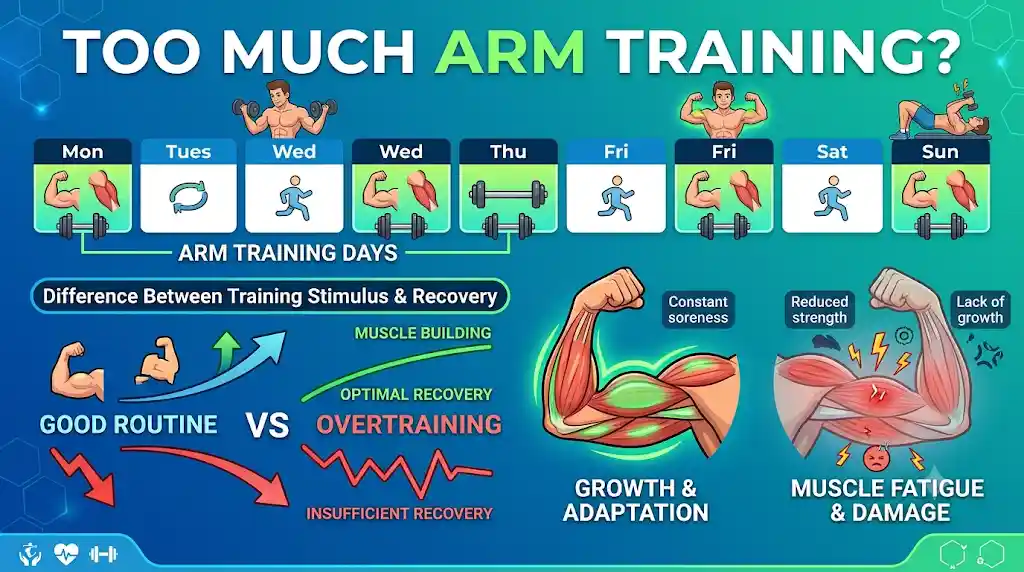
One of the most common reasons why your arms are not growing is training them too frequently without allowing enough time for recovery.
Many gym enthusiasts believe that training biceps and triceps every day will make them grow faster. They perform curls after every workout, add extra triceps exercises and sometimes dedicate multiple days to arm training.
However, more training doesn’t automatically mean more muscle growth.
Resistance training creates a stimulus that encourages muscle adaptation. Your muscles then need adequate recovery, nutrition and sleep to adapt to that stimulus.
If you’re constantly training your arms without managing your overall training volume, you may accumulate fatigue and experience declining performance.
How to fix it:
- Train biceps and triceps around 2 times per week as a starting point.
- Allow sufficient recovery between demanding arm sessions.
- Consider the indirect arm work you perform during chest, shoulder and back workouts.
- Adjust your weekly training volume according to your recovery and progress.
- Avoid adding extra sets simply because your arms aren’t growing quickly.
For most lifters, starting with approximately 8–12 challenging weekly sets per muscle group can be reasonable. You can gradually adjust this based on your training experience, performance and recovery.
Remember, your arms don’t grow while you’re endlessly performing curls. They grow through the combination of an effective training stimulus and proper recovery.
2. Why Are My Arms Not Growing: Not Using Progressive Overload
If you’re performing the same exercises with the same weights and repetitions every week, you might be giving your muscles very little reason to adapt further.
This is where progressive overload becomes important.
Progressive overload means gradually increasing the demands placed on your muscles over time. This doesn’t necessarily mean adding more weight to every exercise during every workout.
You can also improve your training by:
- Increasing repetitions with the same weight.
- Gradually increasing the resistance.
- Performing more controlled repetitions.
- Improving your range of motion.
- Increasing training volume when necessary and recoverable.
For example, imagine you’re performing dumbbell biceps curls with 10 kg dumbbells.
| Week | Weight | Repetitions |
|---|---|---|
| Week 1 | 10 kg | 8 |
| Week 2 | 10 kg | 9 |
| Week 3 | 10 kg | 10 |
| Week 4 | 10 kg | 12 |
| Week 5 | 12 kg | 8 |
This is a simple example of progressive overload. You first improve your repetitions before increasing the resistance.
How to fix it:
Keep a training log and record the weight, repetitions and sets you perform. Try to improve your performance gradually while maintaining proper technique.
Don’t rush to increase the weight if doing so forces you to swing your body or shorten your range of motion.
Consistent progression is more valuable than randomly lifting heavier weights.
3. Why Are My Arms Not Growing: Using Poor Exercise Technique
Poor exercise technique is another major reason why your arms might not be developing as expected.
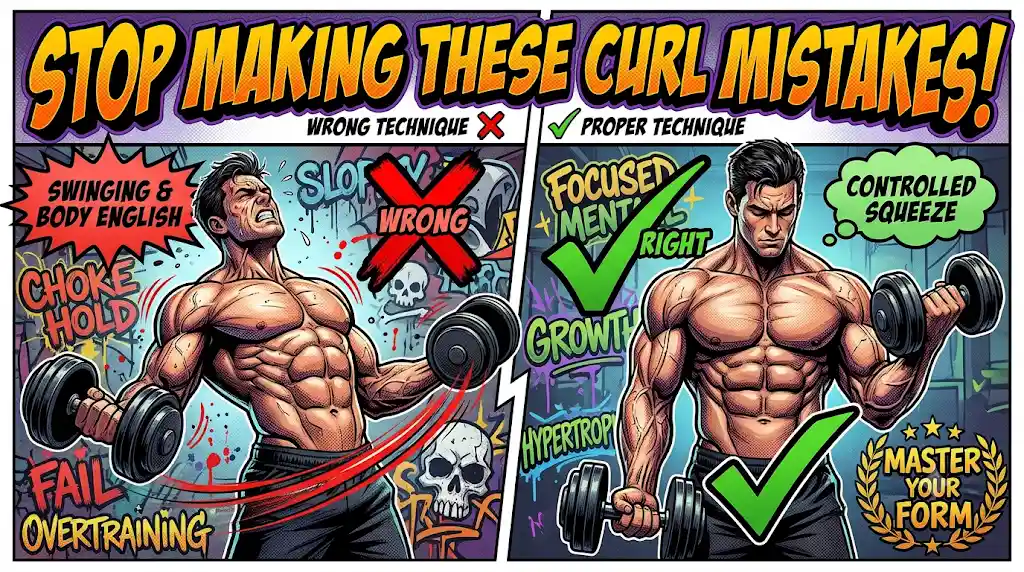
When performing biceps curls, some lifters swing their upper body, move their elbows excessively and use momentum to lift the dumbbells.
Similarly, during triceps pushdowns, people sometimes lean heavily over the cable machine and use their entire body to move the weight.
These movements can reduce the quality of the intended muscle stimulus and make it difficult to measure your actual progress.
The goal isn’t simply to move the weight from one position to another. You want to perform controlled repetitions that challenge the target muscle.
Common biceps technique mistakes:
- Swinging the upper body during curls.
- Moving the elbows excessively.
- Using momentum instead of controlled muscle contractions.
- Allowing the wrists to bend excessively.
- Performing partial repetitions unintentionally.
Common triceps technique mistakes:
- Using excessive body movement during pushdowns.
- Moving the upper arms unnecessarily.
- Failing to control the weight during the return phase.
- Using more resistance than you can handle properly.
How to fix it:
Choose a weight that allows you to perform controlled repetitions. Keep your movements consistent, avoid unnecessary momentum and focus on controlling both the lifting and lowering phases.
You don’t need to lift the heaviest dumbbells in your gym to build impressive arms. You need to train effectively. Primobolan vs Masteron: Muscle Growth, Cutting & Side Effects
4. Using Too Much Weight
Lifting heavy weights can be beneficial for muscle growth, but only when you can maintain appropriate technique and control.
Many people believe that heavier weights automatically produce bigger biceps and triceps. As a result, they select weights that are too heavy for their current strength level.
For example, someone might use 20 kg dumbbells for biceps curls but struggle to perform even five controlled repetitions. Instead of properly curling the dumbbells, they swing their torso and use their shoulders to complete the movement.
This turns a controlled arm exercise into a movement that involves unnecessary body momentum.
The same problem happens with triceps exercises. Excessive resistance during cable pushdowns can cause people to lean forward, move their shoulders and lose control of the movement.
How to fix it:
- Select a weight that allows proper technique.
- Aim for a challenging but manageable repetition range.
- Control the lowering portion of each repetition.
- Avoid using momentum to complete difficult repetitions.
- Increase resistance gradually as your strength improves.
For muscle hypertrophy, many exercises can be effective across a broad range of repetitions when sets are performed with sufficient effort.
You don’t need to train exclusively with heavy weights. Moderate loads and controlled repetitions can also produce excellent results.
5. Why Are My Arms Not Growing: Ignoring Triceps Development
If you want bigger arms but spend almost all your training time performing biceps curls, you’re overlooking a very important muscle group.
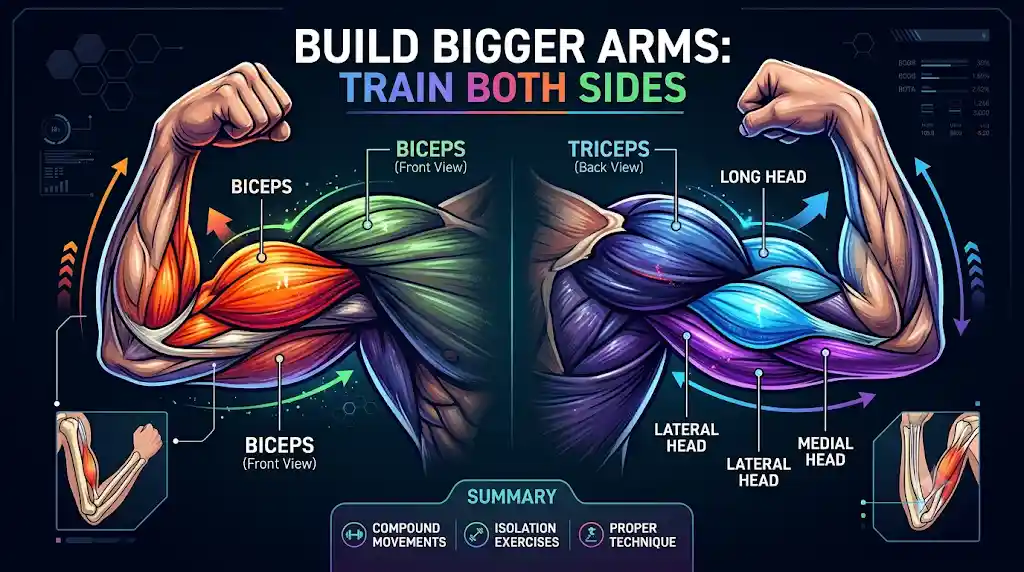
Your upper arm contains two major muscle groups:
- Biceps: Located on the front of your upper arm.
- Triceps: Located on the back of your upper arm.
The triceps consist of three heads: the long head, lateral head and medial head.
Together, these muscles contribute substantially to upper-arm size and thickness.
This is why people who want bigger arms shouldn’t focus exclusively on biceps development.
You might have impressive biceps peaks, but if your triceps lack development, your arms may still look relatively small from the side.
How to fix it:
Give both muscle groups sufficient attention in your weekly training program.
Some useful biceps exercises include:
- Barbell curls.
- Incline dumbbell curls.
- Preacher curls.
- Hammer curls.
- Cable curls.
Some useful triceps exercises include:
- Cable triceps pushdowns.
- Overhead cable extensions.
- Close-grip bench presses.
- Lying triceps extensions.
- Single-arm cable extensions.
Include exercises that train the triceps with the upper arm positioned both overhead and alongside the torso. This helps provide different training stimuli across the three heads.
Remember, bigger arms require balanced development, not just bigger biceps.
6. Not Training Through a Full Range of Motion
Another reason why your arms are not growing could be that you’re performing incomplete repetitions.
Some lifters perform biceps curls by moving the dumbbells only halfway. Others stop their triceps pushdowns before properly extending their elbows.
Although partial repetitions can have a place in certain training methods, constantly using an unnecessarily shortened range of motion may limit the training stimulus you’re trying to achieve.
A controlled range of motion allows you to challenge your muscles through a greater portion of the movement.
For example, during a dumbbell biceps curl, you should generally allow the elbow to extend comfortably at the bottom before curling the weight upward without swinging your body.
During triceps pushdowns, you should control the movement as you extend your elbows and return the weight to the starting position.
How to fix it:
- Use a comfortable and controlled range of motion.
- Avoid bouncing at the bottom of repetitions.
- Don’t forcefully lock your joints.
- Control the eccentric or lowering phase.
- Avoid shortening repetitions simply to lift heavier weights.
Fuller, controlled repetitions are generally a better starting point for building muscle than using excessive weight with inconsistent movement.
7. Why Are My Arms Not Growing: Doing Too Many Exercises and Sets
More exercises don’t necessarily mean more muscle growth.
Some gym enthusiasts perform five or six biceps exercises in a single workout, followed by several additional triceps movements.
They believe that hitting the arms from every possible angle will automatically produce faster results.
However, excessive training volume can become counterproductive when it exceeds your ability to recover.
Performing numerous similar exercises can also create unnecessary fatigue without providing much additional benefit.
For example, doing several variations of standard curls in the same session may not be as useful as selecting a few exercises that train the biceps through different positions.
How to fix it:
Build your arm workout around a small selection of effective exercises.
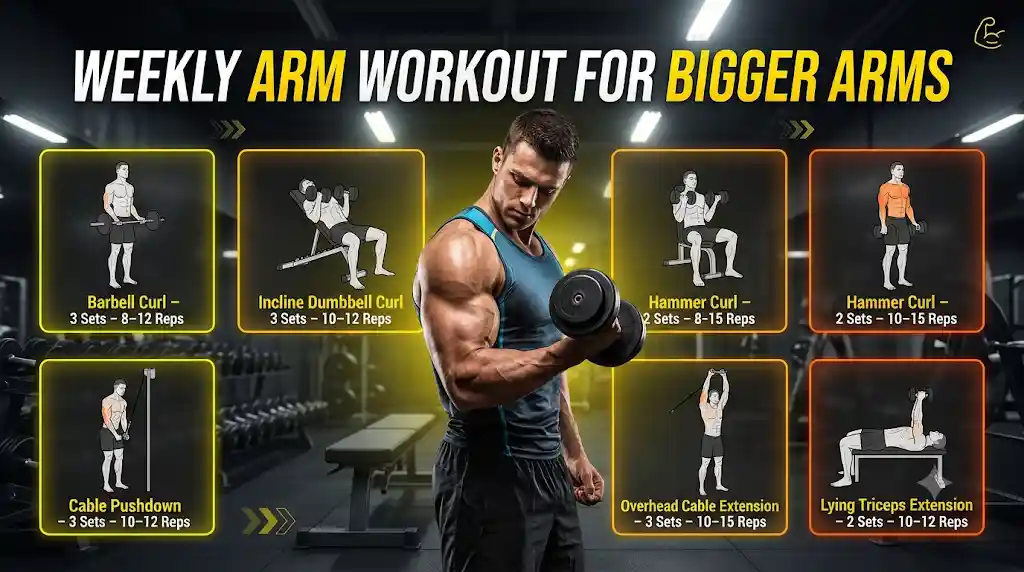
You can start with the following structure:
| Muscle Group | Exercise | Sets | Reps |
|---|---|---|---|
| Biceps | Barbell Curl | 3 | 8–12 |
| Biceps | Incline Dumbbell Curl | 3 | 10–12 |
| Biceps | Hammer Curl | 2 | 10–15 |
| Triceps | Cable Pushdown | 3 | 10–12 |
| Triceps | Overhead Cable Extension | 3 | 10–15 |
| Triceps | Lying Triceps Extension | 2 | 10–12 |
This is an example of a combined arm workout, not a requirement to perform all these sets twice every week without considering your other training.
Start with manageable volume and increase it only when you can recover properly and your progress justifies the adjustment.
Quality training is more important than spending hours performing unnecessary exercises.
8. Why Are My Arms Not Growing: Not Eating Enough Calories and Protein
You can have an excellent arm workout, but if your overall nutrition doesn’t support muscle growth, your results may be disappointing.
Muscle development requires sufficient energy and adequate protein.
One common mistake is trying to build bigger arms while consistently eating too little food.
If you’re training hard but your body weight isn’t increasing and you’re struggling to recover, your calorie intake might be insufficient for your muscle-building goals.
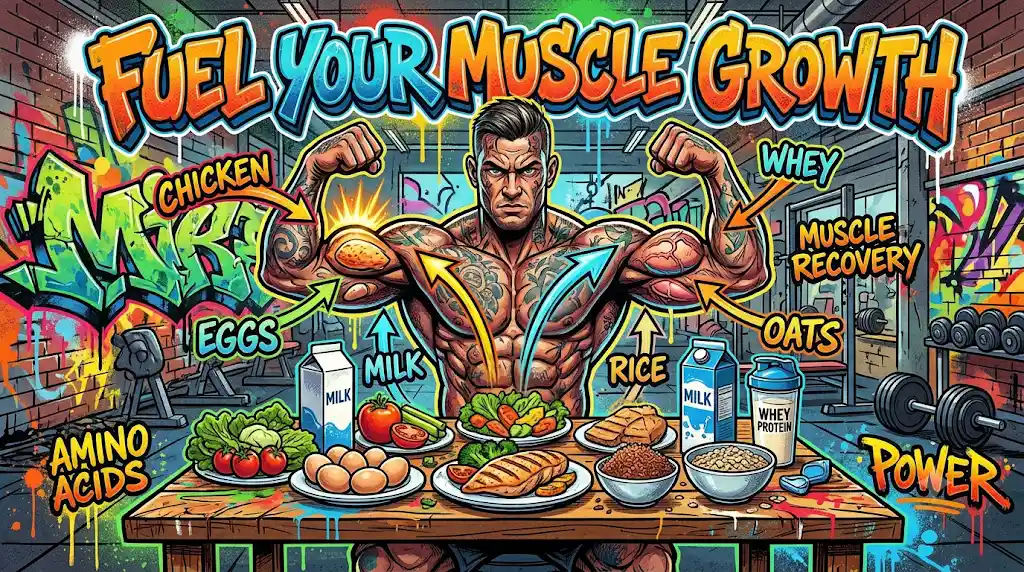
Protein is equally important because it provides the amino acids required for muscle repair and growth.
For people involved in regular resistance training, a daily protein intake of approximately 1.6–2.2 grams per kilogram of body weight is a commonly used evidence-based target.
For example:
| Body Weight | Daily Protein Target |
|---|---|
| 60 kg | 96–132 g |
| 70 kg | 112–154 g |
| 80 kg | 128–176 g |
| 90 kg | 144–198 g |
| 100 kg | 160–220 g |
These are general targets, not mandatory minimums for every individual.
How to fix it:
- Eat enough calories to support your muscle-building goals.
- Include protein-rich foods in your daily diet.
- Distribute protein across several meals.
- Include carbohydrates to support training performance.
- Don’t neglect dietary fats and overall nutritional quality.
Good protein sources include eggs, chicken, fish, dairy products, Greek yogurt, lean meat, whey protein and suitable plant-based protein sources.
If your goal is to increase arm size, remember that you cannot selectively build muscle in your arms while ignoring your overall nutrition.
9. Why Are My Arms Not Growing: Not Getting Enough Sleep and Recovery
Your training program and nutrition are important, but recovery is another major part of muscle development.
Many lifters focus heavily on workouts and supplements while completely ignoring their sleep schedule.
If you’re consistently sleeping only four or five hours, you may experience poorer training performance, increased fatigue and difficulty recovering between workouts.
Your body needs adequate sleep to support normal physiological processes, muscle repair and training adaptation.
How to fix it:
- Aim for approximately 7–9 hours of sleep per night.
- Avoid training the same muscles hard when they’re still excessively fatigued.
- Maintain a consistent sleep schedule.
- Eat enough to support recovery.
- Manage your overall training workload.
Also remember that your arms receive indirect training during other workouts.
For example, biceps are involved in pulling movements such as rows and pulldowns, while triceps contribute to pressing movements such as bench presses and shoulder presses.
Therefore, your arm recovery should be considered alongside your entire workout routine. Blood Tests for Bodybuilders: 10 Key Markers to Check
10. Constantly Changing Your Workout
Another common mistake is changing your arm workout every week.
One week you’re performing barbell curls, the next week you’re switching to completely different exercises. A few days later, you see a new workout online and decide to change everything again.
The problem is that constantly changing exercises makes it difficult to track your performance and determine whether you’re actually getting stronger.
Muscle growth doesn’t require a completely new workout every week.
In fact, maintaining a consistent exercise selection for a reasonable period allows you to improve technique, increase repetitions and progressively increase resistance.
How to fix it:
- Follow a structured workout for several weeks.
- Record your training performance.
- Focus on improving repetitions and resistance.
- Replace exercises when they cause discomfort or stop fitting your program.
- Avoid changing your entire routine just because you saw a new exercise online.
Consistency is one of the most underrated parts of bodybuilding.
You don’t need a different biceps workout every Monday. You need an effective workout that you can perform consistently and progressively improve.
Why Are My Arms Not Growing: Best Ways to Improve Arm Growth
Now that we’ve discussed the 10 common mistakes, let’s put everything together.
If your goal is to build bigger biceps and thicker triceps, focus on the following fundamentals.
1. Train Both Muscle Groups Properly
Don’t prioritize biceps while treating triceps as an afterthought. Both muscle groups contribute to the overall appearance of your arms.
2. Use Different Exercise Angles
Include exercises that challenge your biceps and triceps in different arm positions.
For biceps, incline curls and preacher curls provide different resistance profiles and shoulder positions.
For triceps, overhead extensions and pushdowns offer different training positions.
3. Why Are My Arms Not Growing: Focus on Progressive Overload
Track your repetitions and weights. Try to improve gradually without sacrificing exercise technique.
4. Maintain Appropriate Training Volume
Start with a manageable number of challenging sets and adjust according to your performance and recovery.
5. Eat for Muscle Growth
Make sure your calorie and protein intake supports your overall muscle-building goals.
6. Give Your Muscles Time to Recover
Adequate sleep, rest days and sensible training frequency are essential for consistent progress.
Example Weekly Arm Training Schedule
If your goal is to improve arm development, you can organize your training around two weekly arm sessions.
The following is an example for someone whose other training days already include chest, back and shoulder work.
| Day | Training Focus |
|---|---|
| Monday | Chest + Triceps |
| Tuesday | Back + Biceps |
| Wednesday | Legs |
| Thursday | Rest |
| Friday | Biceps + Triceps |
| Saturday | Shoulders + Legs |
| Sunday | Rest |
On Friday, you can perform a dedicated arm workout:
| Exercise | Sets | Reps |
|---|---|---|
| Barbell Curl | 3 | 8–12 |
| Incline Dumbbell Curl | 3 | 10–12 |
| Hammer Curl | 2 | 10–15 |
| Cable Triceps Pushdown | 3 | 10–12 |
| Overhead Cable Extension | 3 | 10–15 |
| Lying Triceps Extension | 2 | 10–12 |
Adjust the total workload according to the indirect biceps and triceps work you perform earlier in the week. If your arms are not recovering, reduce the volume or modify the schedule.
Frequently Asked Questions
1. Why are my arms not growing even though I train them every day?
Training your arms every day doesn’t guarantee faster muscle growth. Excessive training without sufficient recovery can increase fatigue and affect performance. A structured program with appropriate weekly volume is generally a better approach.
2. How many times should I train biceps and triceps per week?
Training biceps and triceps around twice weekly is a useful starting point for many people. However, the ideal frequency depends on your total training volume, experience and recovery. How Long Should You Rest Between Sets?
3. Which muscle makes your arms look bigger, biceps or triceps?
Both contribute to upper-arm size, but the triceps make up a substantial portion of upper-arm muscle mass. Developing your triceps is particularly important for building thicker arms.
4. How many sets should I perform for biceps and triceps?
Approximately 8–12 challenging weekly sets per muscle group can be a reasonable starting point. Your ideal volume may be higher or lower depending on your training experience and the indirect work your arms receive.
5. Can I build bigger arms with light weights?
Yes. Muscle growth is possible with both lighter and heavier weights when sets are performed with sufficient effort and appropriate technique. Heavier weights aren’t the only way to stimulate hypertrophy.
6. Why are my biceps growing but my triceps are not?
You might be performing more biceps work, neglecting effective triceps exercises or failing to progress your triceps training. Review your weekly exercise selection, training volume and technique.
7. Does protein help increase arm size?
Protein supports muscle repair and growth. However, protein alone won’t make your arms bigger. You also need effective resistance training, adequate calories and recovery.
8. How long does it take to build bigger arms?
Muscle growth is gradual and depends on genetics, training experience, nutrition, consistency and recovery. Beginners may notice improvements relatively quickly, while experienced lifters often need more time to achieve visible changes.
9. Should I train biceps and triceps on the same day?
Yes. Training biceps and triceps together can be an effective way to organize your workout. You can also train them on separate days, depending on your overall training schedule.
10. Are genetics responsible for small arms?
Genetics influence muscle insertions, muscle shape, proportions and growth potential. However, training quality, progressive overload, nutrition and recovery also play important roles. Don’t assume poor genetics are responsible before reviewing your training habits.
Final Thoughts
If your arms are not growing, don’t immediately assume that you need more exercises, heavier dumbbells or expensive supplements.
Start by examining your training routine. Are you progressively increasing your weights or repetitions? Are you training both biceps and triceps properly? Are you using controlled movements? Are you eating enough protein and calories? Most importantly, are you allowing your muscles enough time to recover?
Small improvements in these areas can make a significant difference over time.
Building bigger arms isn’t about performing endless curls or spending every day at the gym. It’s about following a structured training program, consistently challenging your muscles, eating properly and allowing your body to recover.
Stay consistent, track your progress and give your training enough time to work.
Need Help With Your Muscle-Building Journey?
Building bigger biceps and triceps requires the right combination of training, nutrition and recovery. If your arms aren’t growing despite spending hours in the gym, it may be time to review your workout routine and identify what’s holding back your progress.
At Gym Pundit, we share bodybuilding knowledge, workout guidance, nutrition information and fitness-related educational content to help you make better decisions.
Have questions about arm training, muscle growth, workout splits or bodybuilding nutrition? Get in touch with us on WhatsApp.
Connect With Gym Pundit
Get in touch for bodybuilding-related queries and assistance.
Gym Pundit | Bodybuilding Knowledge & Fitness Education