
Mediphorm vs Synthol is an interesting comparison in the bodybuilding world, especially among people researching localized muscle enhancement and site-enhancement products. Although both are associated with increasing muscle fullness and improving physical appearance, they have different formulations, mechanisms of action and potential health risks. Understanding these differences, along with their side effects and long-term complications, is important before considering the claims surrounding either product.
Both products are associated with the idea of increasing the visible size and fullness of specific muscle groups without relying entirely on actual muscle growth. However, they are not the same type of product. Mediphorm is marketed around hyaluronic acid-based formulations, while traditional Synthol is an oil-based site-enhancement product.
The comparison between Mediphorm vs Synthol is interesting because both are associated with cosmetic muscle enhancement, but their compositions, proposed mechanisms and potential complications are different.
It is also important to understand that cosmetic enlargement is not the same as building stronger muscle tissue. Neither product has established evidence demonstrating improvements in muscle strength or athletic performance. Primobolan vs Masteron: Muscle Growth, Cutting & Side Effects
In this article, we will compare Mediphorm vs Synthol, discuss their compositions, explain how they differ, examine their potential effects on muscle appearance and look at the health risks associated with injectable site-enhancement products.
What Is Mediphorm?
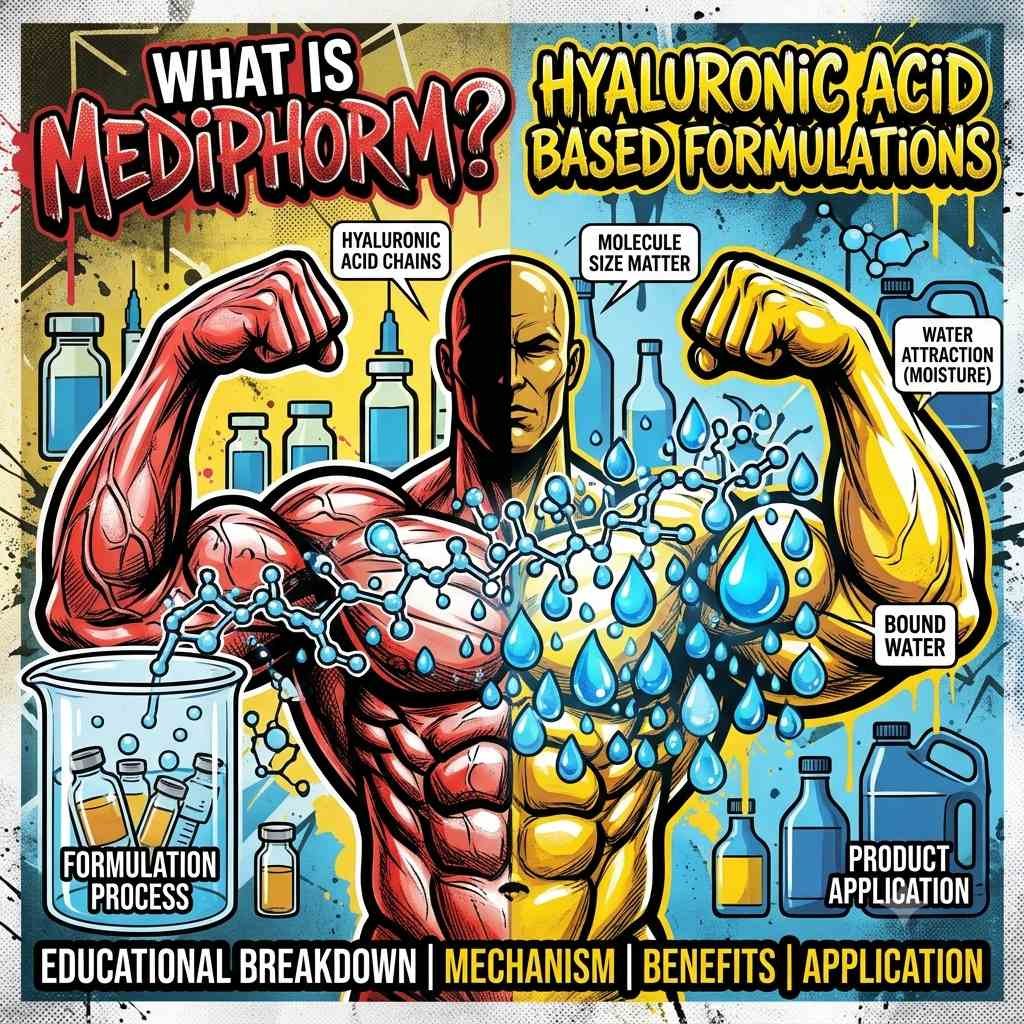
Mediphorm is a product name associated with hyaluronic acid-based formulations marketed in the athletic and bodybuilding space.
Hyaluronic acid (HA) is a naturally occurring substance found in the human body, particularly in connective tissues and skin. One of its important properties is its ability to attract and retain water.
In conventional cosmetic medicine, specially formulated hyaluronic acid gels are used as dermal fillers to create additional volume in approved treatment areas.
Mediphorm has also been marketed in bodybuilding circles for localized muscle appearance and fullness. However, there is an important distinction between the manufacturer’s marketing and independently established medical evidence.
The Mediphorm South website describes its products as water-based hyaluronic acid athletic skincare gels. Some third-party sellers, meanwhile, market Mediphorm-branded products as injectable muscle-enhancement formulations.
These descriptions should not automatically be treated as proof that every product sold under the Mediphorm name has the same composition, manufacturing standards, or approved medical applications.
There is currently insufficient independent clinical evidence to establish the safety and effectiveness of Mediphorm for intramuscular muscle enlargement.
What Is Synthol?
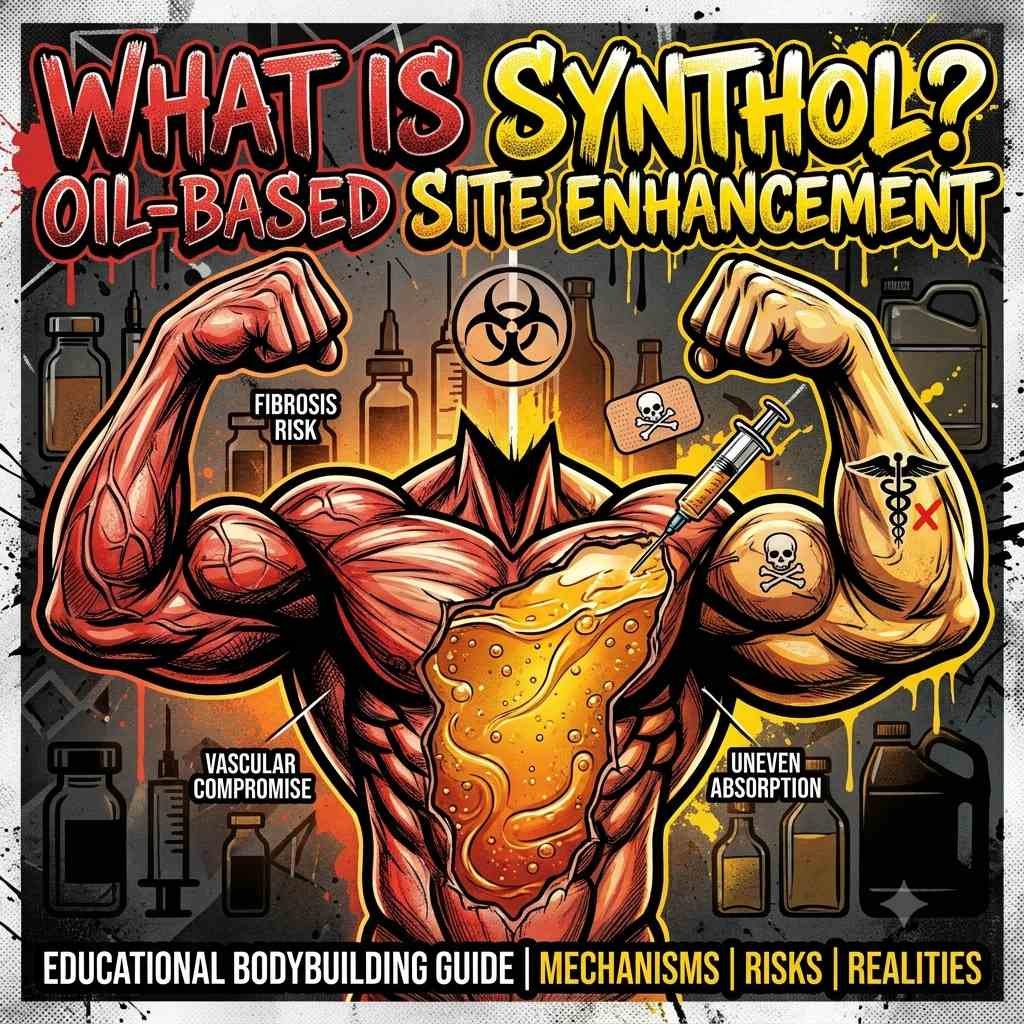
Synthol is a well-known site-enhancement oil used by some bodybuilders to change the cosmetic appearance of specific muscle groups.
Unlike anabolic steroids, Synthol does not stimulate muscle protein synthesis or directly promote muscle growth.
Traditional Synthol formulations are commonly described in medical literature as containing:
- 85% oil, generally medium-chain triglycerides
- 7.5% lidocaine
- 7.5% alcohol
The oil component creates localized volume, while lidocaine is an anesthetic and alcohol is included in the formulation.
The actual composition of products sold as site-enhancement oils can vary, so these percentages should not be assumed to apply to every product.
Synthol is associated with artificial muscle enlargement rather than genuine muscular development. It does not improve strength, increase contractile muscle tissue or provide the performance benefits associated with progressive resistance training.
Medical case reports have documented serious complications, including chronic inflammation, fibrosis, infections and muscle deformity following Synthol injections.
Mediphorm vs Synthol: Main Differences
The biggest difference between Mediphorm and Synthol is their underlying formulation.
Mediphorm is marketed around hyaluronic acid-based water formulations, whereas traditional Synthol is an oil-based site-enhancement product.
| Feature | Mediphorm | Synthol |
|---|---|---|
| Main formulation | Marketed as hyaluronic acid-based | Oil-based |
| Product category | Athletic skincare / marketed site enhancement | Site-enhancement oil |
| Main component | Hyaluronic acid in marketed formulations | Medium-chain triglyceride oil in traditional formulations |
| Water interaction | HA attracts and retains water | Oil-based formulation |
| Intended cosmetic effect | Marketed for fullness and appearance | Localized artificial muscle enlargement |
| Actual muscle growth | Not established | No |
| Strength improvement | Not established | No |
| Long-term safety for muscle enhancement | Insufficient clinical evidence | Documented serious complications |
One important point is that the comparison is based on the commonly described product categories. The exact formulation of a particular Mediphorm or Synthol product must be verified independently.
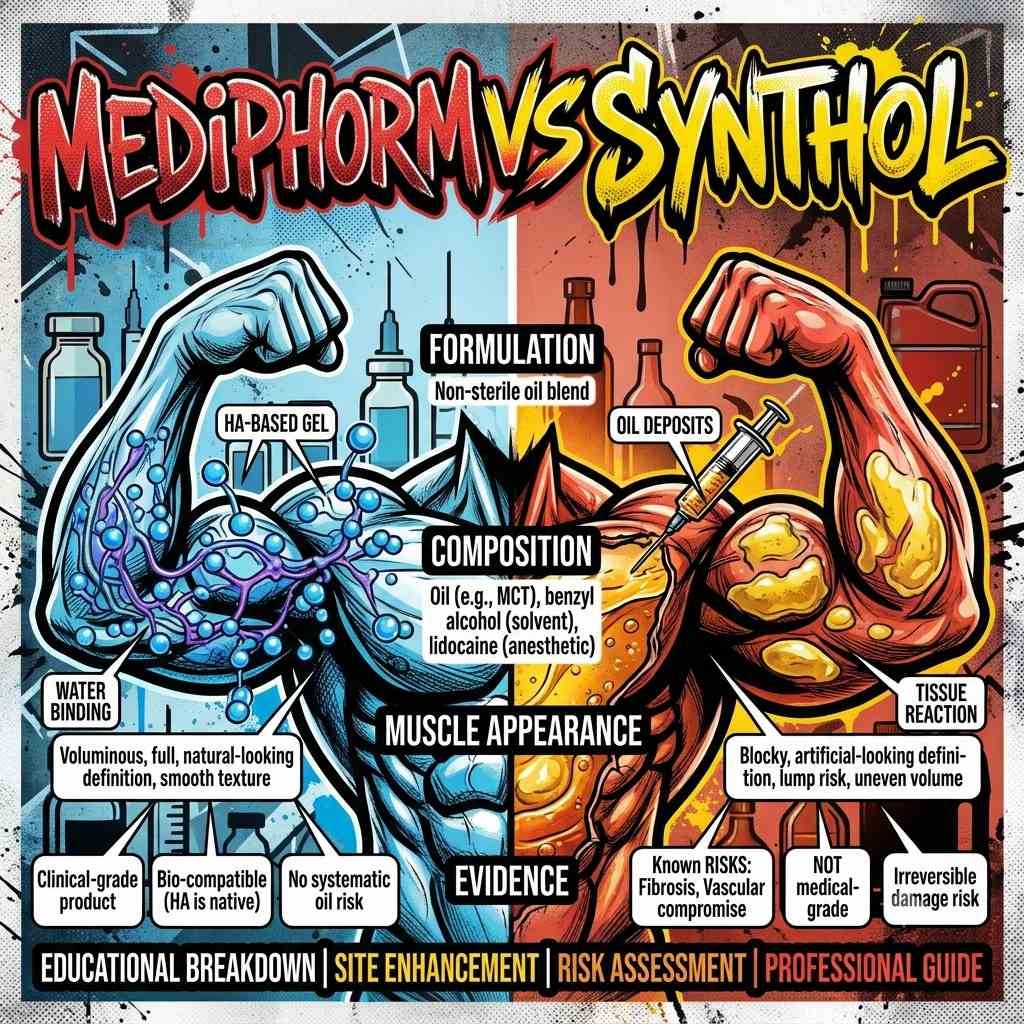
How Does Mediphorm Differ From Synthol?
1. Differences in Composition
Hyaluronic acid and oil-based site-enhancement formulations behave differently in the body.
Hyaluronic acid is a water-binding molecule. In approved cosmetic applications, cross-linked HA gels provide temporary volume by occupying space and attracting water.
Traditional Synthol uses oil to create localized tissue expansion. The oil is not equivalent to normal muscle tissue and can produce a foreign-body inflammatory response.
This difference in composition is one of the most important distinctions when comparing Mediphorm vs Synthol.
2. Differences in Muscle Appearance
Both products are discussed in bodybuilding communities because of their association with localized fullness.
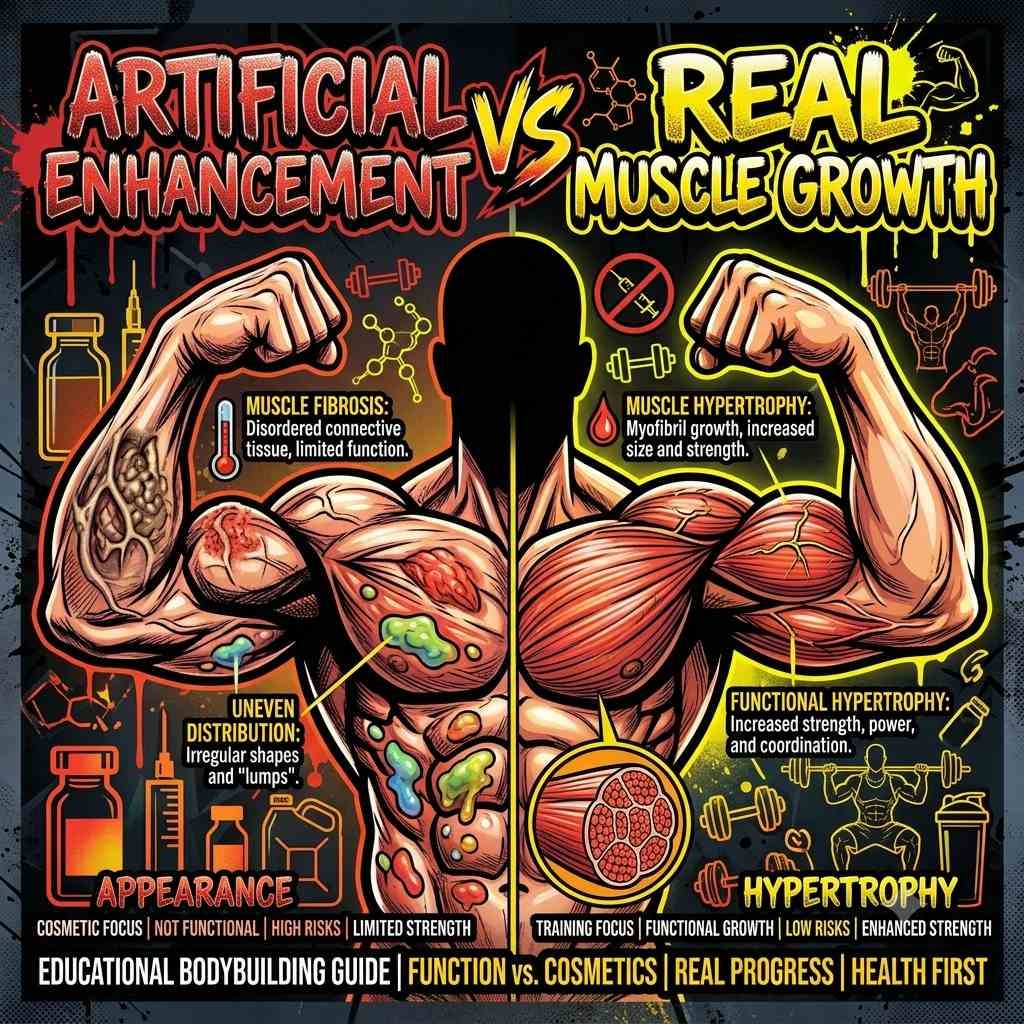
However, neither should be confused with genuine hypertrophy.
Actual muscle hypertrophy involves an increase in the size of muscle fibers through biological adaptations to resistance training.
Artificially increasing the volume of tissue around or within a muscle does not create the same result.
This means that a larger-looking muscle does not necessarily indicate greater strength, improved performance or increased contractile tissue.
3. Differences in Duration
The duration of any cosmetic filler effect depends on its formulation, placement, tissue response and other product-specific factors.
Hyaluronic acid fillers used for approved cosmetic applications are generally temporary, although their duration varies by product and treatment area.
Synthol oil can remain in tissue for extended periods and may produce long-lasting changes. Unfortunately, those changes can include fibrosis, nodules and deformity. Anadrol vs Superdrol: Strength, Size, Water Retention and Risks
There is insufficient reliable clinical evidence to establish how long Mediphorm products last when used for bodybuilding-related muscle enlargement.
Mediphorm vs Synthol: Potential Side Effects
This is where the comparison becomes particularly important.
A product being water-based or containing a substance naturally present in the human body does not automatically make an injectable application safe.
The risks depend on the complete formulation, manufacturing quality, injection site and intended use.
Potential Mediphorm Risks
Hyaluronic acid fillers have an established medical use in certain cosmetic applications, but their safety profile in those applications cannot simply be transferred to intramuscular muscle enlargement.
Potential complications associated with injectable HA fillers include:
- Localized swelling and bruising
- Pain and tenderness
- Infection
- Inflammatory reactions
- Granuloma formation
- Persistent lumps or nodules
- Filler migration
- Tissue damage from vascular complications
The FDA specifically recommends against using dermal fillers for implantation into muscle or other unapproved body-enhancement applications.
There is also insufficient clinical information to quantify the complication rate of Mediphorm when used for muscle enlargement.

Potential Synthol Risks
Synthol has a more established history of documented complications in bodybuilding-related use.
Some reported complications include:
Muscle fibrosis: Chronic inflammation can cause scar-like tissue formation within the affected area. This can result in painful, hardened and poorly functioning muscle tissue.
Infections: Injectable oils can introduce bacteria or trigger inflammatory reactions. Infections may require medical treatment and, in severe cases, surgical intervention.
Muscle deformity: Uneven tissue reactions and localized accumulation can create abnormal muscle contours.
Nodules and granulomas: The body can react to injected foreign material by forming inflammatory masses.
Chronic wounds and ulceration: Severe local tissue reactions can damage the skin and surrounding structures.
A published medical case described a bodybuilder who developed painful muscle fibrosis and deformity several years after Synthol use. Another medical report published in 2024 described the management of Synthol-induced fibrosis and recurrent infections.
These reports demonstrate that complications can persist long after the original cosmetic procedure.
Does Mediphorm or Synthol Build Actual Muscle?
This is one of the biggest misconceptions surrounding site-enhancement products.
Neither product should be considered a muscle-building compound.
Actual muscle development depends on several factors:
- Progressive resistance training
- Adequate protein intake
- Sufficient calories
- Recovery and sleep
- Appropriate training volume
- Consistency over time
Anabolic compounds and other performance-enhancing substances have different biological mechanisms, but cosmetic site-enhancement products should not be grouped with them.
Synthol does not increase muscle protein synthesis or improve muscular strength.
Similarly, there is no convincing clinical evidence demonstrating that Mediphorm produces genuine muscle hypertrophy.
A change in external muscle appearance should never be interpreted as proof of improved muscle development.
Why Do Bodybuilders Use Site-Enhancement Products?
Bodybuilding is heavily influenced by visual appearance, symmetry and proportions.
Even experienced bodybuilders can have muscle groups that appear less developed than others.
Common concerns include:
- Small-looking biceps
- Underdeveloped triceps
- Uneven deltoid development
- Muscle asymmetry
- Poor-looking muscle proportions
Some individuals become interested in site-enhancement products because they believe localized volume can improve these areas.
However, the cosmetic result may not match expectations, and complications can create problems that are much more difficult to correct than ordinary muscle-development imbalances.
The pursuit of a fuller appearance should not come at the expense of muscle function or long-term health.
Can Mediphorm or Synthol Improve Strength?
No convincing evidence demonstrates that either product improves muscular strength.
Strength is influenced by neurological adaptations, muscle cross-sectional area, technique, training experience and other physiological factors.
Site-enhancement products do not provide the same adaptations as resistance training.
A bodybuilder may have a larger-looking muscle after a cosmetic enhancement procedure, but that does not mean the muscle can produce more force.
This distinction is particularly important for athletes who care about both appearance and performance.
Can These Products Cause Permanent Muscle Damage?
Yes, serious and potentially long-lasting tissue damage is possible with injectable site-enhancement products.
Synthol-related medical reports have documented chronic fibrosis, inflammatory changes, recurrent infections and deformity.
The situation with Mediphorm requires a different level of caution. Its HA-based marketing does not establish the safety of injecting it into muscle. The FDA warns against intramuscular placement of dermal fillers for body enhancement.
Depending on the material and the complication, treatment may require medication, specialist intervention or surgery.
Some tissue changes may not be completely reversible. Cutting Cycle With Peptides: 4 Cycles, PCT & Risks
Is Mediphorm Safer Than Synthol?
It would be misleading to declare Mediphorm safer than Synthol simply because it is marketed as hyaluronic acid-based.
The two products have different formulations, and their clinical evidence is not comparable.
Synthol has documented cases of serious long-term complications, including muscle fibrosis and deformity.
For Mediphorm, the available independent clinical evidence for intramuscular muscle enhancement is insufficient to establish its safety.
Furthermore, hyaluronic acid fillers approved for particular cosmetic applications are not automatically approved for muscle implantation.
The FDA recommends against using dermal fillers for implantation into muscle or other unapproved body-enhancement applications.
Therefore, neither product can be recommended as a safe method of increasing muscle size.
Final Verdict: Mediphorm vs Synthol
Mediphorm and Synthol are associated with localized cosmetic enhancement, but they differ considerably in their formulations.
Mediphorm is marketed around hyaluronic acid-based formulations, while traditional Synthol is an oil-based site-enhancement product.
Synthol has a documented history of serious complications, including fibrosis, infections, painful nodules and muscle deformity.
Mediphorm has a different formulation, but there is not enough independent clinical evidence to establish its safety or effectiveness for intramuscular muscle enlargement.
The most important thing to understand is that neither product builds actual muscle or improves strength.
For bodybuilders, genuine muscle development through resistance training, proper nutrition and recovery remains a fundamentally different process from artificially increasing localized tissue volume.
A temporary improvement in appearance is not worth risking permanent muscle damage.
Frequently Asked Questions
1. What is the main difference between Mediphorm and Synthol?
Mediphorm is marketed around hyaluronic acid-based formulations, whereas traditional Synthol is an oil-based site-enhancement product. Their compositions and tissue interactions are different.
2. Does Mediphorm build muscle?
There is no convincing clinical evidence that Mediphorm increases actual muscle tissue or stimulates muscle hypertrophy.
3. Does Synthol increase muscle strength?
No. Synthol is used for cosmetic muscle enlargement and does not provide established improvements in strength or athletic performance.
4. Is Mediphorm made from hyaluronic acid?
Mediphorm South markets its formulations as water-based hyaluronic acid products. However, buyers should verify the exact formulation and authenticity of any particular product.
5. Can Synthol cause muscle fibrosis?
Yes. Medical case reports have documented painful muscle fibrosis following Synthol injections. Severe cases may require surgical treatment.
6. Is Mediphorm approved for muscle enlargement?
Marketing claims should not be confused with regulatory approval. The FDA does not approve dermal fillers for implantation into muscle for body enhancement.
7. Can site-enhancement products permanently damage muscles?
Yes. Chronic inflammation, fibrosis, infections and tissue deformity can produce long-lasting damage. Cutting Cycles with SARMs: 4 Plans, Risks, Support & PCT
8. Are Mediphorm and Synthol anabolic steroids?
No. They are not anabolic steroids and do not work through the same mechanisms as anabolic-androgenic hormones.
9. Can site-enhancement products improve bodybuilding symmetry?
They may alter external appearance, but the results are unpredictable and can introduce serious medical risks. Resistance training is a safer approach to improving muscular symmetry.
10. Which is better for bodybuilding: Mediphorm or Synthol?
Neither is an evidence-based method of muscle development. Both lack established evidence for improving strength or genuine hypertrophy, and their use for intramuscular enhancement carries safety concerns.
Medical note: This article is for educational purposes and is not an endorsement of injectable site-enhancement products. Anyone experiencing severe pain, increasing swelling, redness, fever, skin discoloration or drainage after an injection should seek prompt medical evaluation. Sudden chest pain, breathlessness or neurological symptoms require emergency care.
Have Questions About Mediphorm vs Synthol?
Still confused about the differences between Mediphorm and Synthol, their muscle-enhancement effects, formulations or potential side effects?
Connect with the Gym Pundit team for bodybuilding-related information, product details and general guidance.
WhatsApp: +91 76965 93279